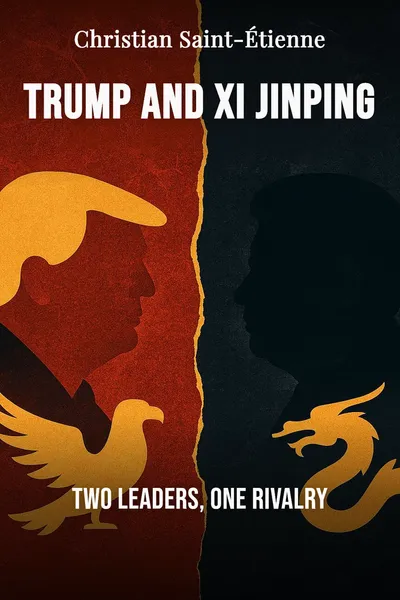
Trump and Xi Jinping
Two leaders, one rivalry
Description
On the surface they could not look less alike. One is a real-estate heir turned television showman turned president, loud, transactional, allergic to the fine print, governing by instinct and by grievance. The other is the son of a purged Communist Party veteran, a man who spent decades climbing a bureaucratic ladder in near-silence before concentrating more authority in his hands than any Chinese leader since Mao. Donald Trump and Xi Jinping belong to different worlds, speak to their nations in opposite registers, and would struggle to agree on what a good deal even looks like.
And yet, in the reading Christian Saint-Étienne offers, the two men are the sharpest available lens onto the single rivalry that will shape the century — the contest between the United States and China for economic, technological and military primacy. Each incarnates the operating system of his country. Trump embodies a democracy that still believes in the raw projection of force, in pressure and leverage applied in real time. Xi embodies a state built for the long game, able to plan across decades precisely because it answers to no electorate.
Reading the two leaders side by side turns an abstract geopolitical standoff into something we can actually hold. The duel is not really about personalities, tariffs or a particular summit photograph. It is about which model — the improvising democracy or the patient autocracy — is better suited to win a struggle that runs through semiconductors, currencies, supply chains and the South China Sea all at once.
The question we’re asking : What does reading the US-China rivalry through its two leaders reveal that a map of tariffs and fleets cannot?What we’ll see : How two opposite temperaments encode two opposite systems of power, and why the clash between them runs deeper than either man.
Table of contents
01 Chapter 1 — Two men, two scripts for power
Saint-Étienne starts where the contrast is loudest: in the way each man relates to time. Trump governs in the present tense. He wants the win now, visible now, scored in headlines and markets by the end of the week. His political capital comes from an electorate he must please every two years, so his horizon is short by design. Pressure, bluff and reversal are not flaws in his method; they are the method. A threat issued Monday can be withdrawn Thursday if it buys a better position.
Xi operates on the opposite clock. Having removed the term limits that had governed the Chinese presidency since the Deng era, he can think in five-year plans and in horizons stretching to the middle of the century. The milestones he sets — technological self-sufficiency, a world-class military, a reunified Taiwan at some point on the Party's calendar — are not slogans for a news cycle. They are objectives a single continuous authority intends to pursue long after any American president has left office.

02 Chapter 2 — The American gamble on force
The United States Trump inherited was still, by any measure, the dominant power — the largest economy, the reserve currency, the deepest capital markets, the most far-reaching military. Saint-Étienne reads the Trump method as a wager that this accumulated strength can be converted, aggressively and openly, into leverage. Where earlier administrations dressed their power in the language of rules and alliances, Trump stripped the dressing away and treated raw weight as the whole argument.
The clearest expression was the trade war. Tariffs on hundreds of billions of dollars of Chinese goods were deployed not as a careful industrial strategy but as a bludgeon, swung to force concessions and reshored jobs. The logic was that an economy as central as America's could absorb the friction better than its rival could, and that pain applied directly would move Beijing in a way that patient diplomacy never had. It was leverage as spectacle, conducted in public and recalibrated by the week.
03 Chapter 3 — The Chinese architecture of patience
China's wager is the mirror image. Where Trump converts strength into immediate pressure, Xi converts time into strategy. Saint-Étienne describes a state engineered to plan — to set a technological or military objective and march toward it across a decade, absorbing setbacks without abandoning direction. The absence of electoral turnover, so costly in democratic terms, becomes here a strategic asset: continuity that no rival democracy can match.
The method shows up in the industrial programs the author tracks closely. Rather than swinging a tariff bludgeon, Beijing pours sustained resources into the sectors it has decided will define the century — semiconductors, artificial intelligence, electric vehicles, batteries, aerospace. The point is not to win this quarter but to climb the value chain steadily until dependence runs the other way, until the world needs China more than China needs anyone. Patience, in this design, is a weapon.
04 Chapter 4 — A rivalry no handshake resolves
Step back from the two biographies and Saint-Étienne's larger claim comes into focus: the confrontation between Trump and Xi is structural, not personal. It would exist, in some form, whoever occupied the two offices. What the two men do is make visible a collision that was already underway — between a system that draws its strength from openness, speed and contested power, and one that draws its strength from closure, continuity and concentrated power. They are the faces of an argument about how the twenty-first century should be governed.
That is why the summits and the handshakes resolve so little. A deal struck on trade addresses a symptom; the rivalry runs through semiconductors, the dollar, the yuan's ambitions, the control of supply chains, the fate of Taiwan and the balance in the Pacific all at once. Each of these fronts is really the same contest fought with different instruments. No single agreement can settle a competition about who sets the rules, because the two models disagree on what rules even are.
05 Conclusion
The book closes the loop it opened. Two men who seem to share nothing — the showman and the apparatchik, the improviser and the planner — turn out to be the most precise available reading of a single rivalry. Each is his country written in a person: Trump the democracy betting on force applied now, Xi the autocracy betting on time applied patiently. The contest between them is the contest between those two bets, placed on the same table and impossible to unmake with any one deal.
Related books