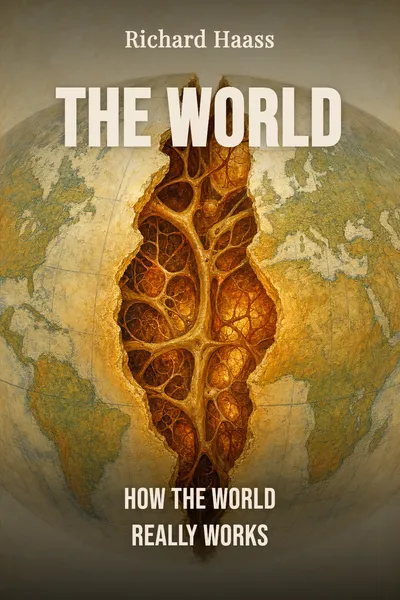
The World
How the world really works
Description
In 2020, a career diplomat named Richard Haass published a book with a title so plain it almost dares you to skip it: The World. Haass had spent decades inside the machinery he was writing about — the State Department, the National Security Council, and then twenty years running the Council on Foreign Relations in New York. He had watched, up close, the Gulf War, the Balkans, the negotiations that follow wars nobody planned. And somewhere along the way he noticed a gap that bothered him more than any single crisis.
The gap was this: most people, including smart and educated people, had never been taught how the international system actually works. You can graduate from a good university in the United States without ever taking a single course on foreign policy. Yet globalization means that a virus in one city, a decision in one capital, or a line of code written on another continent lands, sooner or later, on your own doorstep. Haass set out to write the primer he wished existed — the one class in global affairs that everyone should have had, compressed into a single volume for the general reader.
So The World is less a manifesto than a briefing. It walks through the raw ingredients of international relations, then tours the major regions, then names the threats that ignore borders entirely. The ambition is modest on the surface and large underneath: to make a curious adult conversant in the forces shaping the century they are living through, without a degree and without the jargon.
The question we’re asking : What does an ordinary citizen actually need to know to understand how the world works?What we’ll see : A guided tour through the building blocks of global order, the regions that carry it, and the threats that respect no map.
Table of contents
01Chapter 1 — The book written for the person who never took the class
Haass frames The World around a specific frustration he calls global illiteracy. His argument is that foreign policy has stopped being a specialist concern and become something closer to public health — a domain where ignorance carries real costs for everyone, not just for the people paid to manage it. A pandemic, a financial contagion, a cyberattack, a wave of migration: none of these ask whether you studied international relations before they reach you.
The structure of the book mirrors that conviction. Rather than tell a single story, Haass builds a curriculum. The first section lays out the history of the modern state system, conventionally dated to the Peace of Westphalia in 1648, when European rulers agreed to a rough principle that has organized the world ever since — states are sovereign within their borders, and outsiders do not get to reach inside. That principle, Haass shows, has been eroding for a long time, and the book is in large part the story of that erosion.

02Chapter 2 — Power, and the many ways it slips through your fingers
The heart of the primer is Haass's account of power — what it is, who holds it, and why it no longer behaves the way the textbooks once promised. For most of the modern era, power meant the power of states, measured in armies, territory, and economic weight. That still matters enormously. But Haass devotes considerable attention to a change he considers defining: power has diffused. It has spread outward to actors who are not states at all.
Multinational corporations now command budgets larger than most countries. Terrorist networks can project fear across continents with tools available to anyone. Non-governmental organizations shape agendas that governments once monopolized. And technology has handed capabilities to small groups and even individuals that used to require the resources of a nation. A single programmer, Haass notes, can now cause disruption that once demanded an army. Power has not vanished; it has scattered, and scattered power is much harder to hold accountable.
03Chapter 3 — Six regions, no single story
After building the vocabulary, Haass takes the reader on a tour of the world region by region, and the effect is deliberately corrective. There is no single global narrative, he insists — no tidy east-versus-west or democracy-versus-autocracy frame that captures everywhere at once. Each region runs on its own logic, its own history, its own set of unresolved arguments, and mistaking one region's story for the world's is a recurring error of the powerful.
China gets the most sustained attention, as the relationship he considers most consequential of the century. Haass resists both the alarmist and the complacent readings. China's rise is real and its ambitions are genuine, but its internal challenges — demographic, economic, political — are equally real. The question, as he poses it, is whether the United States and China can manage their rivalry without stumbling into the kind of catastrophic conflict that neither side wants and both would lose. Russia he treats differently: a declining power in most measures, but a disruptive one, willing to use force and interference to punch above its weight and remind the world it still can.
04Chapter 4 — The problems no country can solve alone
The final movement of the book turns to the threats that make the whole primer urgent: the challenges that treat borders as if they did not exist. Climate change sits at the center. A ton of carbon emitted anywhere warms the atmosphere everywhere, which means no country, however powerful, can insulate itself from a problem it did not cause alone and cannot fix alone. Nuclear proliferation, pandemics, cyber conflict, the governance of a global economy and an open internet — Haass groups these as the defining tests of collective action.
Stepping back, this is where the book's real argument surfaces. Everything before it has been building toward a single claim about sovereignty in the twenty-first century. The old idea of the sovereign state as a walled fortress, master of everything inside its borders, no longer describes reality. The border has become a membrane rather than a wall — porous to trade, disease, capital, information, carbon, and threat. Governments retain formal authority over their territory, but the forces that most shape their citizens' lives increasingly originate outside it. Sovereignty, in Haass's telling, is not gone, but it is fundamentally shared, whether governments admit it or not.
05Conclusion
Haass set out to write the course nobody had assigned him, and The World is faithful to that origin. It does not hand the reader a grand theory or a comforting forecast. It hands over a working vocabulary — power and its diffusion, globalization and its bargain, sovereignty stretched thin, regions that refuse to rhyme, and threats that ignore every map we draw. The book is a briefing built to outlast the headlines that prompted it, which is why its plain title turns out to be honest rather than dull.