The Survival of the Bark Canoe
Ancient craft survives the modern world
Description
In Greenville, New Hampshire — a small town in the southern part of the state — a young man named Henri Vaillancourt spends his days building birch-bark canoes with the same tools and by the same methods the Indians used. No nails, no glue, no manufactured parts. He learned nothing from a living teacher, because there was no living teacher left. He learned by reading, by looking hard at old museum canoes, and by trial. When the writer John McPhee first went to see him, in the early 1970s, Vaillancourt was in his mid-twenties, working out of a modest shop, turning white birch and cedar and spruce roots into vessels almost nobody in the modern world had any practical need for.
McPhee's book, published in 1975, grew out of that visit and out of a trip the two of them took afterward: roughly a hundred and fifty miles through the Maine woods, in canoes Vaillancourt had built with his own hands. It is a slim book about a narrow subject, and it opens onto something much larger — a technology that predates the country it survives in, a craft perfected by people who left almost no written record, and one obsessive craftsman keeping the whole thing alive largely by himself.
The trip does not go entirely smoothly. Vaillancourt turns out to be a superb builder and a difficult companion, and the tension between the man's gift and his temperament runs through the whole journey. McPhee is walking the same water Henry David Thoreau walked more than a century earlier, and he knows it; The Maine Woods is never far from his mind. What emerges is less a how-to than a portrait — of a thing, and of the person who refuses to let it disappear.
The question we’re asking : How does a prehistoric technology survive into a world that has no use for it, and what kind of person keeps it alive?What we’ll see : A craftsman, a canoe built from a tree, a long trip through the Maine woods, and what a handmade object holds that a manufactured one never will.
Table of contents
01Chapter 1 — The man in the Greenville workshop
Henri Vaillancourt did not come from a family of canoe builders. He came from Greenville, and as a young man he became fascinated by birch-bark canoes to the point of obsession. There was, by the time he started, essentially no one alive who could show him how. The Native craftsmen who had perfected the form were gone, and the knowledge had thinned out to a handful of aging canoes in museum collections and a few written accounts. So he taught himself. He studied the old boats, measured them with his eyes, read what little had been recorded, and built, and rebuilt, until the results satisfied him.
By the time McPhee met him, Vaillancourt's canoes were remarkable — light, strong, beautiful, and made without a single modern shortcut. He would not use commercial materials where a traditional one existed. He harvested his own bark, split his own cedar, dug his own spruce roots for lashing. He worked with a crooked knife and an awl and not much else. What he produced was, by most expert accounts, as good as the historical originals, and in some respects better understood by their maker than the originals had been by anyone in a century.

02Chapter 2 — How you build a canoe from a tree
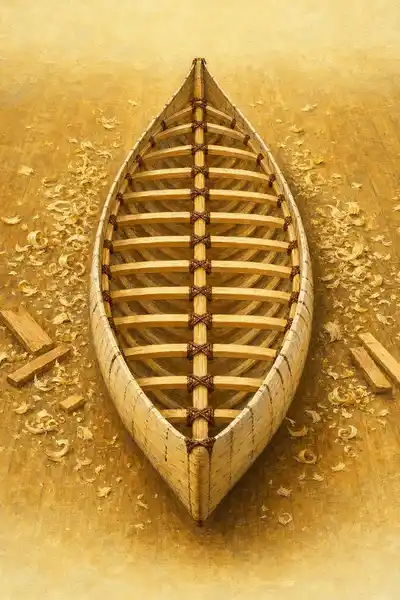
The construction of a birch-bark canoe is the technical heart of the book, and McPhee walks through it the way he walks through everything — patiently, concretely, with the names of things. It begins with the bark. Not just any birch will do; the builder needs a large, clean white birch with bark thick enough and unblemished enough to form the skin of the boat. Removing it is delicate work, done at the right time of year, in a single great sheet if possible. A tree of the right quality is not easy to find, and a good deal of the craft is knowing what to look for before a knife ever touches the wood.
From there the canoe is built essentially inside out and upside down, the bark held in shape by stakes driven into the ground, the gunwales set, the frame worked into place. The ribs and sheathing are split cedar, shaved thin and bent to the hull. The lashing is spruce root, dug up, split, and used like cord. The seams are sealed with heated spruce or pine pitch, tempered so it neither cracks in the cold nor runs in the heat. Every material comes from the forest the canoe is meant to travel through, which is part of the elegance of the design: the boat and its repair kit grow in the same place.
03Chapter 3 — Nine days, four men, one hundred and fifty miles
The second half of the book puts the canoes in the water. McPhee, Vaillancourt, and two other companions set out on a long trip through the Maine woods — roughly a hundred and fifty miles of lakes, rivers, and carries — in boats Vaillancourt had built. The route runs through the same country Thoreau had described more than a century before, and McPhee reads Thoreau against the modern experience, noting what has changed and what, remarkably, has not. The woods are diminished but still there; the water still goes where it went.
The trip is where the man and the craftsman come apart a little. On the river, Vaillancourt turns out to be an uneven traveler — a brilliant builder who is, by McPhee's affectionate but unsparing account, not always an easy person to paddle a hundred and fifty miles beside. He has opinions about how the trip should go and grows frustrated when it does not go that way. There are missed routes, disagreements, long stretches where the party is less a team than four men with one goal and several tempers. McPhee does not editorialize; he reports it, and the reporting is the point.
04Chapter 4 — What a hand-built thing carries that a machine one can't
Step back from the shop and the river, and the bark canoe becomes a strange case in the history of technology. Most tools that get superseded simply disappear; nobody keeps knapping flint once there is steel. The birch-bark canoe was superseded too — by the canvas canoe, then the aluminum one, then fiberglass and plastic, each cheaper, more durable, easier to mass-produce. By any industrial measure the old boat lost. And yet it did not die, because a small number of people came to feel that something was lost along with it that the newer boats, whatever their virtues, did not contain.
Part of what they mean is craftsmanship, but McPhee's book suggests it is more precise than that. The bark canoe is a piece of knowledge held in an object. Every canoe Vaillancourt builds re-enacts a chain of decisions that a whole people once made — which tree, which season, how thin to shave the cedar, how to temper the pitch. A manufactured hull carries none of that; it is the product of a factory, not the memory of a practice. When the factory boat wears out, nothing is lost but the boat. When the tradition dies, the reasoning dies with it, and that is the difference the survival of the bark canoe is really about.
05Conclusion
McPhee ends more or less where he began: with a young man in a New Hampshire workshop, bent over a sheet of birch bark, doing by hand what almost no one else on the continent can still do. The trip is over, the boats are back, the tensions of the river have receded into the larger fact that the canoes carried four men a hundred and fifty miles and came home intact. What lingers is the improbability of the whole thing — that a prehistoric technology should have found, in the late twentieth century, a keeper stubborn enough to reconstruct it from almost nothing.
Related books