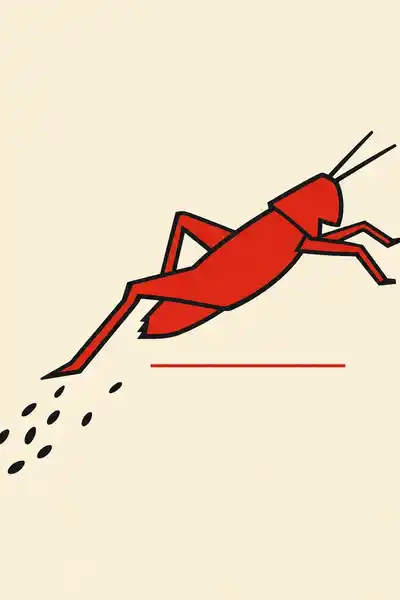
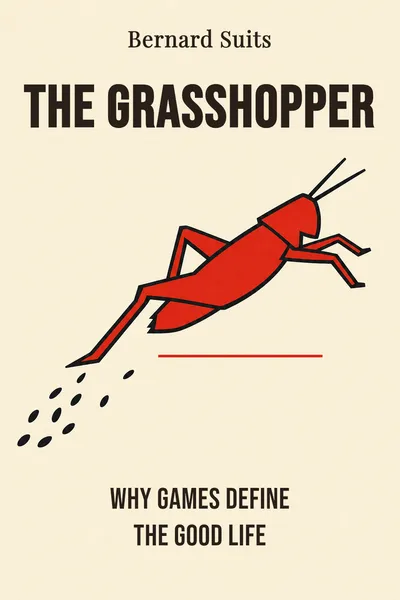
The Grasshopper
Why games define the good life
Description
In Aesop's fable, the grasshopper fiddles all summer while the ant stockpiles grain, and when winter comes the grasshopper starves — a tidy little sermon about industry and its rewards. The Canadian philosopher Bernard Suits, writing in 1978, took that ridiculous, doomed insect and made him the hero of a philosophy book. In Suits's telling, the Grasshopper is a "shiftless but thoughtful practitioner of applied entomology" who plays all his life and dies with a smile, still convinced he was right. Around this figure Suits built one of the strangest and most charming arguments in twentieth-century philosophy: that games can be precisely defined, and that once you see what they are, you realize they might be the whole point of being alive.
He was picking a fight, and with a big name. A generation earlier, Ludwig Wittgenstein had used games as his star example of a word that cannot be pinned down. Look at board games, ball games, card games, children's games, he said — there's no single feature they all share, only a loose web of "family resemblances." The lesson most philosophers drew was that some concepts are simply too baggy to define, and games were the proof. Suits thought this was lazy. Games, he insisted, do have a shared essence, and he was going to state it in one sentence.
What makes the book more than a clever counterexample is where it goes next. Having defined the game, Suits asks what a world without work would actually look like — a world where every need is met and no task is necessary. His answer is disarming, and it puts the loafing Grasshopper on surprisingly firm ground.
The question we’re asking : Can we actually define what a game is — and if we can, what does that tell us about how we ought to live?What we’ll see : How a mock-heroic insect and a single stubborn sentence turn a quarrel with Wittgenstein into a claim about the good life itself.
Table of contents
01Chapter 1 — The insect who refused to store food
Suits opens by giving Aesop's grasshopper a voice, a couple of disciples, and a deathbed. The insect is dying of hunger, exactly as the fable promised, but he is unrepentant. His whole existence has been devoted to play, and he refuses to treat that as a mistake. The ants, with their granaries and their prudence, have merely postponed the question the Grasshopper faced head-on: what is all the storing and toiling actually for? If the honest answer is "so that one day we can stop and enjoy ourselves," then the Grasshopper has simply arrived early, and the joke may be on the ants.
This framing is a bit of a bait. We expect a defense of idleness, a hymn to leisure over labor. Instead the Grasshopper reveals himself to be obsessed with one very particular activity — game-playing — and the book turns into a rigorous hunt for a definition. The playful voice never drops, but underneath it Suits is doing analytic philosophy of the most demanding kind, testing each proposed definition against objections the way a mechanic tests an engine by trying to break it.

02Chapter 2 — A voluntary attempt at unnecessary obstacles
The definition Suits lands on is compact enough to memorize: to play a game is to attempt to achieve a specific state of affairs, using only means permitted by rules, where the rules prohibit more efficient means in favor of less efficient ones, and where the rules are accepted just because they make the activity possible. His shorthand is even neater — playing a game is "the voluntary attempt to overcome unnecessary obstacles." Golf is the cleanest illustration. The goal is to get a small ball into a distant hole. The efficient method would be to walk over and drop it in by hand. The rules forbid exactly that, insisting instead on the absurd business of a club, a stance, and a swing.
Suits breaks this into parts he names carefully. There is the prelusory goal — the state of affairs describable without mentioning the game, like "the ball in the hole." There are the constitutive rules, which rule out the easy route. And there is what he calls the lusory attitude: the player's acceptance of those pointless restrictions precisely so that the activity can exist at all. That last piece does the real work. Without it, a person forced at gunpoint to move a ball around a course isn't playing golf; they're a hostage. The willingness is not decoration. It is what converts an obstacle from a nuisance into a game.
03Chapter 3 — The Grasshopper dies to prove a point
The definition is not the end of the book, and this is where Suits reveals what he was really after. Having established that a game is the voluntary overcoming of needless obstacles, he asks a larger question: what happens to human beings if the obstacles that aren't needless — hunger, danger, scarcity, all the work we do because we must — simply vanish? Imagine an existence where machines and abundance have solved every practical problem. Nobody needs to farm, build, heal, or defend. What is left to do with a day?
Suits's answer runs straight through the Grasshopper. In such a condition, the only activities with any point would be ones we take up for their own sake, activities whose whole appeal is the striving they involve rather than any outcome we need. But an activity pursued purely for the sake of the striving, with obstacles we've chosen rather than obstacles forced on us — that is exactly a game. So the Grasshopper, who devoted his life to play while the ants labored, wasn't shirking the good life. He was living the version of it that everyone else is only working toward. His starvation is the fable's cruelty, not his error; he was simply born into a world that hadn't yet abolished the need to store grain.
04Chapter 4 — What a Utopia would leave us to do
Suits's real wager is bigger than any definition of golf. He is asking what the ideal of human life actually is once you strip away everything we do because we're forced to. Most visions of Utopia describe the machinery — no hunger, no war, no drudgery — and then go quiet about the part that matters most: what people would actually spend their existence doing. That silence is telling. We're good at imagining the removal of problems and strangely bad at imagining a life with no problems left to solve. Suits fills the gap with the Grasshopper's answer: in Utopia, we would play games, because games are the one thing worth doing that doesn't depend on something being wrong first.
This inverts the usual hierarchy quietly but completely. We tend to treat games as recreation — the reward at the end of the real day, the thing that earns its place by helping us recover for more work. Suits suggests the ranking is backward. Work is what we do so that, eventually, we can afford to play; the striving we choose is the goal, and the striving we're compelled into is the detour. Seen this way, a chess problem, a mountain no one needs to climb, a rule invented for no reason but to make an afternoon harder and better, are not distractions from a meaningful life. They may be the purest examples of one.
05Conclusion
The Grasshopper dies as the fable always meant him to, unfed and unbowed, still insisting that a life given to play was a life spent well. Suits lets the death stand without rescuing him, because the rescue would betray the argument. The point was never that the Grasshopper would be spared; it was that he had grasped, earlier than anyone around him, what the striving is finally for. The ants stored their grain against the winter and never asked what the grain was for. He asked, and he answered with how he lived.
Related books