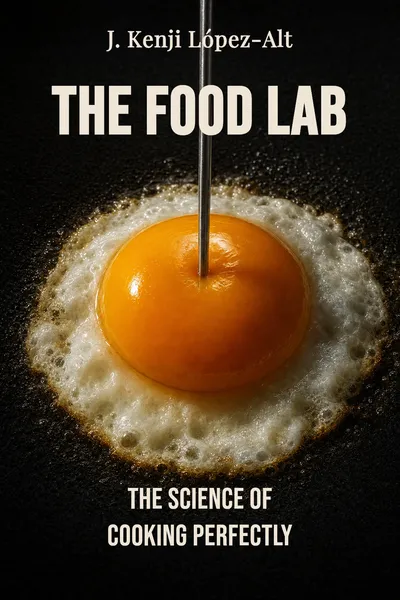
The Food Lab
The science of cooking perfectly
Description
In 2009, a former line cook with an MIT architecture degree started running experiments on dinner. J. Kenji López-Alt would cook forty batches of hash browns, or boil eggs at nine different starting temperatures, or sear a dozen identical steaks flipping each one on a different schedule — and then eat his way through the results, camera and notebook in hand. He was writing a column called The Food Lab for the website Serious Eats, and the premise was simple to the point of provocation: most of what we repeat about cooking has never actually been tested. Rest your steak. Sear to seal in the juices. Add oil so pasta won't stick. Kenji wanted to know which of these held up when you ran the trial.
The column became a book in 2015 — a doorstop of a thing, north of 950 pages, the size of a college textbook and roughly the weight of one. It sold in enormous numbers for a cookbook and won a James Beard Award. What made it land wasn't a new cuisine or a celebrity name. It was the method. Kenji treated the stove the way a lab treats a bench: change one variable, hold the rest steady, taste, repeat, and only then write down the rule. If the folk wisdom survived, great. If it didn't, out it went.
A cookbook that argues with cookbooks is a strange object. It promises perfect roast chicken and a better burger, then spends its pages explaining why the usual instructions were wrong, and how anyone could have found out. The recipes are almost a byproduct. What's really being handed over is a way of standing in your own kitchen.
The question we’re asking : What happens when someone stops trusting kitchen wisdom and starts testing it, one variable at a time?What we’ll see : How a food writer turned the stove into a laboratory, and why the results were never really about the recipes.
Table of contents
01Chapter 1 — The steak that got flipped every fifteen seconds
Start with the most sacred rule in home cooking: to sear a steak, put it in a hot pan and leave it alone. Flip it once, near the end. Flip it more and you'll never get a crust; you'll steam the meat and lose the juice. Every grill dad and half the cookbooks agree. Kenji ran the test anyway. He cooked steaks side by side — one flipped a single time, one flipped every fifteen seconds — and the frequently flipped steak came out with an even crust, cooked more uniformly through the middle, and got there faster. The rule was not just soft. It was backwards.
The reason is physics, and Kenji is happy to walk through it without turning it into a lecture. A steak left face-down on the pan builds heat on one side while the other cools; flip often and neither side has time to overshoot, so the whole thing climbs in temperature more gently and evenly. The browning — the Maillard reaction, the cascade of chemistry that makes seared meat taste like seared meat — doesn't need one long uninterrupted contact. It just needs enough time above a certain temperature, which frequent flipping delivers fine.

02Chapter 2 — Why the recipe was never the point
A conventional cookbook gives you a list: this much of that, cooked this long, at this heat. Follow it and you get dinner. Deviate and you're on your own. The Food Lab does something quietly different. It gives you the recipe, then explains the mechanism underneath it, so that when your pan runs hotter or your chicken is bigger, you can adjust without panicking. The recipe is an instance. The understanding is the thing you keep.
Take the roast chicken, one of the book's set pieces. Everyone wants crisp skin and moist breast, and the two goals fight each other, because the breast is done well before the legs. Kenji doesn't just hand you a temperature. He explains why breast meat dries out above roughly 150 degrees while dark meat needs to climb higher to render properly, and then shows the tricks that resolve the conflict — drying the skin, starting the bird in a way that lets the legs catch up. Once you know why, you can hit the target with a bird you've never cooked before.
03Chapter 3 — Eggs, sous vide, and the war on dogma
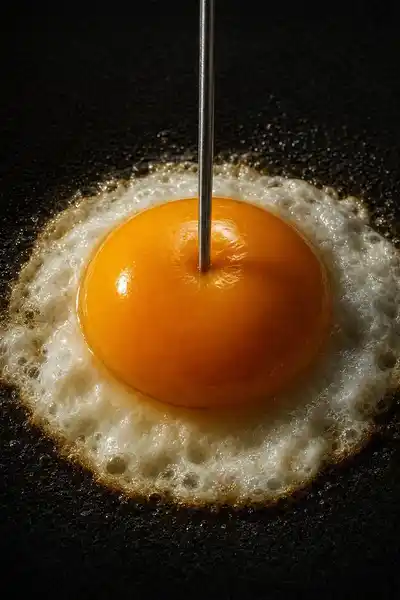
If one ingredient became the book's mascot, it's the egg — the cheapest, most abused, most mythologized thing in the fridge. Kenji cooked eggs by what feels like every method a stubborn person could invent. For the hard-boiled egg, the enemy is the shell that won't peel and the grey-green ring around the yolk. He tested starting eggs in cold water versus dropping them into already-boiling water, older eggs versus fresh, and reported that eggs eased into steam or boiling water peeled far more cleanly, while the ugly ring was simply a sign of overcooking. Small findings, but the kind that quietly fix a lifetime of minor kitchen frustration.
Scrambled eggs get the same treatment, and the answers cut against reflex. Low and slow, the gentle-cook gospel, gives you one texture; higher heat with constant motion gives you another; a pinch of salt beaten in ahead of time actually changes how the proteins set, keeping the curds tender. None of this is presented as the one true way. Kenji lays out what each choice does and lets you pick the eggs you want, which is a more grown-up form of instruction than telling you there's a single correct breakfast.
04Chapter 4 — Cooking as a way of paying attention
Strip away the recipes and what The Food Lab is really teaching is a disposition — a way of treating everyday claims with friendly suspicion and a willingness to check. That's the scientific temperament, minus the lab coat. Change one thing at a time. Keep the conditions honest. Trust the result over the tradition, and over your own hopes. Kenji applies it to steak and eggs, but the habit is portable, and that's the quiet ambition under all those pages.
It matters that the object of the experiment is dinner, not something rarefied. Cooking is one of the few domains where an ordinary person can run a genuine controlled trial in an afternoon, taste the difference, and update what they believe. There's no peer review and no funding grant — just two pans, one variable, and a fork. In that sense the kitchen is the most accessible laboratory most of us will ever have, and Kenji is pointing at it and saying: you already own the equipment.
05Conclusion
Kenji began by mistrusting the steak — the one everyone told him to flip once and leave alone — and ended with a book the size of a cinder block that argues, over and over, that the confident rule is worth checking against the fair test. Perfect roast chicken and a better burger are in there, and they work. But the through-line is the method: change a variable, hold the rest steady, taste, and report what happened even when it embarrasses the folklore. The recipes are the evidence. The reasoning is what you take home.
Related books