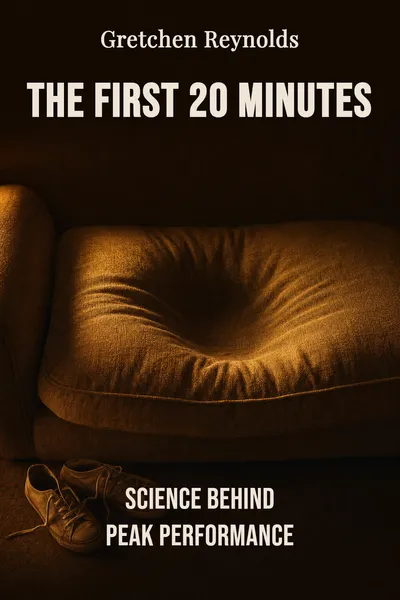
The First 20 Minutes
Science behind peak performance
Description
For years the received wisdom about exercise sounded punishing. To get any real benefit, you had to sweat for an hour, push to exhaustion, stretch carefully before and after, and generally treat your body like a machine to be broken in. Gretchen Reynolds, who wrote the New York Times "Phys Ed" column for years, spent a long time reading the actual studies behind that wisdom — and found that a lot of it didn't hold up. Her 2012 book, The First 20 Minutes, gathers what the exercise-science labs had quietly been discovering, and much of it contradicts the advice most of us grew up repeating.
The title itself is the first surprise. The steepest health gains, the research suggested, don't come from the marathon or the two-hour gym session. They come from the move most people never make: getting off the couch at all. The gap between doing nothing and doing a little turns out to be far larger than the gap between doing a little and doing a lot. That reframing quietly upends a whole culture of guilt around not exercising enough.
Reynolds is not a coach and doesn't write like one. She reads the labs, talks to the physiologists, and reports what the evidence actually says — including where it's messy, contested, or still unknown. The book is less a training plan than a tour of what science had learned about how bodies respond to movement, and where the popular advice had drifted from the findings.
The question we’re asking : What does the exercise-science evidence actually say about how much movement we need, and how much of the advice we inherited was ever true?What we’ll see : A walk through the research Reynolds gathered — on where the real gains hide, on the rituals we perform for no reason, and on what the body seems to want from us.
Table of contents
01Chapter 1 — The most important twenty minutes are the first ones
The number in the title comes from a body of research Reynolds walks through, and the finding behind it is almost comically encouraging. When physiologists compare sedentary people to those who move even modestly, the health difference is enormous. When they compare moderately active people to serious athletes, the difference is much smaller. The curve is steepest right at the start. The first stretch of movement — roughly the first twenty minutes a formerly inactive person adds to their day — delivers a disproportionate share of the benefit.
This matters because the cultural message has long been the opposite: that unless you commit to a real program, you may as well not bother. The evidence Reynolds assembles says bothering, even a little, changes the numbers that matter. Blood pressure, insulin response, mortality risk — the biggest improvements show up when someone crosses the line from zero to something. Going from something to a great deal keeps helping, but with diminishing returns.

02Chapter 2 — Warm up, but forget the stretching you were taught
Few rituals were more sacred than the pre-exercise stretch. Generations were told to reach for their toes and hold before running, on the theory that a stretched muscle was a protected muscle. Reynolds reports that the research quietly dismantled this. Static stretching — the long, held reach performed cold — does not appear to prevent injury, and several studies suggested it can briefly make muscles weaker, as though the held stretch tells them to relax when you're about to ask them to fire.
What the evidence did favor was warming up, which is a different thing. Movement that gradually raises the body's temperature and gets blood into the muscles — an easy jog, dynamic motions that rehearse the activity to come — seemed to prepare the body in a way the static hold did not. The distinction matters: the goal isn't to lengthen a cold muscle but to wake a warm one. Athletes who did dynamic warm-ups performed better and, in some studies, got hurt less than those who sat and stretched.
03Chapter 3 — The body wants to move, not to be optimized
One of the book's quieter arguments is about the brain. Reynolds gathers research showing that movement changes the organ we usually treat as separate from the body. Exercise appeared to spur the growth of new neurons in the hippocampus, the region tied to memory, and to improve mood and cognition in ways that held up across ages. The animal studies were striking: rats given running wheels grew measurably more capable brains than their sedentary cages-mates.
This connects to a larger idea running through the book — that humans are, in an evolutionary sense, endurance animals. Our ancestors walked and jogged across long distances to find food, and our physiology seems to expect that kind of steady, low-grade motion. Sustained movement isn't a modern imposition on the body so much as a return to what it was shaped for. The desk, not the trail, is the unnatural condition.
04Chapter 4 — Fitness is less about the gym than about the day
Step back from the individual findings and Reynolds's book is quietly arguing about where the whole conversation belongs. We tend to file exercise under ambition — a project you undertake, with goals and gear and a membership. The research she gathers keeps relocating it somewhere more ordinary: into the shape of an ordinary day. Whether you stand up during phone calls, take the stairs, walk to lunch, fidget at your desk — these unglamorous choices turned out to carry weight the culture had assigned to the workout alone.
That relocation changes who the advice is for. If fitness lives in the gym, it belongs to people with the time, money, and inclination to go there. If it lives in the accumulated movement of a day, it belongs to everyone, and the barrier drops to almost nothing. The book's most democratic implication is that the person who has never exercised has the most to gain and the shortest distance to travel. The gains are front-loaded precisely for the people the fitness world tends to ignore.
05Conclusion
The book takes its title from the finding that undoes the most discouraging myth about exercise: that unless the effort is large, it doesn't count. Reynolds's reading of the labs says the opposite. The first movements a sedentary person makes are the ones that move the health numbers most, and nearly everything after that is refinement. The rituals we layered on top — the cold stretch, the recovery drinks, the sense that only the gym counts — turn out to be mostly decoration, and sometimes worse than nothing.
Related books