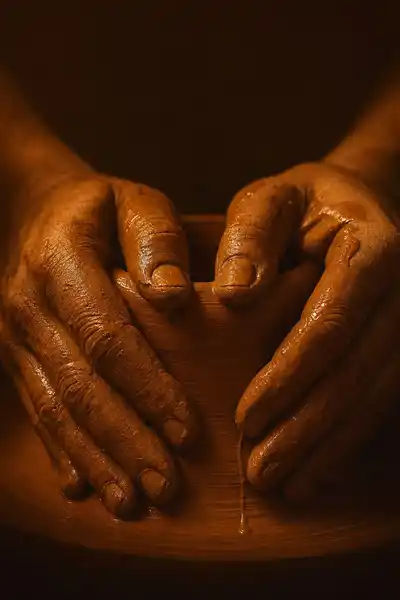
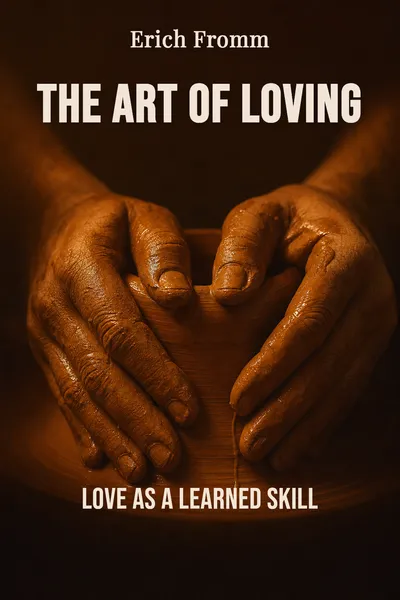
The Art of Loving
Love as a learned skill
Description
In 1956, a German-born psychoanalyst named Erich Fromm published a short book with a title that sounds almost too pleasant to be serious: The Art of Loving. It ran to barely a hundred and thirty pages, and it opened with a warning — anyone hoping for easy instructions in how to be loved would be disappointed. Fromm had spent decades moving between Freud and Marx, between the clinic and wider society, watching people arrive heartbroken and convinced that the problem was finding the right person. He thought they had the whole thing upside down.
The book became one of the most widely read works of popular psychology of the twentieth century, translated into dozens of languages and still in print seventy years later. Its argument is simple to state and hard to swallow. Most of us treat love as a matter of luck — the right object, the lucky encounter, the person who finally sees us. Fromm insisted that love is not a feeling that happens to us but a capacity we either develop or fail to develop, the way one develops any craft. He put it flatly: love is an art, like music or medicine, and it demands knowledge and effort.
That claim cuts against almost everything a modern culture whispers about romance. We are told to fall, to find, to be swept up. Fromm asks a colder and more interesting question. If love is a skill, then failing at it is not bad luck — it is a lack of practice, and the reasons we don't practice say something about the kind of people, and the kind of society, we've become.
The question we’re asking : If love is a skill rather than a stroke of luck, why are so few of us any good at it?What we’ll see : How Fromm turns love from something we wait for into something we learn to do — and what stands in the way.
Table of contents
01Chapter 1 — The problem we get backwards
Fromm opens by naming three errors that keep people stuck. The first is that we treat love as a problem of being loved rather than of loving. We spend our energy becoming attractive — successful, charming, agreeable — as if the whole game were to secure affection from someone else. Men chase status and power, women their looks; the strategies differ, the mistake is the same. We optimize ourselves as bait and then wonder why the catch never satisfies.
The second error is treating love as a problem of the object rather than of the faculty. We assume loving is easy and that the only real difficulty is finding the right person. This, Fromm argues, is like a man who wants to paint but decides that instead of learning the craft, he simply needs to wait for the perfect subject — then he'll paint beautifully. Nobody imagines you could want to play the piano well without practicing. Almost everybody imagines you can love well without learning how.

02Chapter 2 — Loneliness is the thing love answers
To understand what love is for, Fromm goes underneath the couple to the human condition itself. Man is the animal aware of his own separateness. We know we are born alone, that we will die alone, that no one else can fully inhabit our experience. This awareness of aloneness is, for Fromm, the source of all anxiety — the shame Adam and Eve feel is really the shame of two beings conscious of themselves as separate and not yet able to bridge the gap. Every human life is organized, at some level, around the need to overcome this separateness.
People have tried to escape it in ways that don't work. There is the orgiastic solution — trance, intoxication, sex used as anesthetic — which drowns the awareness of aloneness for a while but leaves it intact, so the dose must be repeated. There is conformity, merging into the herd, where a person escapes separateness by becoming indistinguishable from everyone else; Fromm thought this the dominant escape of modern industrial society, a togetherness so smooth that difference begins to feel like a threat. And there is creative work, which unites the maker with his material but leaves loneliness between persons untouched.
03Chapter 3 — The forms love takes — and where they break
If love is an activity, it has recognizable components regardless of its object. Fromm names four. Care — the active concern for the life and growth of what we love. Responsibility, not as duty imposed from outside but as a readiness to respond to another's needs. Respect, from the Latin respicere, to see a person as they actually are and want them to grow in their own way, not shaped into a tool for our needs. And knowledge, the effort to understand the other from the inside rather than through our projections. These four hang together: you cannot truly care without respecting, cannot respect without knowing.
With this template Fromm walks through the varieties. Brotherly love, the love between equals, is the most fundamental — love for the stranger, for the one who is not useful to us. Motherly love is unconditional, given because the child exists, though its true test comes in the mother's willingness to let the child separate and become independent. Erotic love, by contrast, craves fusion with one other person — and it is here that most modern confusion lives, because we mistake the craving for fusion for the fact of love.
04Chapter 4 — A practice, not a windfall
The most quietly radical part of Fromm's book is that he refuses to keep love in the private sphere. Our difficulty loving, he argues, is not a personal failing scattered among unlucky individuals. It is a predictable product of the society we live in. A culture organized around acquisition, exchange, and consumption produces people who approach one another the way they approach the market — scanning for a good deal, weighing what they can get against what they must give. We have made ourselves into commodities and gone looking, on the marketplace of romance, for the best available object we can afford.
In such a society, love in its full sense is almost necessarily a marginal phenomenon. The same qualities that make someone a smoothly functioning cog — alienation from oneself, treatment of others as means, automaton conformity — are the very qualities that make loving impossible. Fromm is not sentimental about this. A culture cannot mass-produce workers who see themselves and everyone around them as instruments and then expect love to flourish in the evenings. The capacity is one capacity; it does not switch off at the office and on at the dinner table.
05Conclusion
Fromm never promises a technique that will work by Friday. He does the opposite — spending a hundred and thirty pages arguing that the thing everyone assumes is easy is among the hardest achievements a human being can attempt, because it asks us to develop our whole character rather than acquire a single trick. The lonely person certain they only need the right partner leaves, if Fromm has done his work, suspecting they need to become a different kind of person — one capable of care, respect, knowledge, and the courage to give without accounting.
Related books