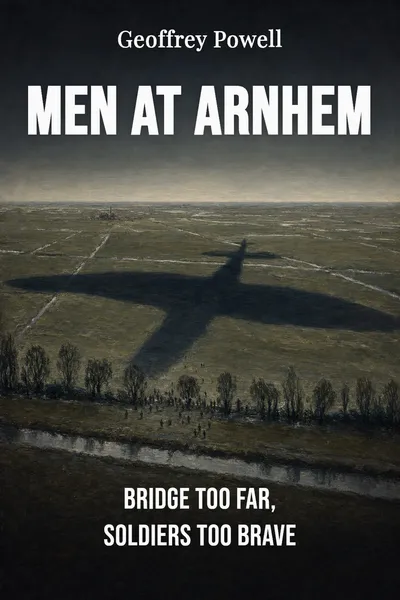
Men at Arnhem
Bridge too far, soldiers too brave
Description
In September 1944, the Allies were moving fast across France and Belgium, and the mood at the top was close to triumphant. The Germans looked beaten, the war looked nearly over, and Field Marshal Montgomery had a plan bold enough to match the moment. Operation Market Garden would drop tens of thousands of airborne troops behind German lines to seize a chain of bridges across the Netherlands, opening a corridor straight to the Rhine. The last and farthest bridge, at Arnhem, was the prize that would let the Allies outflank Germany's western defences and, the argument went, end the war by Christmas.
It did not end the war by Christmas. The men who landed near Arnhem found the corridor didn't hold, the relief column didn't arrive in time, and the town filled with German armour that intelligence had insisted wasn't there. Over roughly nine days, the British 1st Airborne Division was ground down from around ten thousand men to a fraction of that. Geoffrey Powell was one of the officers on the ground, a major commanding a company, and he came home. Decades later he wrote down what it had actually been like — not the operation, the experience.
That distinction is the whole point. Plenty of books explain why Market Garden failed, tracing the decisions from the map rooms down. Powell's Men at Arnhem does something rarer: it stays at ground level, inside a single perimeter, with a handful of exhausted men trying to survive the next hour. It is less a history of a battle than a reconstruction of what the battle felt like from within, built from his own memory and the recollections of the survivors he fought beside.
The question we’re asking : What does one survivor's account reveal about Arnhem that the strategic histories leave out?What we’ll see : How a brilliant plan met an impossible reality, and how a soldier who lived through it turned that reality into one of the most unflinching war memoirs ever written.
Table of contents
01Chapter 1 — A plan that looked brilliant on paper
By late summer 1944, the Allied advance had outrun its own fuel lines, and the generals disagreed about what to do next. Montgomery wanted a single concentrated thrust rather than a broad, slow push, and Market Garden was his answer. The idea had a clean geometry to it. Airborne divisions would land ahead of the ground forces and grab the bridges over a string of Dutch rivers and canals — Eindhoven, Nijmegen, and finally Arnhem, where the Rhine itself would be crossed. Down that captured corridor, the armoured columns of XXX Corps would race, bridge to bridge, all the way to the German frontier.
The plan's elegance was also its weakness. Everything depended on speed and on nothing going wrong in the right order. The airborne men would be lightly armed, holding bridges against whatever the Germans could throw at them, and they could not hold indefinitely. The relief column had to reach each bridge before the defenders were overwhelmed. The whole thing was a relay race run against the clock, over a single narrow road that ran, in places, along raised embankments where tanks had nowhere to hide.

02Chapter 2 — The drop, and everything that went wrong at once
The landings began on 17 September 1944, and the first thing that went wrong was distance. There weren't enough transport aircraft to deliver the whole division at once, so the drop was staggered over successive days, splitting the force and telegraphing intentions to the enemy. Worse, the landing zones had been chosen well outside Arnhem, on open ground judged safer for the gliders and parachutes. That safety came at a price: the men who were supposed to rush the bridge now had a long march to reach it, through country that filled with German troops as they walked.
Only a fraction of the division ever got to the bridge itself. Lieutenant Colonel John Frost's battalion managed to reach the northern end and dug in, holding it with a stubbornness that became the operation's one genuine triumph. But the rest of the division, Powell's part of it included, was caught out on the approaches, pinned down and pulled apart by German fire before it could concentrate. The neat plan dissolved into a scatter of separate fights, each unit improvising against an enemy that was reacting faster than anyone had expected.
03Chapter 3 — Nine days in a shrinking perimeter
Unable to reach the bridge, the surviving elements of the division pulled back toward Oosterbeek, a suburb west of Arnhem, and formed a defensive pocket with its back to the river. This is the ground Men at Arnhem lives on. The perimeter was never large and it kept getting smaller, squeezed inward day after day as German attacks bit off its edges. Inside it, a few thousand men held on, waiting for a relief that everyone could feel slipping further out of reach.
Powell writes the days from inside a single company, and the texture is relentless. Ammunition ran low, then critical. Food and water gave out. Resupply drops, aimed by the map at positions the Germans now held, floated down into enemy hands while the men who needed them watched from cover. Sleep came in minutes. Men fought, dug, carried the wounded, and buried the dead, and did it again the next day with fewer of them each time. The prose stays close to the ground precisely because that is where the survivors' attention was fixed.
04Chapter 4 — The book a survivor had to write
Men at Arnhem first appeared decades after the battle, and its authority comes from a fact the operational histories can't reproduce: the man writing it was there. Powell had commanded within the perimeter, and to fill the gaps in his own recollection he went back to the men he had fought beside, gathering their accounts of the same days seen from slightly different corners of the same shrinking pocket. The result is not a general's overview but a mosaic of ground-level memory, assembled by someone who knew exactly which details mattered because he had lived on them.
That choice reflects a larger truth about how war gets remembered. The strategic story — Montgomery's plan, the failed timetable, the bridge too far — is real and necessary, but it is told from above, in the language of corps and objectives and decisions. It tends to lose the men entirely, or to keep them only as casualty figures. Powell's book pushes back against that erasure by refusing to leave the perimeter, by insisting that the truest account of a battle is the one held in the bodies and memories of the people who could not see the map.
05Conclusion
Arnhem entered popular memory as the noble failure of the Second World War, the daring stroke that fell just short. Frost's men held the bridge longer than anyone had a right to expect; the relief column arrived too late; the perimeter at Oosterbeek held until it could hold no more, and then two thousand men slipped back across the Rhine in the dark. The plan had reached one bridge too far, and the men who paid for the reach were the ones who had jumped into a picture that no longer matched the ground.