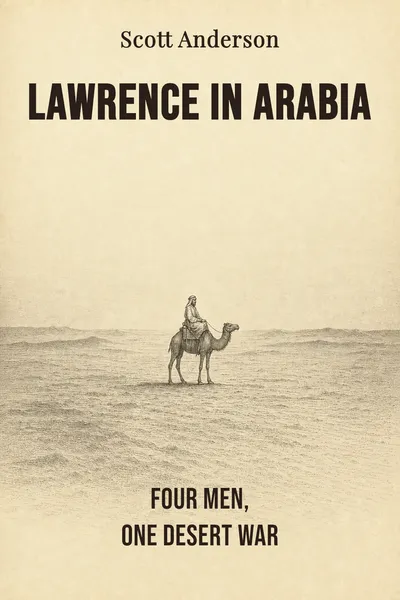
Lawrence in Arabia
Four men, one desert war
Description
In early 1914, a young Oxford archaeologist named T.E. Lawrence was crouched in the Syrian sand at Carchemish, brushing dust off Hittite ruins near the Euphrates. He was twenty-five, slight, awkward with authority, and profoundly happy digging. Nobody who watched him sift potsherds would have guessed that within three years he would ride into Damascus at the head of an Arab army, his name attached to one of the most romantic legends of the century. Scott Anderson's Lawrence in Arabia opens on this quiet scene precisely because of how far it sits from what came next.
The Arab Revolt against the Ottoman Turks was, in Lawrence's own words, "a sideshow of a sideshow." While Europe fed a generation into the trenches of the Somme and Verdun, the great powers barely glanced at the Middle Eastern theater. And because nobody important was watching, the region's fate fell to an improbably small cast: not generals and foreign ministers, but a handful of adventurers, spies, and junior officers operating far from any chain of command that could rein them in.
Anderson's move is to widen the frame beyond the lone hero. He braids Lawrence's story together with three other men chasing their own designs across the same sand — a German orientalist, a Zionist agronomist, an American oil scout. Four ambitious outsiders, one desert war, and a modern map still being argued over a century later.
The question we’re asking : How did four low-ranking outsiders, not the statesmen above them, end up shaping the modern Middle East?What we’ll see : Four intertwined lives colliding in the same wartime desert, and the private schemes that outlasted the war itself.
Table of contents
01Chapter 1 — A sideshow of a sideshow
Anderson's premise is deceptively simple: the war in the desert mattered enormously, and almost nobody in power treated it that way. For London, Paris, and Berlin, the decisive front ran through France and Belgium. The Ottoman Empire, sprawling and creaking, was a secondary problem to be managed with whatever officers and money could be spared once Europe's needs were met. That neglect created a vacuum, and the book is really the story of who rushed to fill it.
The men who did were, almost without exception, junior figures with no business setting policy. A vast empire's future was being negotiated by people whose superiors could barely place them on an organizational chart. This inversion — big consequences flowing from small actors — is Anderson's organizing insight. When the corridors of power look away, decisions migrate to the periphery, and the periphery in 1915 was full of restless, talented, half-supervised young men convinced they understood the region better than their governments did.

02Chapter 2 — The archaeologist who became a weapon
Lawrence sits at the center of the four, and Anderson takes care to strip the myth back to the man. He was an outsider in the British establishment — illegitimate by birth, uneasy with hierarchy, more comfortable among Arabs than among fellow officers. Posted to military intelligence in Cairo when war broke out, he spent his early service drawing maps and writing sharp, insubordinate memos that annoyed his superiors and revealed how much more he grasped than they did about Ottoman politics and Arab aspiration.
When the Sharif of Mecca raised his revolt against the Turks in 1916, Lawrence talked his way into the field and found his subject. He grasped that the Arab forces could not win a conventional war against a modern Ottoman army, so he pushed a strategy of mobility and disruption — raiding the Hejaz railway, striking supply lines, refusing pitched battle. The 1917 capture of the port of Aqaba, taken from the undefended landward desert side after a brutal crossing, became the emblem of what a small, fast, locally led force could achieve.
03Chapter 3 — The spy, the oilman, and the German
The three men circling Lawrence give the book its unusual depth of field. Curt Prüfer was a German orientalist attached to the embassy in Cairo, an intellectual with a gift for languages and a taste for intrigue. His assignment was audacious: to foment Islamic jihad against British rule across the empire, weaponizing religion to bleed Britain in its colonies. He would grow into Germany's most effective spymaster in the region, running agents and plots with a cold competence that makes him the natural dark mirror to Lawrence's romanticism.
Aaron Aaronsohn was a celebrated agronomist and committed Zionist who had earned the trust of Djemal Pasha, the Ottoman governor of Syria. Using that access as cover, he built an elaborate Jewish spy network in Palestine, feeding intelligence to the British in hope of advancing the Zionist cause. Anderson tells his story as a tragedy of misplaced faith: the British were slow, suspicious, and at times openly anti-Semitic, first ignoring Aaronsohn's ring and then mishandling it. The personal price was devastating, including the capture and death of his sister Sarah, who ran the network on the ground.
04Chapter 4 — The Cairo bargain and the map that stuck
Step back from the four men and Anderson's larger argument comes into focus: the modern Middle East was not designed in a conference room by farsighted statesmen. It was improvised at the margins, by operatives whose local schemes hardened into permanent facts because no one at the center was paying close enough attention to stop them. The borders and grievances we still live with trace back not to a master plan but to the accumulated bets of a handful of junior players.
The formal machinery existed, of course — the secret Anglo-French agreement to partition the region, the public promise of a Jewish national home, the encouragement of Arab independence. But these commitments contradicted one another, and Anderson's point is that they were made carelessly, by men who assumed the desert was too marginal to demand consistency. The contradictions were then left for the operatives on the ground to absorb, exploit, or betray. Lawrence knew the promises to the Arabs would not be kept and fought anyway; the gap between word and intent became the region's founding wound.
05Conclusion
The war ended, and the four men scattered into the peace they had helped shape. Lawrence, sickened by the betrayal of the Arabs he had led, retreated from his own fame, eventually hiding inside the ranks under assumed names. Prüfer rose within the German diplomatic service. Aaronsohn died in a plane crash in 1919, before the homeland he schemed for existed. Yale drifted between government and academia, one of the few who lived quietly with what he had seen. The map they left behind did not scatter with them; it stayed.