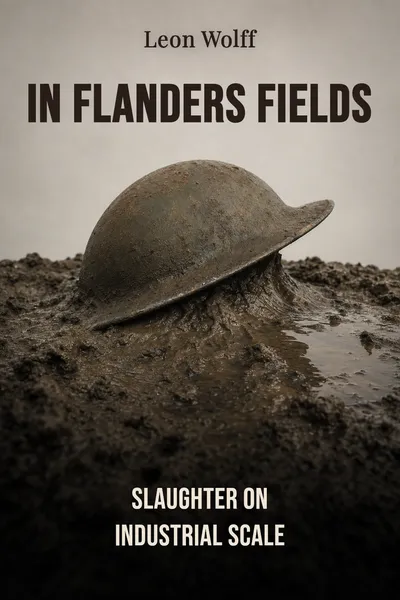
In Flanders Fields
Slaughter on industrial scale
Description
On New Year's Day 1917, the Western Front was a frozen line of trenches running from the North Sea to Switzerland, and the men holding it had already learned not to expect much from the coming year. Behind them, in London and Paris, the politicians and generals were doing the arithmetic of a war that had swallowed a generation and asked for more. The Somme had ended weeks earlier, in November, having cost the British roughly 420,000 casualties to advance a handful of miles. And yet the machinery of the offensive was already turning again, pointed this time at a low, waterlogged ridge in Flanders around a village called Passchendaele.
That is where Leon Wolff opens his account — not with a battle but with a calendar, a diary of a year that would produce one of the most futile campaigns in military history. Between July and November 1917, the British Empire threw itself at the German lines around Ypres for three and a half months, in rain that turned the reclaimed marshland into a sea of mud where wounded men drowned. The gains were measured in yards. The dead were measured in the hundreds of thousands. And the whole thing happened only a year after the Somme had supposedly taught everyone what such offensives cost.
Wolff's book, first published in 1958 and reissued for the battle's centenary, is less a chronicle than an attempt to answer a question that still divides historians. How does a war reach the point where it keeps feeding men into a killing ground long after any reasonable hope of victory there has gone? The answer he pursues is not simple villainy. It runs through the plans, the personalities, and the strange institutional momentum of a conflict that had outgrown the men supposedly directing it.
The question we’re asking : How could a slaughter on an industrial scale unfold at Passchendaele, only one year after the Somme had shown everyone the price?What we’ll see : How a Flanders campaign was conceived, defended and driven forward while the ground, the weather and the arithmetic all argued against it.
Table of contents
01Chapter 1 — New Year's Day, 1917
Wolff begins where the diarists began: the first hours of a new year, with the war entering its fourth winter and no end in sight. The device is deliberate. By anchoring the story to a calendar rather than to a battle, he lets us feel the war as the men and the leaders felt it — as an inheritance, a set of assumptions already hardening into fact before anyone had decided anything. The Somme was still fresh. Verdun, the French bloodletting of the same year, had drained the other great army of the alliance. Everyone knew what a modern offensive cost, and everyone kept planning them anyway.
The picture Wolff paints of that January is one of exhaustion dressed as resolve. The French army was closer to collapse than the British high command fully understood; within months, mutinies would spread through its ranks after the failed Nivelle offensive of the spring. The Russians were sliding toward revolution. The Americans had not yet arrived in force. Into this narrowing set of options, the British began to advance a proposal that had been sitting in the drawers of the General Staff for some time: a great push in Flanders, out of the Ypres salient, toward the Belgian coast and the German submarine bases beyond.

02Chapter 2 — The plan nobody could quite stop
At the centre of the campaign stands Sir Douglas Haig, the commander of the British Expeditionary Force, and Wolff's portrait of him is one of the book's most argued-over passages. Haig was not a monster. He was a cavalryman of deep religious conviction who believed, sincerely and against mounting evidence, that the German army was near breaking point and that one more sustained blow would shatter it. His confidence never quite bent to the reports coming back from the front. In Wolff's telling, that immovable optimism is not a personal flaw so much as a kind of institutional armour, worn by a man who could not afford, psychologically, to doubt the enterprise he had committed his men to.
Against Haig stands David Lloyd George, the prime minister, who distrusted the whole scheme and said so, and yet could not bring himself to stop it. Wolff draws out the peculiar paralysis of a civilian leader who suspected his generals were wrong but feared the political cost of overruling them, and feared still more the responsibility of being proved wrong himself. So Lloyd George temporised. He questioned, delayed, extracted half-promises, and in the end let the offensive proceed while withholding the wholehearted support that might have shortened it or the outright veto that would have prevented it.
03Chapter 3 — Mud that swallowed an army
The main offensive opened on 31 July 1917, and Wolff's account of what followed is the emotional core of the book. The rains came early and stayed, heavier than the seasonal average, and fell on ground already shattered by weeks of bombardment. The drainage was gone. Shell craters filled and merged into a landscape that had no precedent in the experience of the men sent across it — not solid, not water, but a churned porridge that could pull a man down and hold him. Wolff records, without melodrama, that wounded soldiers who slipped from the duckboard tracks sometimes drowned within sight of comrades who could not reach them.
This is where the book earns its authority as a work of narrative history. Wolff moves between the map and the mud, between the tidy arrows on staff diagrams and the reality of infantry wading forward at a pace of yards per hour toward machine guns sited on the only firm ground for miles. He is precise about the tactics — the creeping barrages that outran the men who could not keep up, the concrete pillboxes the Germans had built to survive any bombardment, the way each captured position became a new target for enemy artillery zeroed in advance.
04Chapter 4 — When the arithmetic stops meaning anything
Step back from the individual assaults and Third Ypres becomes something larger in Wolff's hands: a case study in what happens when the industrial capacity to kill outruns the human capacity to justify it. The Somme had already delivered the lesson that mass artillery and entrenched machine guns turned frontal assault into arithmetic. What Passchendaele reveals is that the lesson could be known, documented, argued in cabinet — and still not acted upon. The knowledge existed. The machinery to act on it did not.
Part of the explanation Wolff pursues is the sheer momentum of the enterprise. A modern army in the field is not a chess piece a leader can simply lift and set down. It is millions of men, thousands of guns, railways, supply dumps, a plan already circulated to every level of command. Stopping it required a decision as large and difficult as launching it, and there was no one willing to own that decision. Haig would not, because he believed. Lloyd George could not, because he doubted but would not carry the doubt to its conclusion. The offensive continued, in a real sense, because no single hand was strong enough to close it.
05Conclusion
The campaign ended in November 1917, not with a triumph but with a kind of exhaustion, as Canadian troops occupied the smear of brick and mud that had been Passchendaele. The British had advanced perhaps five miles over three and a half months, at a cost usually reckoned in the region of a quarter of a million casualties, with German losses on a comparable order. Within months, the German spring offensive of 1918 would sweep across much of the ground so laboriously taken, making even the meagre territorial gain temporary. Wolff closes his year where he opened it, with the sense of a machine that had run past the point of anyone controlling it.