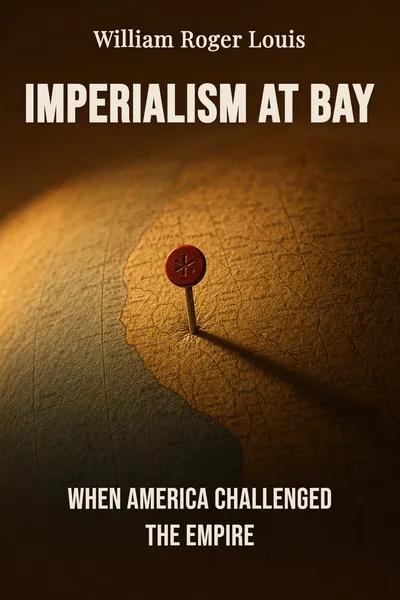
Imperialism at Bay
When America challenged the empire
Description
In August 1941, on warships anchored off Newfoundland, Franklin Roosevelt and Winston Churchill drafted a short statement of war aims that became the Atlantic Charter. Its third clause affirmed the right of all peoples to choose the form of government under which they would live. Roosevelt read it as a promise that stretched from occupied Europe to the villages of India and Nigeria. Churchill, who had spent his career defending the British Empire, insisted almost immediately that it meant nothing of the kind — it applied to nations under the Nazi boot, not to His Majesty's colonial subjects. The two men had signed the same words and meant opposite things.
That gap between one document and two readings is the subject of William Roger Louis's Imperialism at Bay, a diplomatic history of the quiet war fought inside the wartime alliance. Between 1941 and 1945, while British and American soldiers died on the same beaches, their governments quarreled over what would happen to the world's largest empire once the fighting stopped. Washington wanted colonies placed under international supervision and pointed toward independence. London wanted them left alone. The argument ran through State Department memos, Foreign Office minutes, and tense conversations at Yalta and San Francisco.
Louis built the book from the archives — the cables, the marginal notes, the drafts nobody meant for publication — and what emerges is less a story of principle than of pressure, bluff, and calculation. The Americans talked a great deal about self-determination. The British talked a great deal about responsibility. Underneath both languages, a harder question sat waiting for an answer that the war would postpone rather than resolve.
The question we’re asking : Why did the United States, at the height of its power, challenge Britain over the fate of the empire — and why did so little change by 1945?What we’ll see : How a single clause about freedom became a four-year contest of ideals, suspicion and self-interest between two allies who needed each other too much to let it break them apart.
Table of contents
01Chapter 1 — The alliance that came with strings
The United States entered the war as Britain's rescuer and creditor, and that arithmetic shaped everything that followed. By 1941 Britain was surviving on American supplies delivered under Lend-Lease, and dependence of that scale is never free of opinion. American officials, and a good part of the American public, carried a settled dislike of empire that predated the war — the country had, after all, been founded against one. To many in Washington, fighting fascism while propping up colonial rule looked like a contradiction the alliance ought to face rather than paper over.
Louis is careful to show that this anti-colonial feeling was not a single, coherent policy. It ran from genuine idealism about self-government to hard-nosed commercial interest in opening imperial markets that British preference tariffs kept closed. American planners who wanted a postwar world of free trade saw the empire's closed economic blocs as an obstacle, and the language of liberation could serve the language of commerce without either side needing to admit it. The rhetoric of freedom and the pursuit of markets moved together, sometimes indistinguishably.

02Chapter 2 — Two Roosevelts, one word: trusteeship
The American alternative to empire had a name — trusteeship — and Franklin Roosevelt was its most persistent champion. The idea was that colonial territories should be placed under international supervision, held in trust by the powers on behalf of their inhabitants, and prepared over time for self-government. Roosevelt returned to it again and again, sometimes proposing dates by which particular colonies should be ready for independence, sometimes musing aloud to Stalin and Chiang Kai-shek about how the old empires had failed the people they ruled. He spoke of French Indochina and British colonies alike as candidates for the arrangement.
Louis treats Roosevelt as central but not simple. The president's anti-colonialism was sincere and also unsystematic — he improvised, floated ideas, and let them drop, and his own State and War departments were often unsure what he actually intended. Trusteeship as he described it could mean genuine international accountability or a thin repackaging of great-power control under a new label. And the closer the war came to its end, the more American strategic interests complicated the principle. The military wanted the Pacific islands taken from Japan kept firmly under American control, which sat awkwardly with lectures to London about surrendering colonies.
03Chapter 3 — London digs in
Against the American pressure, the British constructed a defense that was partly principle and partly delay. Their argument was that colonial peoples were not ready for self-government and that abrupt withdrawal would produce chaos rather than freedom. Britain, the claim went, was already committed to development and eventual self-rule — but on its own timetable, through its own institutions, and without an American hand on the schedule. The empire, in this telling, was not a prison but a school, and the schoolmaster would decide when the pupils could leave.
Louis shows that this was more than obstruction; parts of the British establishment genuinely believed in a reformed, developmental imperialism, and the Colonial Office produced real plans for economic investment and gradual constitutional advance. But the effect, whatever the intent, was to keep control in London while conceding the vocabulary of progress. The British were willing to talk about partnership, welfare, and eventual autonomy — anything except a binding external commitment that could be used to force their hand.
04Chapter 4 — The empire the war left standing
Step back from the individual quarrels and a larger pattern comes into view, and it is the pattern Louis is most interested in. The wartime argument over empire was, at bottom, a test of how much a great power will surrender in the name of principles it proclaims loudly. The United States proclaimed self-determination with real conviction. When it came to the specific acts that would have given the principle teeth — forcing a supervised timetable on London, subjecting its own conquests to the same rule — the conviction ran into the limits of interest, and interest generally won.
This is why the book's title carries a double edge. Imperialism was at bay in the sense that it faced, for the first time, a rival superpower openly hostile to its legitimacy and armed with the language of freedom. But at bay also means cornered without being killed — held off, not brought down. By 1945 the British Empire was intact on paper, its territories un-liberated by any international mechanism, its authority formally undiminished. The American challenge had bent the rhetoric of the postwar order without dismantling the thing it condemned.
05Conclusion
The words signed off Newfoundland in 1941 outlasted the men who argued over them. Roosevelt died in April 1945, his trusteeship vision half-formed and already narrowed by his own generals' demands for Pacific bases. Churchill was voted out of office that summer, spared the sight of the liquidation he had refused to preside over but which was now only a matter of time. The British Empire that survived the war intact would be largely gone within twenty years, dismantled not by an international mechanism but by the pressure of the peoples it ruled and the exhaustion of the power that ruled them.