History Has Begun
Power is being rewritten
Description
For most of the last century the United States was read as the finished product of Western history — the place Europe had been trying to become. Liberal, commercial, individualist, the natural winner of the Cold War, the country everyone else would eventually resemble. When the Berlin Wall came down in 1989, that reading hardened into a slogan: this was the end of history, the argument over how to organize a society settled once and for all. America was less a nation than a destination.
Bruno Macaes, a Portuguese political scientist and former diplomat, wrote a short book in 2020 to say that the whole picture is upside down. His claim, in "History Has Begun," is that America is not the mature end of the European story at all. It is something younger and stranger — a new civilization, only a few centuries old, that has spent its life pretending to be the last chapter of an old one. And it is only now, he argues, starting to become itself.
That is a provocative thing to say about the most-studied country on Earth, and Macaes says it with a mix of European detachment and genuine fascination. He is not mourning a decline or cheering a triumph. He is watching a civilization discover that the script it inherited no longer fits, and improvise a new one — with consequences for everyone who assumed the American century simply meant more of the same.
The question we’re asking : If America is not the endpoint of Western history but the beginning of a different civilization, what exactly is being born?What we’ll see : How a country everyone treated as the finished West turns out to be an unfinished experiment, and why that unsettles the balance of power.
Table of contents
01Chapter 1 — A civilization that only looks American
The book opens by refusing the obvious frame. We tend to slot the United States into a lineage: ancient Greece, Rome, Christian Europe, the Enlightenment, and then America as the place where all of it finally paid off. On that reading, the country is Europe's heir, the West's best version of itself. Macaes thinks this is exactly the mistake that keeps us from seeing what is actually happening.
His counter-claim is that America was never really European in spirit, only in costume. From the start it was more religious, more commercial, more restless, more comfortable with reinvention than the continent it broke away from. The founders quoted Rome and Montesquieu, but the society that grew up underneath the borrowed vocabulary was a new kind of thing — a civilization in its own right, with its own instincts, wearing European clothes because no other clothes existed yet.

02Chapter 2 — The country that turned into a fiction
The most talked-about idea in the book is also the one that sounds most outlandish at first: that America is becoming a fundamentally fictional society. Macaes does not mean it is full of lies. He means something closer to a culture that has learned to live inside stories the way earlier societies lived inside religion — treating narrative, performance and imagination as the real substance of public life rather than a decoration on top of it.
He points to the texture of American culture to make the case. Hollywood, reality television, superhero franchises, the blurring of politics into entertainment, a public sphere where the compelling story routinely beats the accurate one. Where a European might see decadence or a crisis of truth, Macaes sees a civilization discovering its native medium. Fiction, for this culture, is not an escape from experience. It is a way of experiencing more — a technology for expanding what life can contain.
03Chapter 3 — Between Europe and Asia, the unfinished third
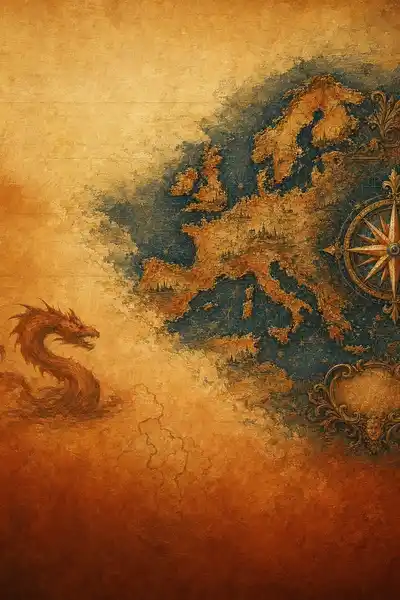
Having pulled America loose from Europe, Macaes places it in a wider field, and the picture gets more interesting. The twenty-first century, he argues, is not a two-way contest between a Western order and its challengers. It is a three-body problem: an old Europe still committed to universal rules and reason; a rising Asia, and China in particular, building a different model of power organized around the state; and an America that belongs fully to neither camp.
China matters in the book not as a villain but as proof that the future is genuinely plural. Beijing is not trying to become Western and failing; it is pursuing a coherent alternative, in which the state directs technology, capital and society toward its own ends. Alongside it, other rising powers are charting paths that owe little to the liberal template. The assumption that everyone was eventually converging on the same destination — the assumption behind "the end of history" — simply does not survive contact with this world.
04Chapter 4 — The West after the West
Step back and the title stops being a paradox. "History Has Begun" is a deliberate answer to the idea that history had ended. Macaes's real argument is not about America alone; it is about time. The comfortable twentieth-century belief was that the big questions were settled and the future would just be an extension of the present, run more efficiently. His counter is that the settlement was an illusion, and that we are standing at the opening of a new sequence rather than the tail of an old one.
What makes the claim more than a slogan is where he locates the beginning. The society treated for decades as the finished product of Western history turns out, on his account, to be the first prototype of whatever comes after it. America is not the last European nation but the earliest example of a post-European civilization — improvising an identity that its own citizens have not fully named, and that the rest of the world keeps misreading as either triumph or collapse.
05Conclusion
Macaes wrote a short, fast book to unsettle a long, slow assumption. The country the twentieth century filed under "end of the story" is, in his hands, the first draft of a story we do not yet know how to read — younger than it looks, stranger than it admits, and only now beginning to act like itself rather than the polished conclusion of someone else's history.