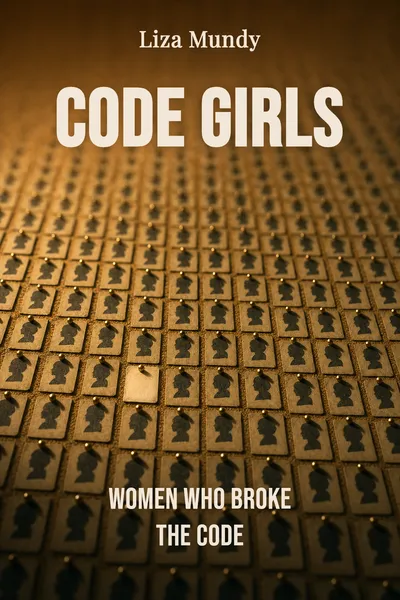
Code Girls
Women who broke the code
Description
In the fall of 1941, seniors at Wellesley, Bryn Mawr, and a scattering of other women's colleges started receiving quiet invitations to a strange meeting. A professor would take a promising student aside and ask two questions that seemed to have no connection to each other: did she like crossword puzzles, and was she engaged to be married? The right answers — yes to the first, no to the second — could lead to a second conversation, and then to a train ticket to Washington. What waited there was never explained. The young women were told only that their country needed them and that they could tell no one what they did.
By the end of the Second World War, more than ten thousand American women were breaking enemy codes. They read the messages of the Japanese navy and the German high command. They tracked supply ships across the Pacific so that submarines could sink them, and they helped drain the U-boats out of the Atlantic. Some of the intelligence that shaped Midway, and later the interception that killed Admiral Yamamoto, ran through their hands. They made up the majority of the American codebreaking workforce, and for decades almost no one knew they had existed at all.
Liza Mundy's Code Girls pulls that cohort back into the daylight. It is built from declassified files and from the memories of the women themselves, many of them interviewed in their nineties, still reflexively guarding secrets they had been sworn to keep before D-Day. What comes out is not a footnote to the war but a large, load-bearing piece of it — and a portrait of what it meant to do essential work you were forbidden to name.
The question we’re asking : How did thousands of young American women end up secretly winning battles they were never allowed to talk about?What we’ll see : How they were found, what they actually did inside the code rooms, and why the silence outlasted the war by half a century.
Table of contents
01Chapter 1 — The recruiters came looking for a certain kind of woman
The armed services had a manpower problem, and the word was literal. Men were needed at the front, which left the enormous, tedious, brilliant labor of codebreaking short of bodies. So the Army and Navy did something that would have been unthinkable a few years earlier: they went recruiting among women, and specifically among the educated young women the country had trained and then given almost nowhere to go. The elite women's colleges were the first stop. A dean would flag her sharpest math and science and language students, and a recruiter would follow.
The profile they wanted was oddly specific. Codebreaking, it turned out, rewarded a mind that could hold patterns and tolerate mind-numbing repetition without losing the thread — the same temperament, someone decided, that produced good crossword solvers and patient piano players. The recruiters also wanted women unlikely to leave. An engaged woman might marry and quit; a schoolteacher from a small town, with few other prospects and a strong sense of duty, would stay and keep her mouth shut. Loyalty and limited options were, from the military's point of view, features.

02Chapter 2 — The room where the war was actually fought
Once inside, the work was not the glamour of a spy film. It was a factory of the mind. Encrypted enemy messages arrived by the tens of thousands, stripped of meaning, and the job was to turn them back into words. That meant sorting, counting, and comparing symbols across huge sheets, hunting for the faint repetitions that betrayed the underlying system. Much of it was numbing. All of it mattered, because a single recovered code group could unlock a stream of traffic that told the Allies where a convoy was heading or when a garrison expected reinforcements.
The women worked in shifts around the clock, in stifling rooms, on codes that changed constantly as the enemy tried to stay ahead. Some ran the noisy IBM tabulating machines that crunched frequencies. Others did the delicate cryptanalytic work by hand and by intuition, the kind that could not be mechanized. A few became genuine stars of the craft. Mundy's book lingers on figures like Dot Braden, an ordinary Virginia schoolteacher who turned out to have a gift for the work, and on the small circle of women who tracked the Japanese army's supply lines message by message, so precisely that American submarines could lie in wait.
03Chapter 3 — What the silence cost, and what it protected
Secrecy was the entire point, and it was enforced with a seriousness the women never forgot. They signed oaths. They were warned that a careless word could get sailors killed, and they believed it, because it was true. Whole battles turned on the enemy not knowing his codes were broken; the value of the intelligence evaporated the instant it was revealed. So the women learned to live split lives — a public self that did dull clerical work for the government, and a hidden self that was helping to win the war.
The cost was steep and strangely intimate. They could not confide in the men they loved, several of whom were themselves at the front. When those men died, the women grieved without being able to explain what they had known or done. They endured being condescended to as glorified typists and secretaries, aware that the condescension was the cover story working exactly as designed. The silence protected the mission, but it also let the wider world go on assuming these women were doing something trivial — an assumption that would harden into the historical record.
04Chapter 4 — The generation that couldn't say what it had done
Step back from the code rooms and Code Girls becomes a story about who a country decides to see. The war created a sudden, desperate demand for exactly the kind of mind the culture had spent decades ignoring: the overqualified schoolteacher, the math major with no lab to work in, the woman whose intelligence had no professional outlet because the professions were closed. The military did not hire these women out of enlightenment. It hired them because it ran out of men. Necessity, not principle, briefly widened the door — and when the emergency passed, the door swung shut again.
What makes the erasure so complete is that it was self-inflicted, by design. Soldiers came home to parades and could tell their stories. The code girls came home to an oath that outlived the war by half a century. Their competence was not merely overlooked; it was legally unspeakable. So the standard account of the war filled up with men, not because the women weren't there but because they were forbidden to appear in it. Secrecy, meant to protect the nation, quietly rewrote its memory.
05Conclusion
The invitations that went out in 1941 asked about crossword puzzles and marriage plans, and the young women who said yes could not have guessed where the questions led. They ended up reading the enemy's mail, steering submarines toward convoys, and carrying the war's most guarded knowledge home each night to say nothing about it. More than ten thousand of them did this, made up the bulk of the American codebreaking force, and then folded back into ordinary life as though nothing had happened.