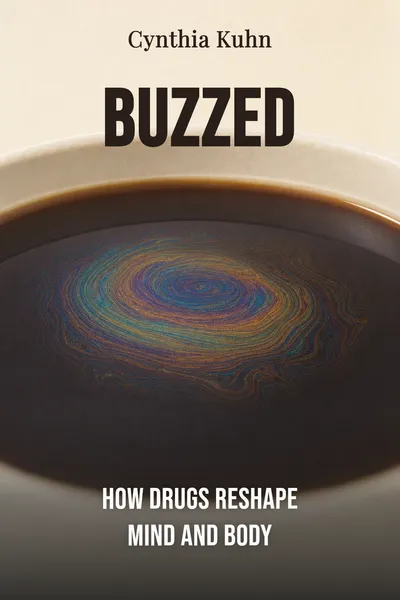
Buzzed
How drugs reshape mind and body
Description
In the early 1990s, three pharmacologists at Duke University kept fielding the same questions from students, parents, and colleagues — not the abstract ones about policy, but the concrete ones. What does this actually do to me? How much is too much? Why does coffee wake you up and alcohol slow you down, when both feel, in the moment, like relief? Cynthia Kuhn, Scott Swartzwelder, and Wilkie Wilson noticed that almost nobody could answer plainly. The information came pre-loaded: either a scare-story warning or a wink from someone selling a good time. So they wrote the book they wished existed, and called it Buzzed. It has been revised across four editions since, and its promise has never changed — tell people how drugs work on the body and the brain, and let them do the rest.
That promise sounds modest until you notice how rare it is. Most of what we hear about drugs arrives sorted into moral bins: this one is fine, that one will ruin you, this one is medicine, that one is a crime. Buzzed refuses the bins. Caffeine, nicotine, alcohol, cocaine, heroin, cannabis, MDMA, the whole pharmacy of prescription pills — they all sit in the same book, described the same way, by the same rules. A molecule enters the body, finds a lock it happens to fit, and changes what the nervous system does next. Everything else follows from that.
What emerges is less a list of substances than a way of seeing. The same principles that explain why the second espresso hits harder than the first also explain tolerance, overdose, and the slow arithmetic of addiction. Once we understand the machinery, the frightening becomes legible and the familiar becomes strange — the cup on the desk included.
The question we’re asking : What are drugs actually doing inside the body and the brain — and why do the answers cut across the categories we sort them into?What we’ll see : How a handful of pharmacological rules explain effects, risks, and the fuzzy border between medicine and poison.
Table of contents
01Chapter 1 — Every drug tells the brain a lie
Kuhn and her co-authors start from a fact that reorganizes everything after it: the brain runs on chemistry, and a psychoactive drug works by imitating or interfering with chemicals the brain already makes. Nerve cells talk to each other by releasing molecules called neurotransmitters, which drift across a tiny gap and dock into receptors on the next cell, like a key into a lock. Dopamine, serotonin, GABA, glutamate, endorphins — these are the body's own signals. A drug's whole trick is to slip into that conversation uninvited.
Some do it by imitation. Heroin and other opioids happen to fit the receptors built for the body's natural painkillers, so they flood a system meant to be dosed sparingly. Nicotine copies acetylcholine well enough to switch on receptors all over the brain and body. Others work by sabotage rather than mimicry. Cocaine doesn't imitate dopamine; it blocks the pump that would normally clear dopamine away, so the signal keeps ringing long after it should have stopped. The effect feels like a surge, but the drug added nothing — it just refused to let the brain hang up.

02Chapter 2 — Dose, timing, and the body doing the math
If the first principle is that drugs borrow the brain's own language, the second is almost defiantly ordinary: the dose makes the effect. Buzzed returns to this constantly, because it is the fact most reliably lost in conversation. There is no such thing as the effect of alcohol or the effect of amphetamine in the abstract. There is only what a particular amount does to a particular body over a particular stretch of time. Double the dose and you don't get twice the buzz — you often get a different drug entirely, one with new and unfriendlier effects waiting at the top of the curve.
Speed matters as much as size. How fast a drug reaches the brain shapes how it feels and how much it grips. The authors explain why smoking or injecting produces a sharper hit than swallowing: the faster the concentration spikes, the more intense the experience and, crucially, the more addictive the pattern. The same nicotine that is merely habit-forming in a slow patch becomes ferociously so in the fast delivery of a cigarette. The molecule hasn't changed. Its arrival time has.
03Chapter 3 — Pleasure has a receipt
The most consequential circuit in the book is the one that makes drugs feel good in the first place. Deep in the brain sits a reward pathway, running on dopamine, that evolved to flag things worth repeating — food, sex, the small satisfactions that kept our ancestors alive. It marks these as valuable and nudges us back toward them. Nearly every drug people misuse, Buzzed notes, ends up pulling this same lever, either directly or downstream. That is not a coincidence. It is the whole mechanism of appeal.
The trouble is that drugs pull the lever harder than anything in ordinary life. Where a good meal produces a modest dopamine bump, a strong stimulant can produce a flood the natural world never delivers. The brain, treating this as an extraordinarily important signal, adapts — turning down its own dopamine, thinning out receptors, resetting its baseline. The result is the quiet cruelty the authors describe carefully: over time the drug produces less pleasure while the ordinary rewards of life produce less too, and the gap between them becomes the pull of craving.
04Chapter 4 — The chemistry under the argument
Step back from the individual chapters and Buzzed is making a quieter, larger claim about how we ought to talk about drugs at all. The categories we lean on — medicine, recreation, poison, controlled substance — turn out to be social and legal sortings, not pharmacological ones. The same molecule can occupy all of them depending on the dose, the setting, and the paperwork. Opioids are a miracle in a surgical ward and a catastrophe in an alley; the chemistry is identical. What changed is the context wrapped around it.
The book's discipline is to keep returning to the molecule and letting the moral vocabulary fall away. Caffeine, the most widely used psychoactive drug on the planet, sits in the same taxonomy as cocaine, because both act on the brain and both follow the same rules of dose, tolerance, and withdrawal. That is not an argument that they are equivalent in danger — they plainly are not — but an insistence that the honest comparison is chemical, not tribal. Legality tells you what a society decided; it does not tell you what a substance does to a cell.
05Conclusion
Three pharmacologists set out to answer the plain questions their students kept asking, and the answers turned out to rest on a small set of rules. A drug borrows the brain's own chemical language, fitting locks the body built for other keys. Its effect is inseparable from its dose, its speed, and the arithmetic of a body breaking it down. And its pull, when it has one, runs through the reward circuit that evolution installed to keep us alive. Everything else — the fear, the glamour, the legal lines — is layered on top of that machinery.
Related books