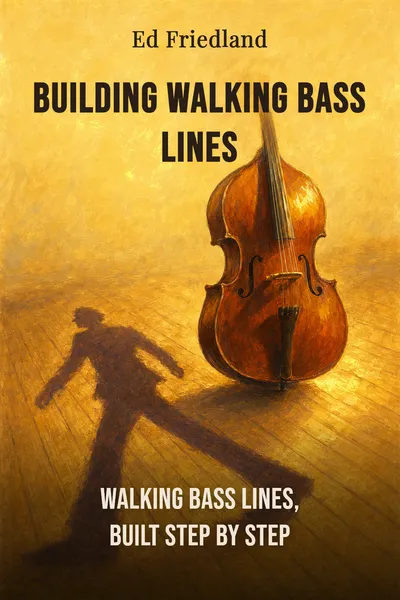
Building Walking Bass Lines
Walking bass lines, built step by step
Description
Put on almost any jazz recording and, underneath the horns and the piano, there is a bass playing one note per beat — four to a bar, steady, unhurried, always going somewhere. It rarely announces itself. Most listeners never single it out. But take it away and the whole thing collapses into a set of disconnected chords with no floor to stand on. That steady quarter-note pulse has a name that describes exactly what it does: walking. The bass walks, one deliberate step at a time, and the band walks with it.
The bassist and educator Ed Friedland built a whole method around a deceptively simple premise: that walking is not a mysterious gift certain players are born with, but a craft anyone can learn to build, note by note, decision by decision. His book "Building Walking Bass Lines" takes the approach apart into its moving pieces and hands them back as tools. And it is not only a jazz concern — the same walking feel drives blues, rockabilly, gospel, R&B, country and plenty else. Wherever quarter notes need to move a song forward, someone is walking.
What looks improvised turns out to be mostly construction: a set of choices about which note lands on which beat, made fast enough to sound spontaneous. The interesting part is how few raw materials it actually takes, and how much depends on knowing where the line is headed before it gets there.
The question we’re asking : How does a bassist turn a sequence of chords into a line that walks — one note per beat, moving, connected, and alive?What we’ll see : The handful of notes a line is built from, how the chords underneath double as a map, and how those pieces assemble into a living musical conversation.
Table of contents
01Chapter 1 — The four notes that make it move
A walking bass line is, at its plainest, one note played on every beat of the bar — in common time, four notes per measure, quarter notes marching along at the tempo of the tune. Friedland starts here because everything else is built on it. The word walking is not decoration; it names the sensation those even quarter notes produce, a forward gait that pulls the music along the way footsteps pull a walk. Before any sophistication enters, this is the job: keep the feet moving, one step per beat, steadily, without stumbling.
The first material Friedland reaches for is the chord tone. Over any given chord, four notes matter most — the root, the third, the fifth and the seventh. The root is home base, the note that tells the ear which chord is sounding. Play roots alone, one per bar or one per beat, and you already have a functioning, if plain, bass part. It is the skeleton everything hangs on, and Friedland has players live in it before adding anything, because a line that loses track of its roots loses track of the song.

02Chapter 2 — Chords are just a map
A bassist reading a jazz tune is usually handed nothing but chord symbols — a grid of letters and numbers, one or two per bar. To most people that grid looks like a set of instructions for the piano player. Friedland's move is to treat it as a map for the bass. Each symbol names not just a chord but a small pool of notes to choose from, and the sequence of symbols traces the route the line will travel over the course of the tune.
Reading the map well means understanding what the chords are doing to each other, not just what each one is in isolation. Most tunes move in recognizable patterns — the two-five-one being the workhorse of the idiom, a three-chord phrase that resolves home so often that a player learns to feel it coming. Once you hear these progressions as motion rather than as separate stops, the line almost suggests itself. You are no longer picking notes chord by chord; you are steering toward a destination you can already sense.
03Chapter 3 — From roots to real lines
With chord tones in hand and the chart understood as a map, Friedland assembles the actual line — and the assembly turns out to follow a loose logic rather than a fixed formula. A common shape puts the root on beat one, so the ear knows where it stands, uses beats two and three for other chord tones or passing notes, and saves beat four for an approach note that leans into the next chord. The bar becomes a small journey: state the home, move through the middle, aim at the door.
That approach note on beat four is the hinge of the whole method. It can be a chromatic step, a half step above or below the target root, which creates the strongest pull of all. It can be a note within the scale that lands a step away. Either way, its job is to make the arrival on the next downbeat feel inevitable rather than accidental. Friedland shows how a single well-chosen approach note is often what separates a line that merely names the chords from one that genuinely walks.
04Chapter 4 — The line as conversation
Learning to build a walking line changes how a musician hears everything else. Once you have spent time deciding which note goes on which beat, and why, you stop hearing accompaniment as background filler. You start hearing it as structure — the live scaffolding the whole performance is standing on. The walking bass, precisely because it is so easy to overlook, is one of the clearest lessons in how music is actually held together underneath the parts that grab attention.
What Friedland's method reveals, without ever stating it as a slogan, is that a bass line is not a solo act. It is one side of a conversation. The bassist is reading the harmony the pianist is laying down, anticipating where the tune is heading, and choosing notes that either confirm or gently push against the group's motion. The line responds in real time to what everyone else is doing. That is why the same set of chord tones can produce a line that sits politely in the pocket or one that prods the band forward — the difference is what the player is listening to.
05Conclusion
The bass on that jazz record, the one nobody singles out, turns out to be doing something quietly demanding: naming the harmony, marking the time, and steering toward the next chord, all at once, one deliberate note per beat. Friedland's book takes that unassuming line apart and shows it was never magic — it was construction. Chord tones for material, the chart for a map, approach notes for the hinges, passing tones for the connective tissue, and ninety minutes of backing tracks so the whole thing gets built with the hands and not just the eyes.
Related books