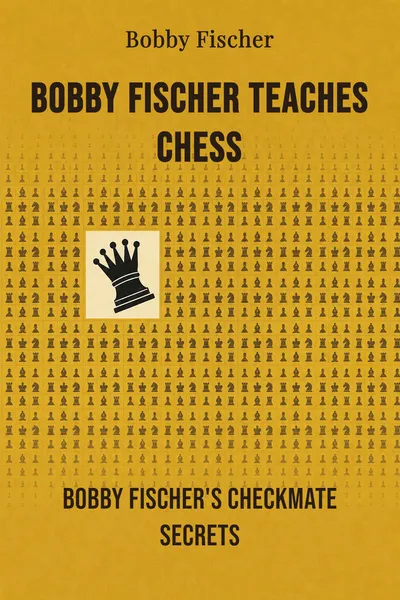
Bobby Fischer Teaches Chess
Bobby Fischer's checkmate secrets
Description
In 1966, at the height of a career that would make him the most famous chess player in the world, Bobby Fischer put his name to a book that taught nothing about openings, nothing about grand strategy, and almost nothing about the tournament wars that had made him a legend. Written with Stuart Margulies and Don Mosenfeld, and built on a teaching method called programmed learning, the book had one modest ambition: to take someone who barely knew how the pieces moved and get them to see a checkmate coming. It was called, plainly, Bobby Fischer Teaches Chess.
That title carries a small surprise. The man who would soon dismantle Boris Spassky in Reykjavik in 1972, who was known for an almost frightening intensity over the board, chose to spend a whole book on the simplest thing chess has to offer — the moment the king has nowhere left to go. No opening theory, no famous games annotated line by line. Just page after page of positions, each one asking the same quiet question: where is the mate? The book has sold in the millions and stayed in print for decades, which is more than most of the deep strategy manuals can say.
So it is worth sitting with what Fischer actually decided to teach, and how he decided to teach it. The book is less a collection of secrets than a training of the eye — a way of looking at thirty-two pieces on sixty-four squares and instantly spotting the one arrangement that ends the game. What he built was a machine for producing that recognition in a reader who started with nothing.
The question we’re asking : What does a world champion choose to teach when he sits down to teach a complete beginner?What we’ll see : How Fischer turned the endgame's final blow into the first thing a reader learns to see, and why he built the whole book around it.
Table of contents
01Chapter 1 — A champion writes a beginner's book
The book arrives with an odd premise for a Fischer product. Here is a player who, by 1966, was already regarded as one of the strongest in the world, a man whose games were studied by professionals for their precision — and the book he lends his name to opens by assuming the reader knows only how the pieces move. It does not court the club player looking to sharpen a French Defence. It courts the person who has been shown the rules once and wants, finally, to feel like they understand what is happening.
The method is the tell. Fischer worked with Stuart Margulies, a psychologist, and Don Mosenfeld, an editor, on a format known as programmed instruction — a teaching style popular in the 1960s in which the material advances in tiny, tested steps. A position appears. A question is asked. The reader answers, then turns to check. Nothing new is introduced until the previous idea has been used, again and again, until it becomes reflex. The book reads less like a lecture than like a patient hand guiding yours across the board.

02Chapter 2 — The one weapon the book puts first
The heart of the book is the checkmate, and Fischer treats it not as a single trick but as a family of recurring shapes. The reader is walked through mate delivered by a queen, by a rook, by a bishop, by combinations of them, each pattern shown so many times and from so many angles that it stops being a puzzle and becomes something recognised on sight. The famous back-rank mate — a king boxed in by its own pawns while a rook or queen slides along the last row — is drilled until the reader can no longer not see it.
What makes the approach work is repetition with variation. The same idea returns dressed differently: the pieces are placed elsewhere, the board is rotated in the mind's eye, an extra defender is added so the reader must notice why the mate still holds or now fails. Fischer is not asking anyone to memorise positions. He is training the reader to abstract the shape out of the specific arrangement — to feel, before counting, that this king is in trouble.
03Chapter 3 — Building the eye that sees the pattern
What Fischer is really cultivating is recognition, and it helps to notice how the book engineers it. Each new position is only a small step from the last, so the reader is never guessing wildly. The difficulty climbs so gently that the sense of progress rarely breaks — and that steadiness is deliberate. Programmed instruction was built on the belief that a learner who answers correctly most of the time stays engaged, while a learner who fails repeatedly quits. Fischer's book is tuned to keep the reader winning small victories on nearly every page.
From the pure mating patterns, the material widens into positions where the mate is not immediate but two or three moves away, hidden behind a forcing sequence. The reader is asked not just where the king dies but how to drive it there — which check comes first, which piece must be sacrificed to open a line, which defender must be pulled away. The book teaches that a strong move is often one that removes the opponent's options, and that the cleanest attacks are the ones where the defender is merely choosing the manner of the loss.
04Chapter 4 — Why a grandmaster taught the very first step
Step back from the positions and the book says something about how hard skills actually pass from a master to a novice. Fischer, who could calculate lines most players cannot even hold in their heads, chose not to pour that depth onto the page. He chose instead to isolate the smallest genuinely learnable unit — the recognised mating shape — and to build a whole book around installing it. That choice is a kind of humility about teaching that the depth of his own play might not lead you to expect.
The deeper insight buried in the method is that mastery, in chess as elsewhere, is largely a stockpile of recognised patterns. A grandmaster does not out-calculate an amateur so much as out-recognise them — the strong position, the familiar trap, the shape of the winning attack, all seen instantly because they have been seen thousands of times before. Fischer's book takes that fact seriously and works backward from it: if recognition is the engine of skill, then the fastest way to help a beginner is to start manufacturing recognition on day one.
05Conclusion
The book that bears Fischer's name never tries to make anyone a champion. It sets out to take a person who knows only the moves and leave them able to see a checkmate forming across the board, and it pursues that single aim with a patience that borders on the obsessive. Position after position, question after question, the reader is drilled in the mating patterns until the shapes announce themselves on sight. What begins as a scatter of pieces ends as a readable field, and the reader closes the book with an instinct they did not have when they opened it.
Related books