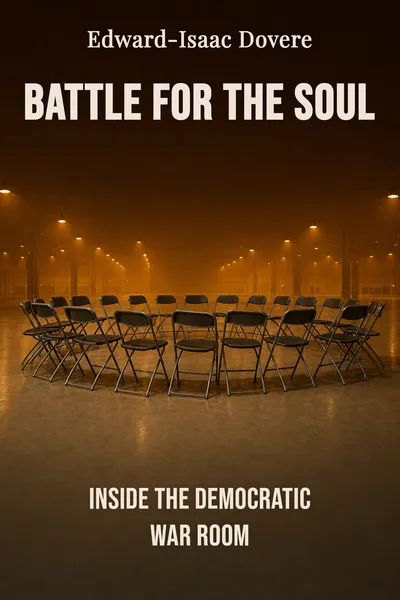
Battle for the Soul
Inside the Democratic war room
Description
On the night of November 8, 2016, in offices and hotel suites across the country, a set of very smart people watched their forecasts come apart in real time. The Democratic Party had spent the better part of two years treating a Trump presidency as an outcome too absurd to plan for seriously. Edward-Isaac Dovere, then covering the party for Politico, was close enough to the operation to see the reaction up close: not a strategy, but a collapse. The people who were supposed to know how power worked in America had misread the country, and they knew it before the networks called it.
What came next is the subject of his book, Battle for the Soul, published in 2021. Dovere spent roughly four years reporting it, sitting through hundreds of interviews with governors, senators, operatives, donors and the candidates themselves. The result is not a tidy account of resistance triumphant. It is a chronicle of a party arguing with itself — about who was to blame, about who should lead, about whether to move left or reclaim the center, about whether the fight was even winnable. The war room, in this telling, was less a command center than a room full of people who could not agree on the map.
The through-line is a question the party kept dodging and could not escape: after 2016, what was the Democratic Party actually for? The answer would be worked out not in a manifesto but in a brutal, crowded scramble for the 2020 nomination — and Dovere was in the room for a striking amount of it.
The question we’re asking : After 2016, could a party this divided about its own purpose still organize itself to win?What we’ll see : How the reporting reveals a party improvising its way through defeat, rivalry and an unruly primary toward a candidate almost nobody's first choice.
Table of contents
01Chapter 1 — The party that lost the room
Dovere begins with the shock, and he lingers on it because the shock explains everything that follows. The Democratic establishment had built its 2016 campaign on the assumption that demography and decency would carry the day. When they didn't, the party had no shared account of what had gone wrong. Was it Comey? Was it Russia? Was it Hillary Clinton herself, or the coalition she'd been handed, or the working-class voters who'd walked away? Everyone reached for the explanation that flattered their prior politics, and so the postmortem never really happened.
What Dovere documents instead is a leadership vacuum dressed up as unity. Barack Obama, still popular and still president for two more months, was privately anguished about the party he was leaving behind — a party that under his tenure had shed roughly a thousand state legislative seats, governorships and congressional seats even as he won twice. He had been, in the book's reading, a phenomenal candidate and an indifferent party-builder, and the machine he handed off was thinner than his personal approval numbers suggested.

02Chapter 2 — Everyone runs, nobody agrees
By 2018 the field was forming, and Dovere's gift is for the texture of ambition — the phone calls, the donor breakfasts, the careful non-announcements. What emerges is a portrait of a generation of Democrats who all looked at Trump and concluded, more or less simultaneously, that if that man could be president, surely they could. The field would eventually swell past twenty candidates. Each one arrived carrying a different theory of why 2016 had happened and what the cure was.
The theories were genuinely incompatible. Bernie Sanders and Elizabeth Warren argued that the party had lost by being too timid, too cozy with donors, too frightened of its own progressive convictions. Others — the governors, the moderates, eventually Biden — argued the opposite: that Trump was an aberration to be corrected, that the country wanted normalcy restored, not a second revolution. Kamala Harris, Cory Booker, Pete Buttigieg and Beto O'Rourke each tried to occupy some middle ground, and Dovere shows how quickly that ground dissolved under the pressure of a primary electorate that wanted to be excited.
03Chapter 3 — The primary that would not end
The 2020 primary is where Dovere's reporting pays off, because the race defied every early forecast. Biden launched in April 2019 as the presumed frontrunner and then spent months looking like a man out of step with his own party — low on money, wooden on the stump, overshadowed by younger rivals with better online energy. By the time voting began, the obituaries were half-written. He finished fourth in Iowa and fifth in New Hampshire, results that would normally end a campaign.
What saved him was not a war room's genius but a coalition the pundits had underweighted. South Carolina, and Congressman Jim Clyburn's endorsement days before the vote, delivered Black voters who had never stopped seeing Biden as Obama's partner and the safest bet against Trump. The victory was decisive, and Dovere shows how fast the party then moved to consolidate — Buttigieg and Amy Klobuchar dropping out and endorsing within seventy-two hours, an establishment suddenly acting with a coordination it had lacked for four years.
04Chapter 4 — What a war room can and cannot do
Step back from the personalities and Battle for the Soul is really an argument about how political parties actually make decisions — which is to say, badly, and mostly by accident. The title promises a struggle for meaning; the book delivers a series of improvisations. Nobody in Dovere's telling ever sat down and decided what the modern Democratic Party stood for. The purpose was arrived at backward, inferred from a candidate who happened to survive, rather than chosen and then embodied.
This is the value of the fly-on-the-wall method Dovere uses. By staying in the room, he strips away the retrospective tidiness that campaigns impose on themselves after the fact. The winning strategy, seen up close, was not a strategy at all but a run of contingencies: an endorsement here, a rival's collapse there, a base too scared to gamble. What looks like collective intelligence from a distance dissolves, on inspection, into a crowd of people guessing under pressure and occasionally guessing right.
05Conclusion
The book ends where it has to: with Biden in office and the argument that produced him still very much alive. Dovere returns, in effect, to that election night in 2016, when the party discovered it had misjudged the country. Four years later it had won, but the win rested on the same fragile coalition and the same unresolved fear, and the internal fight it had suspended in March 2020 was already reopening by inauguration day.