Tuxedo Park
The secret lab that won the war
Description
In the early 1930s, a stone mansion in Tuxedo Park, an exclusive gated enclave forty miles north of Manhattan, filled up on weekends with some of the strangest houseguests in America. Nobel laureates, brain physiologists, physicists who would later split the atom — they came by invitation, stayed in guest rooms wired for experiments, and worked in a private laboratory better equipped than most universities could afford. The man who assembled them was not a scientist. He was Alfred Lee Loomis, a Wall Street lawyer and financier who had made a fortune electrifying rural America and then, unusually, walked away from money to spend it on physics.
Loomis was a genuine amateur in the old sense of the word — someone who did the thing for love. But he was an amateur with a private fortune, a first-rate mind, and no patience for academic hierarchy. He funded experiments he was curious about, published real papers, and pulled the best researchers of the era into his orbit by offering them something universities couldn't: money, equipment, and total freedom. By the time war came to Europe, the informal club he had built at Tuxedo Park would turn out to matter far more than anyone at those weekend gatherings could have guessed.
Jennet Cot's account follows this figure most of us have never heard of into the two projects that would decide the Second World War — the microwave radar that beat the Luftwaffe, and the bomb that ended it. Loomis was at the center of both, and yet he spent the rest of his life making sure his name stayed off the record. The book asks how a private citizen ended up steering the science that saved the Allies, and why history nearly forgot he existed.
The question we’re asking : How did an amateur financier end up assembling the scientific circle that produced radar and the atomic bomb?What we’ll see : The making of a self-taught tycoon, the private lab he ran like a salon, the wartime pivot that turned his hobby into a weapon, and the point where his fortune stopped being enough.
Table of contents
01Chapter 1 — The tycoon who bought a laboratory
Alfred Loomis trained as a lawyer, but he had the instincts of an engineer and the nerve of a speculator. In the 1920s he and his brother-in-law Landon Thorne built a Wall Street firm that specialized in financing electric utilities, wiring up huge stretches of rural America at a moment when the country was hungry for power. The business made Loomis genuinely, spectacularly rich. It also made him one of the few men on the Street who could read a balance sheet and a physics paper with equal ease.
What set him apart from the era's other tycoons was what he did next. In 1929, sensing the market had gone mad, Loomis converted much of his holdings to cash and gold before the crash. Where the collapse ruined his peers, it left him wealthier still — and free to pursue the thing he actually cared about. He had been dabbling in science for years, running experiments in a spare room, corresponding with physicists. Now he decided to do it properly.

02Chapter 2 — The circle at the mansion
The Tower House became something between a laboratory and a salon. Loomis hosted weekend gatherings where the guest list read like a roll call of twentieth-century science. Albert Einstein visited. Niels Bohr came through. Enrico Fermi, newly arrived from Fascist Italy, spent time there. The physicist Ernest Lawrence, inventor of the cyclotron at Berkeley, became one of Loomis's closest collaborators and friends — and Loomis quietly poured money into Lawrence's atom-smashing machines when Depression-era funding dried up.
Loomis had a gift for gathering people and letting them collide. He didn't run the place like a boss issuing assignments; he ran it like a host who happened to have the best equipment in the country. Conversations at dinner ran into experiments in the lab, which ran into ideas nobody would have reached alone. For émigré scientists fleeing Europe, the mansion offered something rarer than a paycheck — a landing place, a sense that someone with resources took their work seriously, and connections into American institutions they didn't yet have.
03Chapter 3 — Radar before the physicists knew they needed it
As the 1930s closed and Europe slid toward catastrophe, Loomis turned his attention and his network toward the coming fight. He grasped earlier than most Americans that this war would be decided by technology, and he began steering his lab — and his contacts in Washington — toward the problem of detection. The British, fighting for survival, had been developing radar, and in 1940 they sent a secret mission to share their most guarded findings with the Americans, betting that industrial help was worth the risk of disclosure.
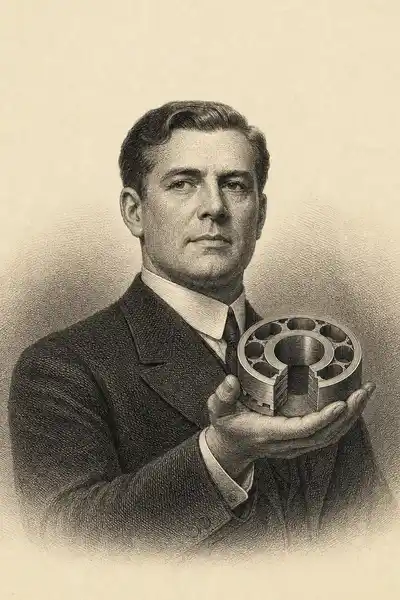
At the heart of the British package was a small device called the cavity magnetron, which generated microwaves powerful enough to make radar far more precise than anything then in American hands. Loomis understood immediately what it meant. Through his connections he helped establish a new laboratory at the Massachusetts Institute of Technology — the Radiation Laboratory, or Rad Lab — dedicated to turning the magnetron into working microwave radar. He didn't just fund and advise; he threw himself into the physics, contributing to the technical work as well as the organization.
04Chapter 4 — When private money runs out of runway
Loomis's story marks a threshold. For a brief window in the early twentieth century, it was still possible for a single wealthy individual to sit at the frontier of physics — to buy the instruments, fund the researchers, and do work that mattered. Loomis was arguably the last man for whom that was true at scale. The science he loved, measurement and radiation and the structure of the atom, was becoming too big for any private fortune, however large, to sustain alone.
The war made this shift visible almost overnight. The Rad Lab and the Manhattan Project consumed resources on a scale no philanthropist could match — billions of dollars, tens of thousands of people, entire secret cities. What Loomis had prototyped in miniature at Tuxedo Park, the state now built at industrial scale. His private lab had shown that gathering the best minds and giving them money and freedom produced extraordinary results; the government took that lesson and nationalized it. After 1945, frontier science in America would run on federal budgets, not gentlemen's fortunes.
05Conclusion
Alfred Loomis lived until 1975, long enough to watch the world of Big Science he had helped birth grow into something vast and permanent. He never wrote a memoir, gave almost no interviews, and burned much of his correspondence. His personal life had unraveled during the war years, and the reserved, secretive temperament that made him such an effective operator behind the scenes also made him nearly invisible to history. For decades, the man at the center of two of the century's decisive scientific projects was a footnote at most.