The Unsettling of America
When farming became extraction
Description
In 1977, a Kentucky farmer named Wendell Berry published a book that read less like an argument about crops than like an obituary for a way of life. He was writing in the wake of Earl Butz, the Secretary of Agriculture who had told farmers to "get big or get out" and to plant fencerow to fencerow. Berry, who worked a hillside farm along the Kentucky River with horses as much as tractors, watched that advice empty the countryside around him. Neighbors sold out. Barns fell in. The land his family had worked for generations was being reorganized by people who had never stood on it, according to a logic that measured everything except whether the soil would still be there in a hundred years.
His diagnosis was blunt and strange for its moment. The problem, he said, was not that American farming had grown inefficient. The problem was that it had grown too efficient at the wrong thing. Somewhere in the century after the Homestead Act, agriculture had quietly changed its nature — from a practice of settling and staying, of caring for a particular place across generations, into an industry of extraction. Food had become a commodity pulled from the ground the way coal is pulled from a seam, and the farmer had been turned from a member of the land into a temporary operator of it.
What made the book unsettling — the word is his — was that Berry refused to keep the argument on the farm. The same mind that mined the topsoil, he thought, was busy mining everything else: rural communities, human bodies, the marriage between a person and their work. Agriculture was simply where the pattern showed first and most clearly, because dirt does not lie about how it is being treated.
The question we’re asking : What happens to a country when it stops farming its land and starts extracting from it?What we’ll see : How Berry traces one civilization's habit of mind from the ruined field outward to the ruined self.
Table of contents
01Chapter 1 — The two kinds of people on the land
Berry opens by dividing the people who have worked American soil into two lasting types, and the division is the hinge of the whole book. There are exploiters and there are nurturers. The exploiter asks how much and how fast; the nurturer asks how good, how lasting, and what it will do to the place. The exploiter thinks in terms of profit and efficiency, the nurturer in terms of health — of the field, the family, the community, all of which he insists are finally one health, not several.
This is not a contrast between good people and bad people, and Berry is careful about that. It is a contrast between two ways of standing in relation to a place. The exploiter can be perfectly decent and still leave ruin behind, because the logic he serves does its damage impersonally. The frontier, in Berry's reading, trained Americans into the exploiter's posture from the beginning: the continent was treated as an inexhaustible supply, to be used up and left behind for the next fresh acreage further west. When the West ran out, the habit did not.

02Chapter 2 — What the machine could not measure
The engine of this unsettling, for Berry, is a particular way of counting. Industrial agriculture measures its success in yield per acre and cost per unit, and by those measures it is a triumph: fewer farmers feeding more people at lower prices than any society in history. Berry does not dispute the numbers. He disputes that they are the whole account. The books are balanced only because the largest costs are never entered — the eroding topsoil, the poisoned water, the exhausted people, the hollowed-out town.
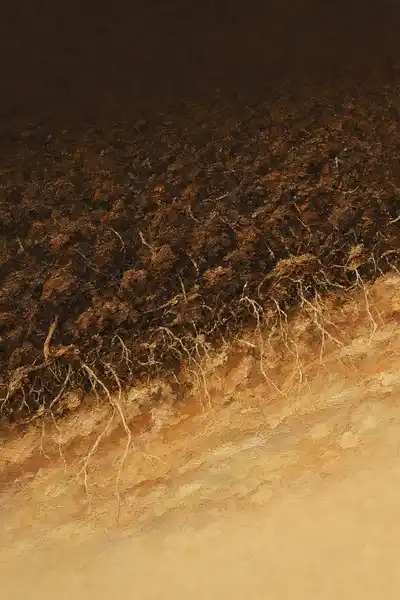
Soil is his central example, and it is not sentimental. A fertile topsoil is a living thing, built over centuries by the slow cooperation of roots, worms, weather, and decay. It can be spent far faster than it can be made. The industrial method — vast monocultures, heavy chemical inputs, the removal of animals and their manure to distant feedlots — treats this living inheritance as a mineral deposit. The fertility that took an age to accumulate is drawn down in a few decades and replaced with fossil-fueled fertilizer, which is to say replaced with a debt to be paid later by someone else.
03Chapter 3 — The specialist and the divided mind
Behind the machinery, Berry finds a mind, and he names its defining trait: specialization. Modern life, he argues, has been organized around the principle that each of us should do one narrow thing very well and buy everything else. The farmer specializes in one crop; the eater specializes in eating and knows nothing of growing; the expert specializes in a fragment of a problem and answers for none of the whole. This looks like sophistication. Berry thinks it is a kind of disintegration.
The trouble with the specialist is that responsibility falls between the gaps. The chemist who designs the herbicide is not answerable for the dead stream; the economist who praises consolidation is not answerable for the abandoned town; the farmer forced onto the treadmill of debt and yield is not free to farm well even when he wants to. Everyone is doing their assigned piece competently, and the sum of the competent pieces is a catastrophe that no single person feels they caused. The division of labor becomes a division of conscience.
04Chapter 4 — A discipline the culture forgot
Step back from the fields and what Berry is really describing is a civilization's habit of mind — one first perfected on the farm and then applied everywhere. Agriculture is his case study because land keeps an honest record; you cannot argue with a gullied hillside. But the extractive posture he traces there is the same one a culture brings to its forests, its labor, its attention, and eventually its own citizens. Once you have learned to treat a field as a supply to be drawn down, you have learned to treat everything that way.
This is why the book has outlived the farm crisis that produced it. Berry saw, decades early, that the logic of "get big or get out" was not an agricultural policy but a whole theory of how humans should relate to the world: maximize the take, externalize the cost, move on. We now recognize that logic in supply chains that treat workers as interchangeable, in platforms that mine our hours of attention, in an economy that books quarterly gains against a climate bill nobody intends to pay. The feedlot was only the early prototype.
05Conclusion
Berry never left the hillside farm along the Kentucky River, and he went on writing from it for the next half-century, in essays and poems and fiction that circle the same conviction. He kept working the land partly with horses, kept declining to treat his own life as a thing to be optimized, and in doing so made himself into the standing rebuke his book describes. The neighbors who sold out did not come back. The soil that washed away did not return. But the argument for why any of it mattered was now on paper, harder to dismiss than a single stubborn farmer.
Related books