The Soul of an Octopus
Eight arms, infinite intelligence
Description
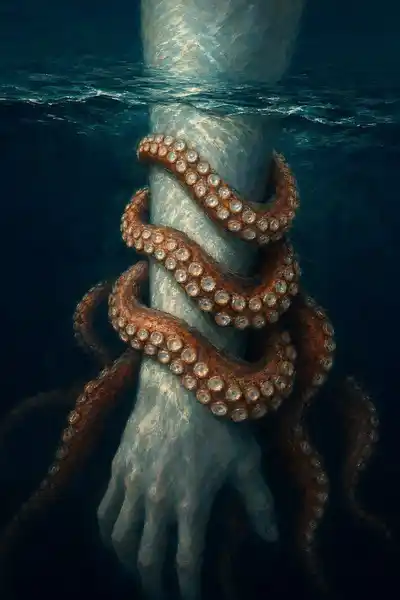
In the spring of 2011, a naturalist named Sy Montgomery leaned over a tank at the New England Aquarium in Boston and put her hand into cold salt water, unsure what would happen. What happened was that a giant Pacific octopus named Athena rose from the rocks, turned red with what her keepers read as excitement, and reached up with dozens of suckers to taste the stranger's skin. Montgomery would later write that being gripped by an octopus is like being tasted and examined at once — the animal doesn't just touch you, it reads you. She had come to write about a creature most people file somewhere between calamari and horror movie. She left having befriended something.
The book that grew out of those visits, published in 2015, is not really a nature guide. Montgomery kept returning to the aquarium over several years, following one octopus after another — Athena, then Octavia, then Kali, then Karma — through their short, vivid lives. Each had a temperament. Some were shy, some were bold, one was a known escape artist. What began as reporting turned into a set of friendships across the strangest possible gap, between a warm-blooded primate with a spine and a boneless invertebrate that tastes with its skin and can pour its whole body through a hole the size of an orange.
The animal at the center of all this is genuinely alien in its body and its plan. It has three hearts, blue-green blood, and most of its neurons distributed not in its head but down its eight arms. And yet Montgomery keeps arriving at the same unsettling conclusion — that this creature, evolved along a branch that split from ours more than five hundred million years ago, is curious, moody, playful, and possibly self-aware. Not alien after all. A mind, built to a different specification.
The question we’re asking : What is it actually like to be an octopus — and can a creature this different from us really have an inner life?What we’ll see : How Montgomery's years among the aquarium's octopuses turn a slimy stereotype into a portrait of intelligence, personality, and a consciousness assembled on a plan nothing like our own.
Table of contents
01Chapter 1 — A mind that lives in the arms
The first thing to understand about an octopus, Montgomery insists, is that almost nothing about its body works the way ours does. It has three hearts — two pumping blood through the gills, one driving it around the body — and blood that runs blue-green because it carries oxygen on copper rather than iron. It has no bones at all, which is why a giant Pacific octopus weighing as much as a large dog can squeeze through a gap barely wider than its own eye. The only hard part is the beak, a parrot-like bit of keratin at the center of the arms. Everything else is muscle, will, and water.
Then there is the nervous system, which is where the strangeness turns philosophical. An octopus has around five hundred million neurons — roughly the count of a dog. But only a third of them sit in the brain wrapped around its throat. The other two thirds are spread out along the eight arms, which means each arm carries something close to its own intelligence. Sever the nerve connection and an arm will still reach, grip, and pass food toward where the mouth would be. The animal is, in a real sense, thinking with its whole body.

02Chapter 2 — The ones with names
The heart of Montgomery's book is not anatomy but acquaintance. She got to know four octopuses over her years of visits, and the thing she most wants readers to grasp is that they were not interchangeable specimens. They were individuals with settled dispositions, as recognizable to their keepers as different dogs would be. Athena, the first, was bold and inquisitive. Octavia, who came next, was gentler and eventually withdrawn. Kali was a young live wire, endlessly curious and prone to mischief. Karma had her own temper entirely.
The keepers at the New England Aquarium spoke about these personalities matter-of-factly, because they lived with the evidence daily. Some octopuses liked certain people and soured on others, remembering a face across weeks. In one well-known experiment Montgomery recounts, octopuses were treated kindly by one researcher and irritated by another; they later greeted the two very differently, spraying water at the one they'd learned to dislike. They hold grudges. They play, pushing a floating pill bottle into a jet of water to watch it bounce back, over and over, for no reward but the game itself.
03Chapter 3 — What it means to be touched by a boneless creature
Much of the book unfolds with Montgomery's arm in the water, and she keeps circling back to the sheer physical strangeness of contact. An octopus does not shake your hand; it explores you. The suckers attach and release in waves, each one tasting, so that meeting an octopus is less like touching an animal than like being investigated by a curious, many-fingered stranger who happens to be made of water and muscle. She describes the surprising strength of the grip, and the odd tenderness of it, and the vertiginous sense of a mind on the other end paying close attention.
This is where her larger argument lives. If the octopus were merely a reflex machine, none of this would matter — a sea cucumber doesn't investigate you. But the octopus chooses. It approaches some visitors and ignores others. It goes pale with contentment or flushes with irritation depending on how the encounter is going. Montgomery reads these as signs of preference, mood, even a kind of relationship, and while she knows the charge of anthropomorphism, she argues the greater error runs the other way — assuming that because a creature is unlike us, nothing is happening inside it.
04Chapter 4 — The problem of another kind of consciousness
Step back from the individual animals and the octopus becomes a genuine problem for how we think about minds at all. Consciousness, in our usual story, is a thing that evolved once, in creatures more or less like us — a centralized brain, a face, a spine. The octopus wrecks that story. Its last common ancestor with humans was a wormlike thing that lived over five hundred million years ago, before the split between vertebrates and mollusks. Whatever intelligence the octopus has, it built independently, from different materials, on a different plan. If there is something it is like to be an octopus, evolution arrived at that inner light twice, by separate roads.
Montgomery is careful, and honest about how much remains unknowable. We cannot ask the animal what it experiences, and its senses are so unlike ours — tasting through skin, sensing light without seeing color, thinking partly through arms that may not report fully to the brain — that its world may be organized in ways we have no words for. She lets that mystery stand rather than resolving it, which is the book's real intellectual nerve. The octopus is not a puzzle to be solved into human terms. It is proof that the space of possible minds is far larger than the one we inhabit.
05Conclusion
By the book's close, the octopuses Montgomery befriended have mostly completed their brief lives, and she has learned to grieve creatures whose whole existence spans less time than it took her to write about them. Athena, Octavia, Kali — each rose from the rocks to taste her, each turned out to have a temperament as distinct as a person's, and each slipped away on the fast clock its body kept. What lingers is not the anatomy, remarkable as it is, but the recognition: the animal in the tank was somebody, not something.
Related books