The Republic
The philosopher's path to justice
Description
Around 380 BC, in a house at the port of Piraeus just outside Athens, a group of men stay up late arguing. The host has money, the wine is flowing, and someone throws out a question that sounds almost too simple to bother with: what is justice, really? Is it just paying your debts and telling the truth? An old man offers that, shrugs, and heads off to a sacrifice. And then Socrates, the barefoot troublemaker Plato puts at the center of nearly everything he wrote, refuses to let the question go. What starts as after-dinner talk turns into the longest night in the history of philosophy.
Out of that conversation comes The Republic, a dialogue in ten books that begins with one man's honest answer and ends, hundreds of pages later, with the most famous image Western thought ever produced: prisoners chained in a cave, mistaking shadows for the world. In between, Socrates does something strange. To figure out what justice means in a single person, he builds an entire city from scratch — its classes, its schools, its rulers, its rules about who may write poetry. Justice in the soul, he wagers, will be easier to read if we first find it written large across a whole society.
That move — reasoning from the city to the self and back — is what makes the book so much stranger and more alive than its reputation as a blueprint for a perfect state. Plato is not really drawing up a constitution. He is asking whether it is better to be just or only to seem just, and he refuses every easy way out.
The question we’re asking : Is it actually better for us to be just, or just better to look it?What we’ll see : How one dinner-party question grows into a whole city, a theory of the soul, a case for philosopher-kings, and a cave that still won't let us go.
Table of contents
01Chapter 1 — A question raised over dinner
The book opens light and gets serious fast. Cephalus, the wealthy old host, says justice is telling the truth and paying what you owe. Socrates pokes a hole in it: would you return a weapon to a friend who had since lost his mind? Clearly not. So justice can't just be keeping your word. Cephalus, sensing the trouble coming, excuses himself, and his son and the others take up the fight.
Then Thrasymachus barges in, and the dialogue finds its real opponent. Justice, he says bluntly, is nothing but the advantage of the stronger — the rules the powerful write to serve themselves. The just person is a sucker; the unjust one, if he's clever enough to get away with it, lives better. This is the challenge the whole book exists to answer, and Plato makes it as strong as he can before knocking it down.

02Chapter 2 — The just city, the just soul
The imagined city, later called Kallipolis, grows by necessity. No one is self-sufficient, so people specialize: the farmer farms, the builder builds, and each does the one thing he does best. This principle of specialization — one person, one job suited to their nature — turns out to be Plato's key to everything. As the city grows richer and needs protection, a class of guardians appears, warriors bred and trained to defend it. And from the very best of those guardians, over long years of testing, a still smaller group emerges to rule.
Three classes, then: producers, guardians, and rulers. Plato matches each to a part of the soul. The producers answer to appetite, the hungry, acquisitive drive for food, money, and pleasure. The guardians answer to spirit, the seat of courage, honor, and anger. The rulers answer to reason, the part that seeks truth and knows what is genuinely good. A city is just, Socrates argues, when each class does its own work and doesn't meddle in the others'. A soul is just on exactly the same terms.
03Chapter 3 — The rulers nobody would want the job
If the just soul is one ruled by reason, then the just city must be ruled by those in whom reason is strongest — and here Plato makes his most notorious claim. Cities will never stop suffering, Socrates says, until philosophers become kings or kings become philosophers. Not clever debaters or lovers of opinion, but people who genuinely know the good and don't merely have views about it. The trouble is that such people, precisely because they'd rather contemplate truth, are the ones least eager to rule. A city is well governed, Plato suggests, only when its rulers regard governing as a chore.
To get them, the city needs an extraordinary education, laid out in detail. The guardians are raised in common, their stories and music strictly controlled, their bodies trained, their souls shaped from childhood. The most promising climb through decades of study — mathematics, geometry, astronomy, and finally dialectic, the art of reasoning toward first principles. Only around fifty, after both study and hard practical service, is someone fit to rule. Plato asks a lot. He is describing a lifetime of formation, not a résumé.
04Chapter 4 — The shadows on the wall
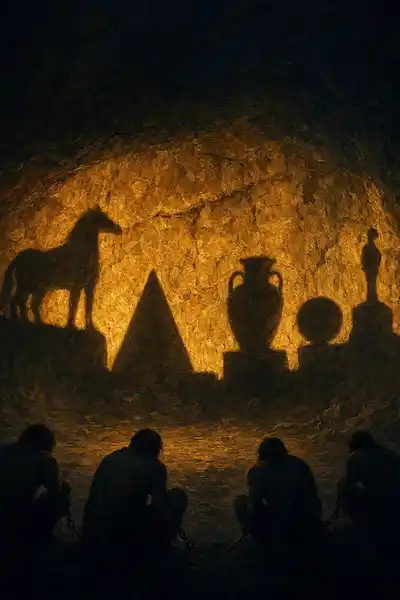
Picture people chained since birth in an underground cave, facing a blank wall. Behind them a fire burns, and between the fire and the prisoners, figures carry objects whose shadows fall on the wall. The prisoners see only the shadows. They name them, predict them, compete over who reads them best. For them, the shadows are not a copy of reality. They are reality, the only one there is. This is the Allegory of the Cave, and it is Plato's account of the human condition.
The story is one of escape. A prisoner is freed and dragged, unwillingly, up toward the light. Every stage hurts. The fire dazzles him; the sunlit world blinds him at first; only slowly can he look at shadows, then reflections, then things themselves, and last of all the sun. That climb is education as Plato understands it — not pouring information into an empty mind, but turning the whole soul around, away from appearances and toward what is real. Knowing the good is less like learning a fact than like walking out of a cave.
05Conclusion
The long night that began with an old man's simple answer ends far from where it started. Socrates has built a city, dismantled the tyrant's boast that injustice is the smarter life, mapped justice onto the parts of the soul, and climbed out of a cave into the light of the good. His answer to Glaucon holds: the just person is not the fool who misses out, but the only one whose soul is whole. Injustice was never strength. It was a kind of inner ruin, dressed up as winning.
Related books