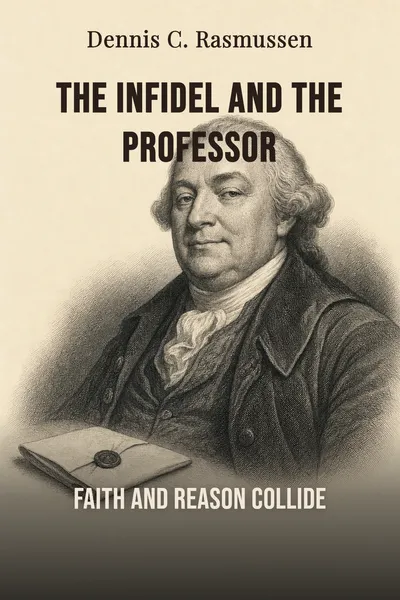
The Infidel and the Professor
Faith and reason collide
Description
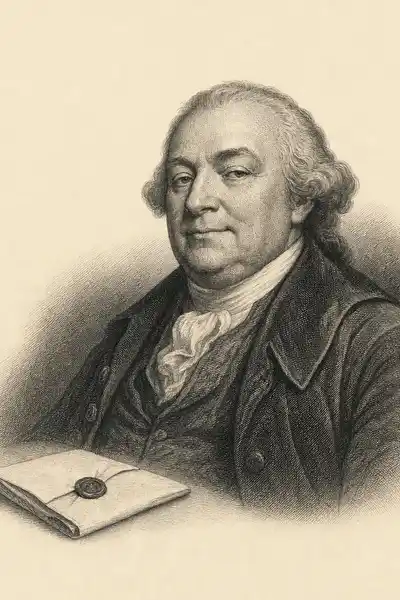
In the summer of 1776, a dying man in Edinburgh spent his last good weeks joking about death. David Hume, the most notorious skeptic in Britain, was wasting away from what was probably bowel cancer, and he refused to pretend otherwise. When the diarist James Boswell came to interrogate him about the afterlife, hoping to catch the great infidel flinching, Hume calmly told him he found the prospect of annihilation no more troubling than the thought that he had not existed before his birth. The performance scandalized the pious. But one friend was not scandalized at all. Adam Smith, the man who would soon publish The Wealth of Nations, sat with Hume through the decline and afterward wrote a short public account of how his friend had died.
That account cost Smith more grief than anything in his enormous economic treatise. He had written, in effect, that a man could reject Christianity, mock the idea of judgment, and still die serenely — a good man to the end. To an eighteenth-century readership, this was close to heresy by proxy. Smith later said the single paragraph brought ten times more abuse down on him than his blunt attack on the entire commercial system of Britain. The safest economist of his age had, out of loyalty, done the most dangerous thing he ever did.
The historian of political thought Dennis Rasmussen took these two lives — the skeptic and the cautious professor — and traced the friendship that ran between them for nearly three decades. What emerges is less a story of two thinkers than of one bond, and of how much a friendship can carry when the world outside it is watching for a slip.
The question we’re asking : What did the closest friendship in the history of philosophy actually consist of, and why did it matter to what each man wrote?What we’ll see : A skeptic, a careful economist, and the quiet loyalty that held between them through fame, exile, and a very public death.
Table of contents
01Chapter 1 — Two men who should not have been friends
They met around 1749, when Smith was a young man in his mid-twenties and Hume was already forty and already infamous. Hume had published A Treatise of Human Nature nearly a decade earlier — the book that, in his own wry phrase, fell dead-born from the press — and had since become the most feared unbeliever in the English-speaking world. His skepticism about miracles, about the argument from design, about the very reliability of cause and effect, had made him unemployable in the universities. He was twice denied a professorship, at Edinburgh and then at Glasgow, on the grounds of his irreligion. Smith, by contrast, was rising fast in exactly the institutions that had shut Hume out.
On paper they were mismatched. Hume was sociable, plump, endlessly good-humored, happy in a Paris salon or an Edinburgh tavern. Smith was absent-minded, awkward, prone to talking to himself and once, it was said, falling into a tanning pit while lost in thought. Hume wore his fame lightly; Smith guarded his reputation like a man who knew how easily it could be lost. And yet the temperamental gap seems to have been part of the attraction. Each supplied what the other lacked.

02Chapter 2 — The letter Hume asked Smith to publish
Hume had written one book he did not dare release. His Dialogues Concerning Natural Religion was a devastating, patient dismantling of the argument that the order of the universe proves a benevolent designer. He had drafted it in the 1750s, revised it for years, and kept it in a drawer, knowing that publishing it in his lifetime would be a step too far even for him. As death approached in 1776, the question of what to do with the manuscript became urgent — and he turned to the friend he trusted most.
Hume asked Smith to see the Dialogues into print after his death. It should have been a simple last favor between friends. Instead it opened the one real fault line in the relationship. Smith did not want to do it. He was not being cowardly about his own convictions so much as calculating about consequences: he foresaw, correctly, that his name attached to Hume's most explosive book would follow him for the rest of his life. He gently, repeatedly, tried to talk Hume out of publishing at all, suggesting the manuscript stay unpublished or be handled by someone else.
03Chapter 3 — The economist who read the philosopher
It is easy to file Hume under philosophy and Smith under economics and leave them in separate rooms. Rasmussen's argument runs the other way: the two bodies of work grew out of the same conversation, and Smith's famous economics is soaked in Hume's earlier thinking. Hume had written, before Smith, about commerce, money, trade balances, and interest — arguing that commercial society made people not greedier but gentler, that trade civilized manners and softened the old warrior virtues. Much of what we now credit to The Wealth of Nations was already circulating in Hume's essays of the early 1750s.
Smith took these threads and built the systematic account Hume never quite assembled. But the underlying vision was shared: a society could be held together not by pious self-denial or by the commands of a church, but by ordinary self-interest channeled through exchange, and by the natural human tendency to seek the approval of others. Where a theologian saw markets as a arena of sin to be restrained, Hume and Smith saw a mechanism by which private passions produced public benefit — and by which a modern, freer, more tolerant world became possible.
04Chapter 4 — A good death, and the price of saying so
Return to that letter Smith wrote after Hume died. He described his friend's last days with tenderness and precision, and closed with a line that would haunt him: that he had always considered Hume, both in his lifetime and since his death, as approaching as nearly to the idea of a perfectly wise and virtuous man as human frailty will permit. On its face, an ordinary tribute. In context, an outrage — because Hume was the most famous atheist of the age, and Smith was insisting, publicly, that such a man had lived and died well.
This is where the friendship stops being a private matter and becomes an argument. The eighteenth century took as settled that the unbeliever must die in terror, that a life without faith curdled into despair at the end. Hume's serene, joking death refuted this in the most concrete way possible, and Smith's letter forced the refutation into public view. To describe an infidel's death as good was to suggest that virtue and happiness did not depend on the church at all — and readers understood exactly what was being claimed.
05Conclusion
Smith outlived Hume by fourteen years and never wrote another word about religion in the direct way that letter had. He had learned the lesson the abuse taught him. When he died in 1790, he had his own unpublished papers burned, taking care not to leave behind anything that might provoke a second reckoning. The infidel had been braver on paper; the professor had been braver in the one act of loyalty that mattered, and then he grew careful again.
Related books