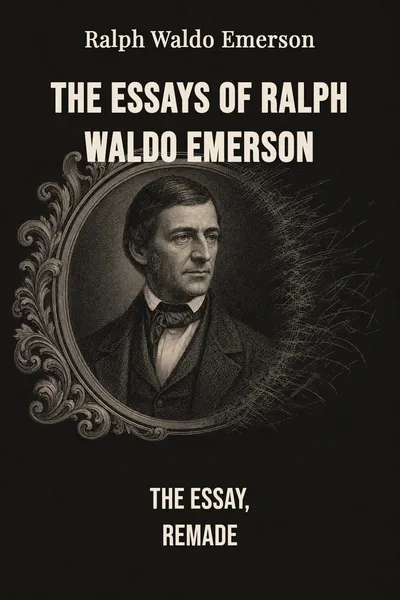
The Essays of Ralph Waldo Emerson
The essay, remade
Description
In the winter of 1841, a former Unitarian minister from Concord, Massachusetts, gathered a stack of pieces he had been reworking for years and published them as Essays: First Series — twelve of them, including one called Self-Reliance that would end up quoted, misquoted, and stitched onto motivational posters for the next two centuries. Ralph Waldo Emerson was thirty-seven. He had already left the pulpit, buried a young wife, toured Europe, and settled into a life of lecturing on the New England circuit. The essays were, in large part, those lectures rebuilt for the page. Three years later came Essays: Second Series, eight more. Together, these twenty pieces are the core of what we now simply call the Essays.
What is easy to miss, reading them today, is how strange they were as objects. An essay in 1841 had a shape people recognized — a thesis, an orderly march of arguments, a tidy landing. Emerson's essays refuse almost all of that. They lurch, double back, contradict themselves inside a single paragraph, and hand you a sentence so complete it seems to have forgotten the sentence before it. The critic Alfred Kazin, introducing them, put it plainly: Emerson was a great writer who turned the essay into a form all his own.
That is the thread worth pulling. Not just what Emerson believed about nature, friendship, self-trust or the divinity of the ordinary — though all of that is here — but what he did to the container those beliefs arrived in. The ideas are radical. The form is arguably more radical still, and it is the form that shaped how the essay has been written ever since.
The question we’re asking : What did Emerson actually do to the essay, and why do these twenty pieces still feel less like arguments than like a mind caught in the act of thinking?What we’ll see : How the lecture hall shaped the page, why his sentences stand apart, what Self-Reliance really asks of a reader, and how the form he built outlived even his ideas.
Table of contents
01Chapter 1 — The lecture that became a page
Before the essays were essays, they were talk. Emerson made his living on the lyceum circuit — a network of lecture halls that had spread across the northern United States in the 1830s, where a paying audience turned out on winter evenings to hear a man reason aloud about virtue, history, or the soul. He delivered hundreds of these lectures, revised them endlessly, and eventually mined them for the printed books. Self-Reliance, Compensation, Spiritual Laws — many of the First Series pieces began as things spoken to a room.
This origin left fingerprints all over the prose. The essays are built to be heard as much as read. They favor the arresting phrase over the connective tissue, the line that lands over the paragraph that explains. When Emerson writes that a foolish consistency is the hobgoblin of little minds, he is doing what a good lecturer does — handing the room something portable, something a listener can carry home without notes. The books are full of these detachable coins.

02Chapter 2 — Sentences that don't hold hands
The most peculiar thing about reading Emerson is a structural one: his sentences do not seem to need each other. A conventional paragraph is a small machine of connected parts, each sentence setting up the next. Emerson's paragraphs read more like a string of independent flares, each blazing on its own. You can lift almost any line out of context and it holds. This is thrilling and, honestly, sometimes maddening — the argument keeps dissolving into aphorism.
Kazin and other readers have pointed to this as the signature of his method. Emerson trusted the sentence more than the paragraph, and the paragraph more than the essay. He believed, and said outright in places, that a genuine thought arrives whole and self-justifying, that it does not require the scaffolding of proof around it. So he wrote in flashes of conviction and let the connections stay implicit, expecting the reader to do the joining. The prose demands a kind of active reading; it will not spoon-feed you a through-line.
03Chapter 3 — Self-Reliance and the argument against consistency
If one essay carries the reputation of the whole book, it is Self-Reliance. Its reputation, though, has been sanded down into something Emerson did not quite write. Read cold, it is far stranger and more demanding than the boot-strap creed it gets mistaken for. Emerson is not telling us to hustle or to trust our appetites. He is arguing that the source of authority is inward, that each person has access to a truth that no institution, tradition, or crowd can supply, and that the great betrayal is conforming to the expectations of others against that inner reading.
The essay's most famous move is its defense of inconsistency. To be great, Emerson says, is to be misunderstood, and a foolish consistency is the hobgoblin of little minds. He is granting himself — and us — permission to contradict today what we insisted on yesterday, because the alternative is to imprison a living mind inside a dead position simply to look coherent. It is a remarkable thing for an essayist to write, since it amounts to warning the reader not to hold the essay's own earlier lines against its later ones.
04Chapter 4 — The essay after Emerson
Step back from the twenty pieces and a larger claim comes into view — the one Kazin was making. Emerson did not just contribute good essays to an existing form; he changed what the form could be. Before him, in the English tradition running from Montaigne through Bacon to the eighteenth-century periodical writers, the essay was a place for graceful, ordered reflection, an argument dressed well. Emerson broke it open. He made the essay a container for a mind in motion, for thinking as it happens rather than thinking after it has finished.
That reinvention is why the Essays outlived their own doctrines. A good deal of Emerson's actual philosophy — his transcendental confidence that nature mirrors the soul, his near-mystical trust in the individual conscience — has aged into something we read as period belief, beautiful but not quite believable. Yet the form he built proved durable in a way the beliefs did not. The personal essay as we now know it, the one that follows a mind's turns instead of a thesis's steps, that trusts the reader to assemble the meaning, descends directly from what he did on the page.
05Conclusion
The former minister who assembled those twelve pieces in 1841, and eight more in 1844, was not trying to build a literary form. He was trying to say true things in the only way he trusted, which was one flaring sentence at a time, without pretending the flares added up to a system they never did. The revisions he kept making until the end were attempts to get each line closer to the perception behind it, not to bolt the lines together.
Related books