The Enchiridion
Freedom through inner control
Description
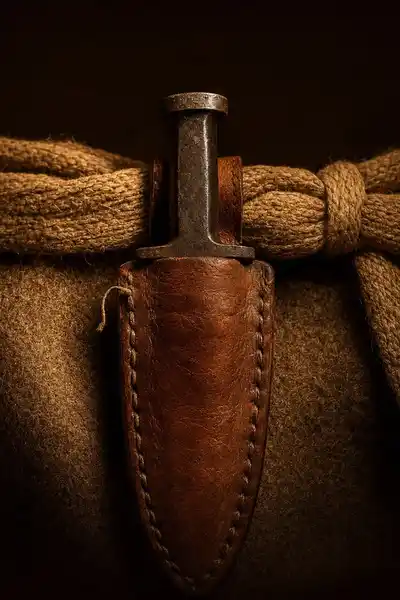
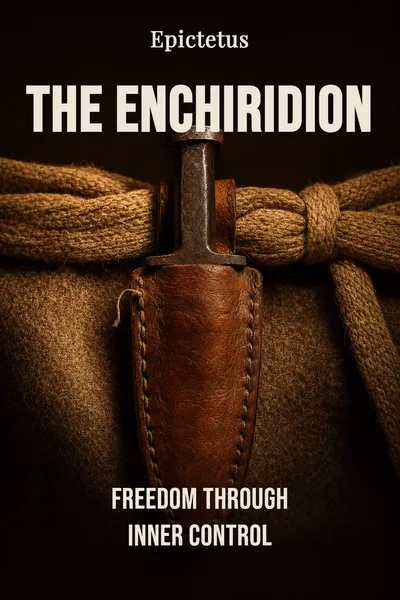
Sometime around the year 125, a man who had spent his early life enslaved in Rome was teaching philosophy in a small town in western Greece. His name was Epictetus, he walked with a limp, he owned almost nothing, and he wrote none of it down. A student named Arrian took notes. Out of those notes came two works — the long Discourses and a short one, the Enchiridion, a word that means both handbook and something you keep close, a dagger you carry on your belt. It runs to barely fifty short sections. We can read the whole thing in under an hour.
That brevity is the point. The Enchiridion is not a treatise arguing anyone into Stoicism; it assumes we are already in trouble and hands us tools. It opens with a single distinction so plain it sounds like nothing: some things are up to us, and some are not. Our judgments, our impulses, our desires belong to us. Our bodies, our reputations, our jobs, other people — those do not, not fully, not ever. Almost everything Epictetus says afterward is a consequence of taking that line seriously.
What makes the little book strange is how cheerful it stays while saying hard things. It tells us that the people we love will die, that we cannot control the sea we sail on, that insults are not injuries unless we agree to be injured. And somehow the effect is not bleak. Epictetus keeps insisting that this is where freedom actually lives — not in getting the world to cooperate, but in the one small territory the world can never reach.
The question we’re asking : If we cannot control what happens to us, where does Epictetus locate the freedom he keeps promising?What we’ll see : How a handful of blunt lessons from a former slave draws the line between what is ours and what isn't — and turns that line into a way to live.
Table of contents
01Chapter 1 — The one distinction that changes everything
The Enchiridion begins where it means to stay. "Of things," Epictetus says in its first line, "some are in our power, and others are not." In our power: opinion, desire, aversion, the movements of our own will. Not in our power: body, property, reputation, office — in short, everything that is not our own doing. It reads like a filing system, and that is roughly what it is. Every situation gets sorted into one of two boxes before we react to it.
The reason this matters is that we routinely file things wrong. We treat our reputation as if it were ours to command, when it lives in other people's heads. We treat our health as a possession rather than a loan. And when the thing we mistook for ours slips away, we feel robbed — because we had, without noticing, staked our peace on something we never held. Epictetus is not being cold here. He is pointing at the exact spot where suffering enters: the gap between what we assume we control and what we actually do.

02Chapter 2 — Desires trimmed to fit what we can reach
Having drawn the line, Epictetus turns to desire, and here the handbook gets demanding. Most of us treat our wants as fixed facts and then chase the world until it satisfies them. He reverses the order. Since desire aims at getting and aversion at avoiding, and since most outcomes are not in our power, unregulated desire is a setup for frustration. The fix is not to want more skillfully. It is, for a time, to want less — to suspend desire almost entirely and practice aversion only toward things that are actually ours to avoid, like our own bad judgments.
This sounds like renunciation, and partly it is, but the aim is not gray detachment. It is to align what we want with what nature actually offers. Epictetus's famous images make the point without a lecture. Life is a banquet: when the dish comes round, take a reasonable portion; if it passes, don't grab; if it hasn't reached us yet, don't strain toward it. Or we are actors in a play whose length and role are chosen by someone else — our only business is to play well the part we're given, not to complain that we wanted a longer one.
03Chapter 3 — The event is neutral, the judgment is ours
The engine of the whole handbook is a single sentence: people are disturbed not by things, but by their judgments about things. Death is not terrible — if it were, Socrates would have found it terrible too. What is terrible is the opinion that death is terrible. Between what happens and how we feel about it, Epictetus inserts a step we usually skip: the verdict we pass, silently and instantly, on the raw event. And that verdict, unlike the event, is ours.
This is the lever that turns the Stoic line from a theory into a practice. When someone insults us, the words alone do nothing; it is our judgment that we have been harmed which does the wounding. When our travel is delayed, the delay is neutral until we rule that it is an outrage. Epictetus does not deny that events are inconvenient. He denies that they carry their emotional charge built in. The charge comes from us, which means it can be examined, and often withdrawn.
04Chapter 4 — A pocket manual for people who never met its author
Step back from the individual lessons and something about the book's whole shape comes into view. The Enchiridion was never meant to be admired. It was meant to be carried, memorized, muttered under one's breath before a difficult meeting or a funeral. That is why it comes in short numbered chunks with no argument connecting them — it is designed for the moment of pressure, not the seminar room. A former slave dictated it, in effect, so that anyone in any circumstance could run the same operating system on the one machine they fully own: their own mind.
There is a quiet radicalism in that. Epictetus had been property; he knew from the inside what it was to have his body, his movements, his whole external life controlled by another. His philosophy is what remains when everything external can be taken: the sovereign inner space of judgment that no owner, no emperor, no accident can reach. This is why the handbook keeps returning whenever life feels ungovernable. Its readers have included Roman emperors and prisoners of war — Marcus Aurelius drew on the same tradition, and the U.S. Navy pilot James Stockdale credited Epictetus with getting him through years in a Vietnamese prison camp.
05Conclusion
The book ends more or less where it began, with a reminder to keep its principles close at hand "as laws that we cannot break without impiety." No grand finale, no summing-up — Epictetus simply tells us to start behaving as though we already understood, because philosophy that stays in the head is not philosophy at all. Arrian's notes preserved a teacher who cared less about being profound than about being useful at the moment life goes wrong.
Related books