
The Anti-Christ
Nietzsche's war on the weak
Description
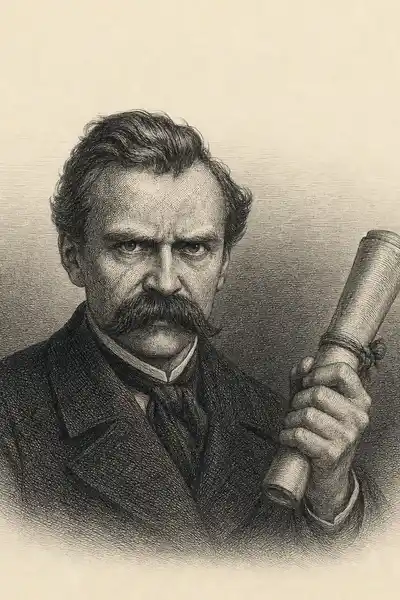
In the autumn of 1888, in a rented room in Turin, Friedrich Nietzsche wrote a short, furious book in a matter of weeks. He was forty-four, already half-forgotten by the reading public, and only months away from the breakdown in a Turin street that would end his working life. The book was called The Anti-Christ, and its first line does not warm up. It sets out to settle accounts. Not with a rival philosopher, not with a bad argument — with Christianity itself, two millennia of it, treated as a single defendant hauled into court.
The charge Nietzsche brings is not the usual one. He is not the village atheist asking whether God exists or whether miracles happened. He grants none of that any importance. His question is stranger and, in his hands, far more aggressive: what kind of human being does a value system produce, and what kind does it destroy? On that measure he finds Christianity guilty of something he considers close to a crime against the species — of having taken the side of the weak, the sick and the failed against everything strong, healthy and self-affirming, and of having called that reversal morality.
It is an ugly, brilliant, deliberately provocative book, and it has been misread in almost every direction since. To read it as Nietzsche wrote it — as a diagnosis of instincts rather than a debate about doctrine — is to meet one of philosophy's most uncomfortable arguments on its own terms, before deciding what to do with it.
The question we’re asking : When a morality is judged not by whether it is true but by the kind of human being it breeds, what does Christianity turn out to have built?What we’ll see : How a book written on the edge of collapse turns a curse into a diagnosis of the instincts still hiding inside our idea of the good.
Table of contents
01Chapter 1 — A book written in a fever, at the edge of the end
The Anti-Christ belongs to Nietzsche's final productive months, a stretch of almost frightening intensity in late 1888. In the same short window he drafted several works, wrote to friends with mounting grandiosity, and produced prose that reads as though the brakes have been cut. The book was finished by September but only published years later, in 1895, after his collapse — which is part of why its reputation arrived tangled up with his sister's later manipulations of his papers. Read plainly, though, it is not the raving of a madman. It is tightly argued, savagely economical, and it knows exactly what it wants to attack.
Nietzsche subtitles it, in effect, a curse upon Christianity, and he means the word. But the anger is methodical. He opens by asking what is good, and answers with a definition that will govern everything after: good is what heightens the feeling of power, of strength itself, in a human being; bad is what comes from weakness; happiness is the sense that power is growing, that resistance is being overcome. From that starting point, any moral system can be judged by a single test — does it make its adherents stronger and more alive, or weaker and more resigned?

02Chapter 2 — What Christianity did to the strong
The core accusation is the reversal of values. Nietzsche imagines an older, aristocratic world in which good simply meant noble, capable, powerful, self-affirming, and bad meant common and weak. Then, he argues, something extraordinary happened: the weak — those with no power to assert in the world — staged a revolt not with weapons but with values. Unable to become masters, they redefined mastery as sin. Meekness became holy, poverty became blessed, suffering became meaningful, and the confident, high-handed type became the wicked one. This is the move he elsewhere calls the slave revolt in morals, and in The Anti-Christ he treats Christianity as its most complete expression.
The result, in his telling, is a civilization that systematically protects and celebrates exactly what natural life would let fall away. The self-preserving instincts of a healthy person — pride, ambition, sensuality, the will to command — get relabelled as temptations. The concept of evil itself, he claims, was assembled out of the strong man's own instincts, so that the very qualities that make a person formidable become the marks of the reprobate, the outcast. Christianity, on this reading, did not conquer the strong by defeating them. It conquered them by making them despise themselves.
03Chapter 3 — The physiology of pity, and the priest who profits
If there is a single feeling Nietzsche puts on trial in The Anti-Christ, it is pity. He treats it not as a warm virtue but as something closer to a contagion. Pity, he argues, preserves what is ripe for decline, multiplies misery by making the healthy person share the suffering of the sick, and drags the strong down toward the level of the weak. Where a robust life instinctively selects, sheds, moves on, pity insists that nothing be let go, that the exhausted and the failed be maintained at the expense of the living. He calls it the practice of nihilism — a slow, tender no said to life while pretending to be its greatest love.
He is careful, though, to distinguish between the sick and the ones who profit from sickness. His real target is not the suffering believer but the priest. Nietzsche portrays the priestly type as a figure of genius in a perverse sense: someone who discovered that power over people could be won not by strength but by their weakness, by making them feel sinful, indebted, in need of salvation that only the priest can broker. Concepts like sin, guilt, grace and the beyond become, in his analysis, instruments of control — a whole imaginary economy in which the priest holds the currency and everyone else is permanently in arrears.
04Chapter 4 — Nietzsche against the two thousand years he inherited
Step back from the polemic and The Anti-Christ stops being merely an attack on a religion. It is an argument about what a civilization decides to protect, and what that decision reveals about the instincts underneath it. Nietzsche's real quarrel is with the entire moral atmosphere he was born into — an atmosphere he thought had been shaped, top to bottom, by Christian assumptions that survived long after belief in God had faded. Equality, compassion for the least, the sacredness of the suffering individual: to him these were not neutral common sense but the descendants of the slave revolt, values that had won so completely they no longer looked like values at all. They looked like reality.
That is the deeper provocation. He is not asking his reader to lose their faith; many of his readers already had. He is asking whether the morality that remained after faith — humanitarian, egalitarian, tender toward weakness — was as self-evident as it felt, or whether it was the long shadow of a religion still governing people who thought themselves free of it. In this sense The Anti-Christ is less about Christianity than about inheritance: how a set of instincts, once installed as morality, becomes invisible and rules from below.
05Conclusion
Within months of finishing The Anti-Christ, Nietzsche broke down in Turin and never wrote again; the book reached print only in 1895, into a world that read it through the wreckage of its author and, later, through his sister's meddling. It arrived as a scandal and has stayed one. Few philosophical works are so easy to quote and so hard to hold, so plainly brilliant and so plainly extreme, all at once.
Related books