
The Age of Napoleon
Europe remade in one man's shadow
Description
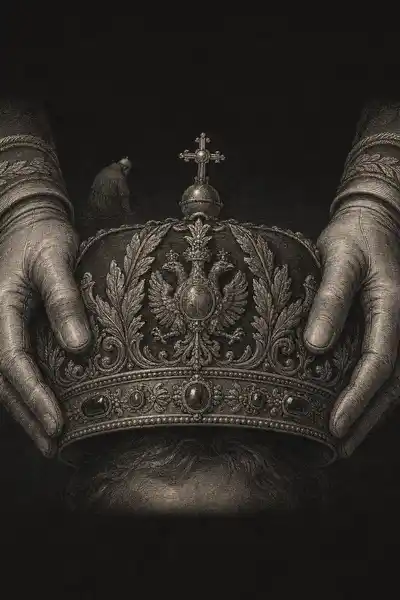
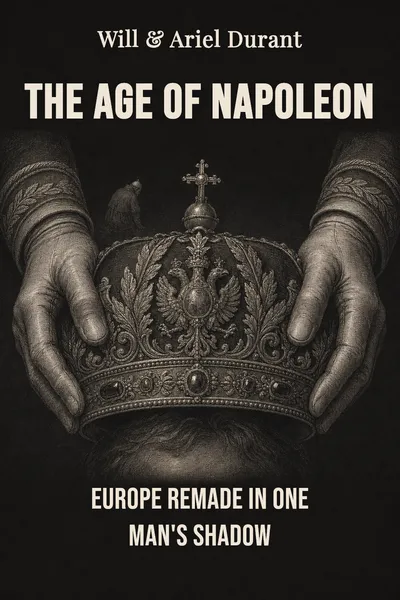
On November 9, 1799, a thin, sallow Corsican artillery officer walked into the Council of Five Hundred at Saint-Cloud, was jostled, nearly fainted, and had to be rescued by his brother Lucien and a line of grenadiers. By nightfall the French Revolution had a master. Napoleon Bonaparte was thirty, and within five years he would crown himself emperor with his own hands while the Pope looked on. For the next decade and a half, the affairs of a continent would arrange themselves around the moods, campaigns, and calculations of this one man.
Will and Ariel Durant close their vast Story of Civilization with this figure, and the choice is deliberate. They could have written a military biography — the battles are famous enough. Instead they wrote something stranger and larger: a portrait of an entire European civilization between roughly 1789 and 1815, with Napoleon as its center of gravity. Kings and chemists, poets and bankers, salon hostesses and starving conscripts all move through the same book, and the man on the throne is only the loudest of them.
What the Durants are after is not the verdict — genius or tyrant, liberator or wrecker — that later generations have argued over. They want the texture of a world: how people ate and married and worshipped and quarreled while one government after another rose and fell, and how a single ambition could reach into a chemist's laboratory and a peasant's field alike. The era carries his name, but the era was never only his.
The question we’re asking : How does one man's shadow fall across an entire civilization — its wars, yes, but also its arts, its sciences, its manners and morals?What we’ll see : A portrait of Europe between the Revolution and Waterloo, held together by the strangest organizing principle a historian can choose: a single life.
Table of contents
01Chapter 1 — The empire built on a ledger
The Durants are careful to show that Napoleon's power did not rest only on victory in the field. The man who took France in 1799 inherited a country exhausted by a decade of revolution, inflation, and civil war, and his first genius was administrative. He reorganized the finances, founded the Bank of France in 1800, and imposed a system of prefects who answered directly to Paris. The Concordat of 1801 made peace with a Catholic Church the Revolution had tried to destroy, not out of piety — his own faith was thin — but because he understood that a governed people needed altars as well as roads.
The great monument of this ordering instinct was the Code Napoléon, promulgated in 1804. It swept away the tangle of local customs and feudal remnants and replaced them with one civil law: property secure, contracts enforceable, careers open to talent, the family firmly under the father. The Durants treat it as the most durable thing he ever built, outliving the empire across much of Europe and shaping legal systems from Louisiana to Latin America. On Saint Helena, dying, he is supposed to have said his true glory was not his forty battles but his Code.

02Chapter 2 — A civilization that kept working while the armies marched
Away from the battlefields, the Durants insist, a whole civilization was going about its business — and much of it was flourishing. These were extraordinary years for French science. Laplace was completing his celestial mechanics; Lamarck was proposing that species change over time; Lavoisier had already remade chemistry before the Revolution took his head. Napoleon himself, an amateur mathematician who liked the company of scientists, endowed prizes and academies and carted scholars along on his Egyptian expedition, where they stumbled upon the Rosetta Stone.
The arts told a more divided story. Painting served the regime through Jacques-Louis David, whose canvases turned the coronation and the crossing of the Alps into imperial theater. But the deeper artistic energy of the age was already slipping out of France's control. In Germany, Goethe and the young Romantics; in England, Wordsworth, Coleridge, Byron, and the composer whose Third Symphony was first dedicated to Bonaparte and then, in fury at the coronation, dedicated to no one — Beethoven scratching the name from the title page.
03Chapter 3 — The mind of an age that couldn't decide about him
The intellectual life of the period, in the Durants' telling, was in large part an argument about the very forces Napoleon embodied. The Enlightenment had promised that reason could reorder the world; the Revolution had tried it and produced both the Rights of Man and the guillotine. Now here was a man who seemed to be reason itself in boots — efficient, secular, contemptuous of superstition — and who had also made himself an emperor and drowned Europe in blood.
Thinkers pulled in opposite directions. Madame de Staël, exiled for her independence, championed a liberalism the emperor could not tolerate and introduced France to the German mind. The conservative reaction gathered force: Joseph de Maistre and others argued that the Revolution had proved the folly of remaking society by abstract principle, that throne and altar were the only ground of order. Across the Rhine, German idealism — Kant's legacy, then Fichte and Hegel — was building philosophies vast enough to make sense of a world turning over. Hegel, watching Napoleon ride through Jena in 1806, called him the world-soul on horseback.
04Chapter 4 — The retreat that ran in both directions
The Durants end their Story of Civilization with Napoleon for a reason larger than any single reign. He is the point where their whole method comes to rest: the conviction that an age can be held in a single frame, and that a life, rightly told, becomes the axis around which economics and art and philosophy and manners can all be arranged. Choose the wrong figure and you get a biography with scenery. Choose the right one and you get a civilization.
What makes Napoleon that figure is the sheer reach of his shadow. The invasion of Russia in 1812 — the Grande Armée that crossed at over half a million and staggered back as a frozen remnant — was not merely a military disaster. It broke a spell that had held a continent, and the recoil ran through everything: national feeling awakened in Germany and Spain, the balance of power redrawn at Vienna, the confidence of an entire generation shaken. A single man's overreach became the pivot of an era.
05Conclusion
He died in 1821 on a wet rock in the South Atlantic, dictating memoirs, refighting old battles in prose, still arranging his own legend. The man who had reordered a continent finished his life measuring the dimensions of a garden he was forbidden to leave. The Durants close on that shrinkage — the enormous will confined at last to a few damp rooms — because it completes the arc they had drawn: the figure who had gathered an age into himself, given back to ordinary human scale.