Social Chemistry
The architecture of connection
Description
Marissa King spent years mapping something most of us carry around without ever looking at directly: the shape of our relationships. As a professor at Yale's School of Management, she studied social networks the way an epidemiologist studies contagion — tracking how prescriptions spread among doctors, how information moves through firms, how influence travels along the invisible lines between people. In 2021 she gathered that work into a book called Social Chemistry, and its premise is disarmingly simple. The people we know are not a random pile of contacts. They form a structure, with a geometry as particular as a fingerprint, and that structure quietly shapes how we feel, what we create, and how far we get.
The word most of us reach for here is networking, and it usually makes us wince. It conjures name tags, forced small talk, the transactional handshake at a conference we didn't want to attend. King's book pushes against that flinch. She argues that our networks are not something we build through strategic effort so much as something we already have — a pattern we've been assembling since childhood, often without noticing. And that pattern, she shows, is doing real work on our lives whether we attend to it or not.
What makes the book unusual is that it treats connection as a subject for measurement, not just sentiment. King brings network science — nodes, ties, the mathematics of who links to whom — to a domain we normally leave to intuition and self-help. The result is a way of seeing friendship, work, and community that feels both scientific and strangely intimate, as if someone had handed us the blueprint to a house we've lived in all along.
The question we’re asking : If the shape of our relationships is quietly steering our lives, what does that shape actually look like — and can we redraw it?What we’ll see : How network science turns the fuzzy idea of connection into a visible structure, and what that structure does to the people inside it.
Table of contents
01Chapter 1 — Three ways of holding a network
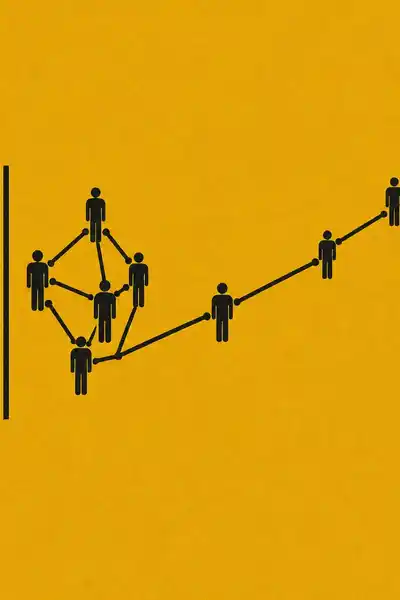
King opens with a claim that reorganizes the whole conversation: most of us fall into one of three networking styles, and we usually don't know which one we are. She calls them expansionists, brokers, and conveners. The labels sound like jargon, but each describes a genuinely different way of holding relationships together, with its own strengths and its own quiet costs. The point isn't that one is correct. It's that we tend to inhabit ours unconsciously, the way we inhabit an accent.
Expansionists are the people with enormous networks — hundreds of contacts, a gift for being known and liked, a name that circulates. They radiate energy and pull others toward them. But King is careful about the trade-off: the expansionist's ties tend to be thinner, harder to maintain, and the sheer volume can leave the person at the center feeling curiously unknown. Being connected to everyone is not the same as being close to anyone.

02Chapter 2 — The measure hidden between people
To make any of this rigorous, King leans on a discipline that treats relationships as data. Network science doesn't ask whether someone is charming or trustworthy in the abstract; it asks about position. Where does a person sit in the web of connections? How many ties do they hold, how strong are those ties, and — the crucial question — how connected are their connections to each other? That last measure, which researchers call closure or density, turns out to explain a startling amount.
The intellectual lineage here matters, and King tells it as story rather than citation. The sociologist Mark Granovetter, in the early 1970s, noticed that people rarely found jobs through their closest friends. They found them through acquaintances — the weak ties that reached into other social worlds. The finding was counterintuitive enough to become one of the most cited ideas in the social sciences: the people at the edge of our lives often deliver more novel opportunity than the people at the center. Ronald Burt later built on this with the notion of structural holes — the gaps between clusters that brokers profitably span.
03Chapter 3 — What good networks actually do for us
The reason any of this is worth mapping is that the shape of a network does measurable work on the people inside it. King marshals evidence that our social structure feeds into three things we tend to care about deeply: well-being, creativity, and success. And the surprising part is that these three don't all want the same kind of network. What nourishes one can starve another.
Well-being, she argues, tends to grow in denser, convener-style networks — the tightly woven circles where people know and are known, where support arrives without being asked for. Loneliness, one of the quieter epidemics she addresses, is often less about the number of people we know than about the absence of this kind of overlapping, mutually reinforcing closeness. A person can have a thousand contacts and still lack the dense pocket of ties that actually holds a life together.
04Chapter 4 — The architecture we can redraw
Step back from the three styles and the measurements, and King's larger argument comes into focus. Our social lives have a design, and for most of us that design is invisible precisely because we're standing inside it. We experience our relationships as a series of individual bonds — this friend, that colleague, this old acquaintance — and rarely as a whole with a shape. Social Chemistry is an attempt to lift us out of the structure long enough to see its outline. The move is closer to architecture than to advice.
The word architecture is doing real work in her framing. A building's floor plan determines how people move through it, who runs into whom, where conversation happens and where it doesn't — usually without anyone consciously deciding. Our networks operate the same way. The distribution of our ties channels information toward us or away from us, exposes us to certain ideas and shields us from others, places us near some opportunities and far from the rest. We feel the effects as luck or temperament. King insists they are largely structural.
05Conclusion
King's book returns us, in the end, to the flinch it began with. Networking felt distasteful because we imagined it as accumulation — more contacts, more handshakes, more reach. What she offers instead is a way of seeing the connections we already carry as a coherent structure, one with real consequences for our health, our ideas, and our sense of belonging. The expansionist, the broker, the convener are not personality types to be graded but starting positions to be understood, each with its own gifts and its own blind spots.
Related books