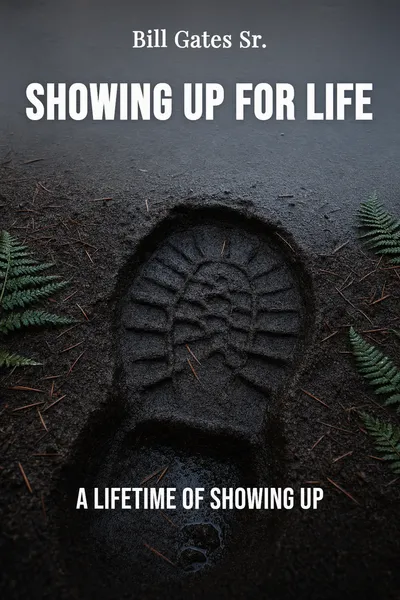
Showing Up for Life
A lifetime of showing up
Description
There is a photograph people like to bring up when they talk about Bill Gates Sr.: a very tall man, six foot six, standing beside a son who became one of the richest people alive, and a daughter-in-law who runs one of the largest charitable foundations on earth. But the man himself would rather start somewhere less dramatic. He would start in Bremerton, Washington, in a furniture store his father ran, during the years when money was scarce and a family measured its worth by whether it turned up when it was needed. Showing Up for Life, the memoir he published in 2009 at the age of eighty-three, opens in that register and never really leaves it.
The title is not a slogan. It is close to a whole philosophy compressed into three words. Gates Sr. spent a long career as a Seattle lawyer, helped build a respected firm, raised three children, buried a wife he adored, and then, well past the age most people retire, took a desk at the Bill & Melinda Gates Foundation and went to work on malaria and vaccines and libraries. Through all of it, he keeps returning to a single unglamorous idea: that most of what matters in a life is a matter of presence — being there, again and again, for the people and the causes that ask it of you.
The book is affectionate and a little old-fashioned, and it makes no pretense of being a management manual or a self-help program. It is a father and grandfather setting down what he learned, in the order he learned it, so that it might outlast him. What gives it its quiet force is that the man writing it has watched those small domestic habits scale up to a fortune spent on global health — and found that the principle held.
The question we’re asking : What does a man who watched his son build Microsoft and then gave his own years to a foundation actually count as the substance of a good life?What we’ll see : A childhood shaped by scarcity, the household values that came out of it, and how those same values traveled from a Seattle dinner table to the scale of global philanthropy.
Table of contents
01Chapter 1 — The tall boy from Bremerton
William Henry Gates Sr. was born in 1925 in Bremerton, a Navy town across Puget Sound from Seattle. His father ran a furniture store, and the family lived close to the shop, close to the customers, close to the ordinary transactions that made a small-town living. This is where the book plants its roots, and Gates Sr. is deliberate about it. He wants the reader to understand that everything that came later — the law firm, the fortune in the family, the foundation — grew out of a modest household that had no idea what was coming.
He was, from early on, conspicuously tall, and he writes about that with the wry honesty of a man who spent decades being the largest person in most rooms. Height made him visible whether he wanted to be or not, and something about that shaped his sense of responsibility: if people are going to see you, you had better be worth seeing. He was not a prodigy. He was a steady, dutiful boy who did his chores, joined the Scouts, and absorbed the expectations of a community where reputation was built slowly and lost fast.

02Chapter 2 — What the Depression taught a household
The values that run through the book are the ones a Depression-era household passed down almost without speaking them. Thrift, but not stinginess. Work, but in service of something. Above all, the sense that a person belongs to a web of obligations larger than himself — to family first, then to neighbors, then to the town, then outward. Gates Sr. learned these things not as maxims but as the texture of daily life, and that is why he trusts them. They were tested by scarcity and they held.
Chief among them was the plain conviction that you turn up. When a relative was sick, someone went. When the community needed volunteers, the family put its name forward. Gates Sr. describes a childhood in which absence was close to a moral failure — where the measure of a person was whether they could be counted on to be present, physically and reliably, when presence was what the situation demanded. It sounds almost too simple, and he knows it does. He argues, gently, that the simplest things are the ones people most often skip.
03Chapter 3 — The rules he never wrote down
When Gates Sr. turns to raising his own children, the book softens into something like a family album, and this is where its warmth is most obvious. He married Mary Maxwell, a woman he describes with unmistakable devotion, and together they built a home in Seattle around dinner-table conversation, high expectations, and a refusal to let privilege breed entitlement. He is honest that the children — including the son who would build Microsoft — were spirited, argumentative, and not always easy. He counts that a good thing.
The parenting philosophy is less a set of rules than a set of habits absorbed by example. The Gateses expected their kids to read, to think, to compete, and to serve. Mary in particular was a force in Seattle civic life, deeply involved in the United Way and in volunteer work, and the children grew up watching their parents give time to causes that returned nothing but the satisfaction of having helped. Gates Sr. is clear-eyed that this modeling did more than any lecture could have. Children learn what a good life looks like by watching one being lived.
04Chapter 4 — A foundation is a family habit at scale
The last third of Gates Sr.'s life is the part the world knows, and it is where the book quietly makes its largest claim. When his son and daughter-in-law began giving away an extraordinary fortune, they asked him to help run it. He said yes, and in his seventies he became co-chair of the Bill & Melinda Gates Foundation, applying himself to childhood vaccines, malaria, and public libraries with the same steadiness he had once brought to a Seattle law practice. What the book suggests, without ever announcing it, is that the leap from a family dinner table to global health is smaller than it looks.
The through-line is that presence scales. The instinct to turn up for a sick relative and the decision to fund vaccine programs for children on the other side of the world are, in his telling, the same instinct wearing different clothes. Philanthropy at that magnitude could easily become abstract — spreadsheets, metrics, distance. Gates Sr. keeps dragging it back to the human encounter: the field visits, the mothers, the specific children. He insists on seeing the work up close, because seeing up close is what showing up has always meant to him.
05Conclusion
Bill Gates Sr. wrote Showing Up for Life as a man in his eighties looking back, and it reads that way — unhurried, grateful, occasionally amazed at where an ordinary Bremerton childhood ended up. The furniture store, the war, the Seattle law firm, the marriage to Mary, the raising of three children, the long afternoon of philanthropy: he lines them up not as a ladder of achievement but as a single continuous act of turning up. He died in 2020 at ninety-four, having spent his last decades doing exactly what the title promised.
Related books