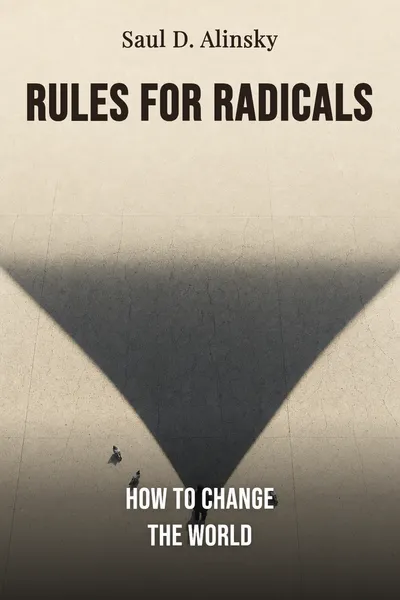
Rules for Radicals
How to change the world
Description
In 1971, a sixty-two-year-old organizer from the South Side of Chicago sat down to write a short book for people who wanted to change the world and had no idea how. Saul Alinsky had spent three decades in the neighborhoods — organizing packinghouse workers behind the stockyards, then Black communities on the West Side, then anyone who would answer the door in the towns where he was invited. He had a reputation as an agitator and a knack for making powerful people furious. What he did not have, and what the young radicals of the late sixties seemed to him to lack most of all, was patience. So he wrote down what he had learned. He called it Rules for Radicals.
The book arrived at a strange moment. The energy of the decade was curdling. Students who had marched for civil rights and against Vietnam were drifting toward a politics of gesture — burning flags, adopting slogans, treating anger as if it were a strategy. Alinsky, who had spent his life on the losing side of most fights, watched this and worried. He had seen what it looked like when righteous people accomplished nothing, and he wanted to tell the next generation the one thing nobody was telling them: that having the right values is not the same as knowing how to win. The book is his attempt to close that gap, dedicated, famously and provocatively, to Lucifer — the first rebel who at least got his own kingdom.
More than half a century later, the book keeps getting read, quoted, and misquoted by people on every side of the political map. Both the left and the right have claimed it and denounced it. Part of the reason is that Alinsky refused the comfortable pieties of his own camp. He was a radical who insisted on working inside the system, a moralist who wrote coldly about tactics, an idealist who despised naïveté.
The question we’re asking : What does it actually take to move power from the people who have it to the people who don't — and what did Alinsky mean by asking radicals to be realistic rather than rhetorical?What we’ll see : An organizer's hard-won account of how ordinary people build the power to change their own lives, and why he thought that work was the truest form of American democracy.
Table of contents
01Chapter 1 — The world as it is, not as we wish it were
Alinsky begins with a distinction he returns to on every page: the difference between the world as it is and the world as we would like it to be. Radicals, he argues, tend to live in the second one. They start from their ideals and then feel betrayed when reality refuses to cooperate. The organizer who wants to accomplish anything has to start from the first — from people as they actually are, motivated by self-interest, distrust, fear, and the ordinary desire for a better life, not from an imagined citizenry already burning with justice.
This is not cynicism, and Alinsky is careful about that. He is not saying people are bad. He is saying that if you want to organize them, you have to meet them where they live, in their kitchens and their grievances, and not where you wish they lived. The organizer who lectures a struggling community about the historical dialectic will be shown the door. The one who asks what is making their lives miserable, and offers a plausible way to fight back, gets invited in for coffee.

02Chapter 2 — Power is not a dirty word
The word that makes people flinch, Alinsky notes, is power. Good people talk about justice, dignity, and love, but they treat power as something dirty, something that belongs to the other side. This squeamishness is, in his view, a disaster. Power is simply the ability to act, to make things happen. The powerful have never been shy about it. If those who want change refuse to touch the word, they concede the only currency that decides anything.
There are, he says, only two sources of power: organized money and organized people. The wealthy have the first. Everyone else has, potentially, the second — but only if they organize. A poor community that stays a collection of frightened individuals has no power at all. The same community, once it acts together, can face the landlord, the city, the corporation, on something closer to equal terms. The whole craft of the organizer is turning the powerlessness of scattered people into the power of a group with a common purpose.
03Chapter 3 — The rules of the game
The most quoted part of the book is the set of tactical rules, and they read like a strategist's field notes. Power, Alinsky writes, is not only what you have but what the enemy thinks you have. A small group that acts as if it commands thousands can force concessions from an opponent who cannot be sure. The corollary is to never go outside the experience of your own people, and always to go outside the experience of the enemy. Confusion, in his world, is a weapon.
His favorite rules turn on ridicule and patience. Ridicule, he says, is man's most potent weapon — there is no defense against it, and it enrages the target into overreacting. A good tactic is one your people enjoy; a tactic that becomes a chore is already dead. And a threat is usually more terrifying than the thing itself. He tells the story of planning a mass occupation of an airport's bathrooms to embarrass a city that had ignored a Black community — a plan that never had to be executed, because the mere rumor of it brought officials to the table. The point was made without a single toilet being used.
04Chapter 4 — What a democracy asks of the people who believe in it
Read only for its tactics, Rules for Radicals looks like a manual for causing trouble. Read whole, it is something less expected: a defense of the American democratic tradition, written by a man who thought that tradition was dying of neglect. Alinsky's radicalism was not a program for overthrowing the system. It was an argument that the system only works when ordinary people know how to use it — and that most of them had forgotten, or never learned.
This is why he insisted on working inside the country's own language and its own founding promises. He quotes the Declaration and the Founders not as decoration but as the standard he holds the present up to. A democracy, in his view, is not a set of institutions that run themselves; it is a permanent, noisy negotiation among organized groups, and it stays healthy only as long as new groups keep learning to organize and enter the argument. When the poor and the excluded have no power, the negotiation is rigged, and the democracy is one in name only. His whole life's work was teaching people to claim their place in that argument.
05Conclusion
Alinsky died in 1972, the year after the book appeared, of a heart attack on a street in California. He never saw how thoroughly it would outlive him — read in classrooms and campaign offices, cited by community organizers and by the politicians who feared them, claimed and attacked by movements he would have found unrecognizable. The Chicago organizer who wrote for a handful of young radicals ended up writing for everyone who has ever stood outside a locked door and wondered how to open it.
Related books