Principia Mathematica
Logic's greatest fortress
Description
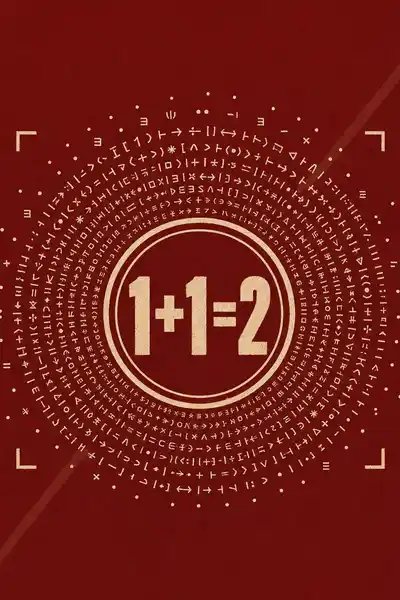
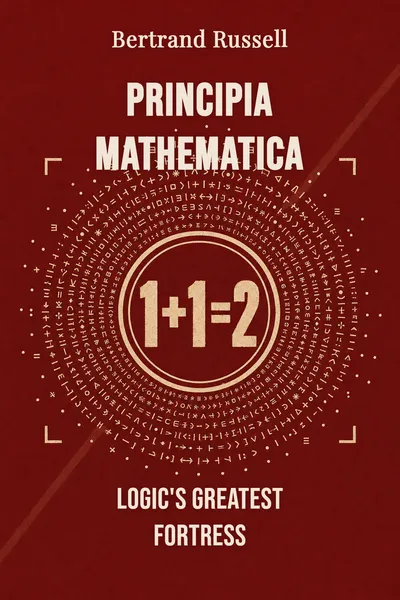
Somewhere around page 379 of the first volume, after a chain of definitions and symbols most readers will never follow, there is a proposition that establishes, with full rigor, that one plus one equals two. Bertrand Russell and Alfred North Whitehead attach a dry note observing that the result "is occasionally useful." The joke, if it is one, sits at the center of the strangest ambition in the history of thought: to prove, from nothing but logic, the truths that every schoolchild already takes for granted. The three volumes of Principia Mathematica, published between 1910 and 1913, set out to show that all of mathematics could be derived from a handful of purely logical axioms, without smuggling in a single mathematical assumption.
The scale of the attempt is hard to overstate. Russell and Whitehead worked for roughly a decade, and the manuscript grew so large that the pair reportedly wheeled it to Cambridge University Press in a handcart. Cambridge agreed to publish only after the Royal Society contributed to the costs; the authors themselves lost money on it. Almost nobody read it cover to cover. And yet it became one of the most consequential books of the twentieth century — not because it succeeded on its own terms, which it largely did not, but because of the questions it forced everyone who came after to confront.
We tend to imagine mathematics as the most secure of all human knowledge, the place where certainty lives. Principia was an attempt to make that intuition literally true — to lay a foundation so solid that no doubt could reach it. What happened when two of the sharpest minds of their era tried to build logic's greatest fortress, brick by symbolic brick, is a story about how far reason can reach and where it stops.
The question we’re asking : Can the whole of mathematics really be grounded in nothing but logic, and what happens when you try?What we’ll see : A decade-long attempt to rebuild arithmetic from the ground up, and the reckoning that followed when the ground turned out to have a crack in it.
Table of contents
01Chapter 1 — Three volumes, one impossible promise
The project began with a wound. In the late 1890s, mathematicians were increasingly worried that their field rested on shaky ground — intuitions about infinity, number and set that nobody had ever rigorously justified. The German logician Gottlob Frege had tried to fix this by reducing arithmetic to logic. Russell, reading Frege's work, found a contradiction that brought the whole edifice down. It became known as Russell's paradox: consider the set of all sets that are not members of themselves. Is that set a member of itself? Either answer contradicts the other. Frege received the letter as his own second volume was going to press and replied, with real grace, that the foundation of his life's work had given way.
Russell could have left it there. Instead he decided the repair was worth attempting on a grander scale. Together with Whitehead, his former Cambridge tutor, he set out to derive not just arithmetic but as much of mathematics as they could reach — from axioms that were, they insisted, purely logical. The word "purely" carried the whole weight of the enterprise. If a single genuinely mathematical assumption crept in, the reduction would be circular and the certainty they wanted would evaporate.

02Chapter 2 — Building number out of nothing
At the heart of the whole undertaking sits a question that sounds almost childish: what is a number? We use "two" constantly, yet defining it without already assuming what a number is turns out to be genuinely hard. You cannot say two is "one and one more" without helping yourself to counting, which is the very thing you are trying to explain. Russell and Whitehead needed a definition of number that reached down to something more basic than number itself.
Their answer, inherited and refined from Frege, is elegant once you see it. Start not with numbers but with the idea of a class — a collection of things — and with the notion of two classes being matchable, one to one, without remainder. The fingers on a hand match the players in a string quintet; each finger pairs off with exactly one player and none is left over. Any two collections that can be paired like this share something, and that something is their number. The number three, on this account, just is the class of all classes that can be matched one-to-one with any given trio. Number is not a thing you count with; it is a property that all equinumerous collections have in common.
03Chapter 3 — The proof that took three hundred pages
To understand why Principia moves so slowly, it helps to picture what proof means inside it. In ordinary mathematics, a proof is a persuasive argument aimed at a competent reader who will fill in the obvious gaps. In Principia there are no gaps and no competent reader is assumed — only the axioms and the rules for moving from one line to the next. Every inference is a formal step, licensed by something already established. The book is less an argument than a machine, grinding from primitives toward theorems without ever appealing to intuition to close a distance.
The cost of this rigor is length, and length of a peculiar kind. Because each concept must be constructed before it can be used, the early volume spends its bulk laying pipe — defining classes, relations, the apparatus of the theory of types — long before anything recognizable as arithmetic appears. Whitehead handled much of the technical architecture, Russell much of the philosophical framing, though the collaboration was so close that they often could not say afterward who had written what. What emerged was a text where the interesting results sit atop a vast, mostly invisible substructure of preliminary machinery.
04Chapter 4 — When certainty stopped being the point
The fortress had a structural flaw, and it was not the paradox Russell had already walled out. In 1931, a young Austrian logician named Kurt Gödel proved something that the whole spirit of Principia had assumed away. Any formal system rich enough to contain arithmetic — Principia emphatically included, since Gödel framed his result partly in its terms — must contain true statements it cannot prove, and can never prove its own consistency from within. The dream of a complete, self-justifying foundation was not merely unfinished. It was impossible. No fortress of this kind could ever seal its own gates.
It would be easy to read this as defeat, and in one sense it was: the specific goal of grounding all mathematics in logic, with certainty guaranteed from the inside, cannot be reached. But the more interesting lesson is what the attempt revealed by failing so precisely. Principia mapped, with a thoroughness nobody had managed before, exactly how much of mathematics logic could carry — and its very rigor gave Gödel the material he needed to show where the carrying had to stop. The book became the clearest possible demonstration of a limit precisely because it pushed against that limit harder than anything before it.
05Conclusion
The handcart that carried the manuscript to Cambridge Press was hauling a paradox of its own: a book that failed at what it set out to do and became indispensable anyway. Russell and Whitehead wanted to prove mathematics safe forever, to close every gap through which doubt might enter. What they built instead was the most exact demonstration ever produced of how far that ambition can go — and the precise point at which it can go no further. The proof that one plus one equals two still sits on its page, earned at enormous cost, occasionally useful.
Related books