

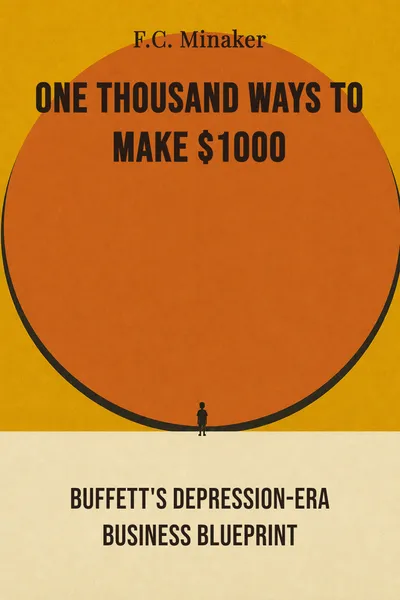
One Thousand Ways to Make $1000
Buffett's Depression-era business blueprint
Description
In 1941, an eleven-year-old in Omaha pulled a book with a bright, almost cartoonish premise off a library shelf. The title promised something specific and slightly absurd: one thousand ways to make one thousand dollars. The boy was Warren Buffett, and by his own account he read it cover to cover, more than once. F.C. Minaker's book had first appeared in 1936, in the middle of the Great Depression, when a thousand dollars was real money and the idea of making it yourself was closer to survival than ambition. The boy finished it and announced, with a confidence that reads as either charming or deranged depending on the decade, that he would be a millionaire by thirty-five.
He beat the deadline. And for the rest of his life he pointed back to that book, and specifically to one thing it planted in him: the feel for compound interest, the sense that money left alone to grow does something quietly monstrous over time. Minaker was not a famous economist. His book was not a theory of markets. It was a plain, chatty manual of schemes — how to run a lunch counter, how to sell to farmers, how to rent things to shops that could not afford to buy them. Most of it has aged into something between a period piece and a curiosity.
And yet the man who is arguably the most successful investor in history keeps naming it as the thing that switched a light on. That is the puzzle worth sitting with. A Depression-era how-to book, long out of print, full of goat-dairying tips — and somehow the blueprint under it survived every decade of finance that came after.
The question we’re asking : How did a plain-spoken 1936 manual of money-making schemes end up shaping the mind of the century's most famous investor?What we’ll see : We follow the book from the library shelf into Buffett's head, and dig into what stayed useful long after the schemes themselves went quaint.
Table of contents
01Chapter 1 — The book an eleven-year-old pulled off the shelf
Picture the object first. One Thousand Ways to Make $1000 is a fat, dense book — well over four hundred pages — and it does not open with philosophy. It opens with the assumption that the reader is broke, or close to it, and would very much like not to be. Minaker writes the way a friend leans across a table: direct, encouraging, occasionally scolding, never abstract. The tone is the same one Dale Carnegie would ride to fame the following year with How to Win Friends and Influence People. Both books share a conviction that ordinary people, given the right nudge and a little nerve, could change their circumstances by their own effort.
That conviction mattered enormously in 1936. The country was years into the Depression. Unemployment was still brutal, savings had evaporated, and the dominant emotional register was one of having been failed by forces too big to argue with. Into that mood, Minaker's book made a stubborn counter-claim: you can still do something. Not because the economy was fine — it plainly was not — but because opportunity, in his telling, is less a matter of conditions than of noticing. Someone always needs something. The person who spots the need and organizes to fill it makes the thousand dollars.

02Chapter 2 — Money begins where the fear ends
Before Minaker gets to any specific venture, he spends a long stretch on the reader's own head. The obstacle, he argues, is rarely a lack of capital or a lack of ideas — those can be found. The obstacle is the private conviction that money-making is for other people. He returns to this again and again: the man who waits for perfect conditions, for enough savings, for permission, waits forever. The book is unusually blunt that starting small and starting scared is normal and fine, and that the alternative to starting is simply not making the thousand dollars.
This is where the Carnegie kinship shows most clearly. Minaker treats selling not as a slick trick but as a form of service and attention. His entire theory of the customer is that people buy from those who understand what they actually want, and that understanding is a discipline anyone can practice. He is contemptuous of the hard sell and warm toward the seller who listens, follows up, remembers a name, delivers a little more than promised. The relationship, in his framing, is the asset. A satisfied customer is not the end of a sale; it is the beginning of the next ten.
03Chapter 3 — Goats, billiard tables, and the math underneath
The famous ventures are the ones that make modern readers smile. Minaker really does explain goat dairying — the economics of the herd, the market for the milk, the margins a careful operator could expect. He walks through manufacturing motor-driven chairs. He lays out, in genuine detail, how to buy billiard tables and rent them to bars, pool halls, and clubs that wanted the draw but could not front the cash. There is advice on running a roadside stand, on breeding rabbits, on a dozen small enterprises that read now like a museum of a vanished economy.
It would be easy to file all of this under nostalgia and move on. But that misses what Minaker is doing. Each scheme is a worked example, and the example is not really the point — the structure is. The billiard-table idea, stripped of the felt and the smoke, is a lesson about capital: you buy an asset once and rent access to it many times, so the same dollar earns again and again while you sleep. The goat dairy is a lesson about recurring revenue and about knowing your true costs. The roadside stand is a lesson about location, footfall, and impulse.
04Chapter 4 — Why the quaint examples aged better than the flashy ones
The strange durability of Minaker's book comes from a distinction it never states outright but embodies on every page: the idea is disposable, the fundamentals are not. Ventures rot. The market for motor-driven chairs vanished, goat dairying became a niche, billiard halls thinned out. If the book had been a list of good ideas, it would have died with its decade, and Buffett would have nothing to point back to. It survived because underneath the ideas sat things that do not expire — the arithmetic of margins, the logic of recurring income, the compounding of reinvested gains, the primacy of the customer relationship.
This is why the quaint examples aged better than a slicker, more contemporary book would have. Precisely because Minaker's specifics are so obviously of their time, the reader is forced past them to the reasoning, the way you stop hearing the accent and start hearing the argument. A book that felt modern would tempt you to copy its answers. A book that feels antique makes you learn its method, because the answers are plainly unusable. The datedness is not a flaw in the teaching; it is what makes the teaching stick.
05Conclusion
The copy that mattered went back on a library shelf in Omaha, and the boy who read it went on to become the reason anyone remembers the book at all. One Thousand Ways to Make $1000 stayed out of print for decades, a period curiosity kept alive mostly by biographers explaining where the compounding obsession came from. It was never a great work of economics. It was a plucky, crowded, deeply practical manual written to help frightened people in a broken decade do something for themselves.