
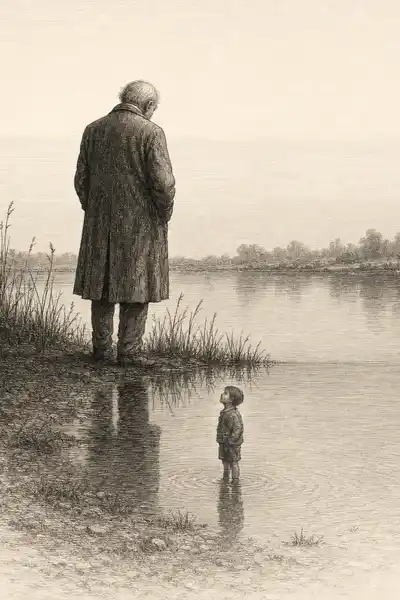
Memories, Dreams, Reflections
Jung's life in his own words
Description
In 1957, when he was eighty-one, Carl Jung sat down with his colleague Aniela Jaffé and began to talk. Not about theory, not about the complexes and archetypes that had made him one of the most famous psychiatrists alive, but about his own life — the dreams that had frightened him as a boy, the voices he had heard, the visions that had nearly overwhelmed him in middle age. The conversations, recorded over several years and shaped into a book Jaffé helped assemble, became Memories, Dreams, Reflections, published in 1962, the year after Jung died in Küsnacht. It is the closest thing he left to an autobiography, and it is unlike almost any autobiography ever written.
Most memoirs are a record of what happened: the schools, the marriages, the professional milestones, the famous people met along the way. Jung's book does something stranger. He tells us, early and plainly, that the outward events of his life have always seemed to him thin and unsatisfying, and that the real story is the one that unfolded inside — in his dreams, his fantasies, his encounters with what he called the unconscious. His break with Freud gets a chapter; a dream of a house with buried floors gets nearly as much space. He is trying to write the biography of a psyche.
The result is a document that reads at times like confession, at times like myth, and asks us to take seriously a proposition most of us quietly resist: that the inner life is not decoration on top of the real one, but the thing itself. Coming from the man who spent sixty years studying the mind, the claim carries a particular weight — and a particular vulnerability, since he is offering himself as the case.
The question we’re asking : What does it mean to tell the story of a life from the inside — through its dreams and visions rather than its public events?What we’ll see : How a founder of modern psychology chose to remember himself, and why he trusted his inner experience over the record of what happened to him.
Table of contents
01Chapter 1 — A childhood built around a secret
Jung was born in 1875 in Kesswil, on Lake Constance, the son of a Swiss Reformed pastor. The house was full of religion and quiet unease. His mother, he tells us, seemed to him to have two personalities — a warm, ordinary daytime self and a second, uncanny presence that would surface at night and say things that unsettled a small boy. He came to feel he had two selves as well: Personality Number One, the schoolboy living in the present, and Personality Number Two, an old, authoritative figure who belonged to another century and understood things the child did not.
This split, which he describes without embarrassment, organizes the whole account of his early years. As a boy he carved a small manikin, wrapped it in a scroll of his own secret language, and hid it in the attic — a private ritual he told no one about for decades, and which he only later recognized in the initiation objects of distant cultures. The point is not the oddness of the act but that Jung experienced his inner world as real, populated, and demanding, long before he had any framework to explain it.

02Chapter 2 — The break with Freud, and the descent that followed
Jung's professional life began at the Burghölzli psychiatric hospital in Zurich under Eugen Bleuler, where his work on word-association tests brought him early recognition. In 1906 he began corresponding with Freud, and their first meeting the next year was famous for its intensity: they talked, by Jung's account, for some thirteen hours. Freud treated the younger man as a son and chosen heir, the one who would carry psychoanalysis beyond its Viennese circle. For several years Jung wore that role.
But the account he gives of the friendship is also the account of its cracking. He could not accept Freud's insistence that sexuality was the foundation of everything, nor Freud's tendency, as Jung saw it, to guard the theory the way one guards a religious dogma. A telling moment: Freud once asked him to promise never to abandon the sexual theory, to make of it a bulwark against what Freud called the black tide of occultism. Jung heard in that request not science but fear. Around the same time, sitting with Freud, he felt a strange heat in his diaphragm and predicted a loud noise in the bookcase — which duly came, twice. Freud was unnerved; Jung took it as evidence of forces neither of them controlled.
03Chapter 3 — The unconscious speaks in symbols
Out of that long descent came the raw material of Jung's mature psychology, and the book lets us watch the ideas grow from experience rather than descend from theory. A recurring dream of his own house — comfortable upper rooms giving onto a medieval floor below, and beneath that a cave with ancient bones — became his image for a mind layered like geology, with a personal self resting on far older, shared foundations. That intuition of a common substratum beneath individual minds became what he called the collective unconscious.
In the fantasies of those years he met figures who seemed to have wills of their own: a wise old man he named Philemon, who told him that thoughts were like animals in a forest, encountered rather than produced. Jung took this seriously. It taught him, he says, that the psyche contains more than the ego makes, and that these autonomous figures — later generalized into archetypes — recur across myths, religions, and the dreams of patients who had never read a page of mythology. He was not inventing a system so much as noticing a pattern that kept appearing.
04Chapter 4 — A life told from the inside out
Step back from the episodes and the shape of the book itself becomes the real argument. Jung warns us at the start that he cannot write the ordinary kind of memoir. Careers, travels, quarrels — the furniture of most biographies — feel to him almost weightless. What he can vouch for are the inner events: the dreams, the visions, the slow work of becoming what he called the self. So he organizes a life not by its dates but by its turning points of meaning, and lets the outer facts appear only when an inner one requires them.
This is a bold choice, and worth naming as a choice. A man who spent his life persuading the world that the unconscious was real ends by staking his own biography on that reality. If the inner life is only froth on the surface of the brain, then Memories, Dreams, Reflections is the ramblings of an old man. If it is what Jung believed — the deepest layer of what a person is — then the dreams he records are not softer evidence than the facts, they are harder. The book is his final experiment, performed on himself.
05Conclusion
Jung died in 1961, and the book appeared the following year, assembled from his conversations, his own written chapters, and the sections Aniela Jaffé shaped from years of talk. He had been reluctant about the project and never fully treated it as one of his official works, which is part of what gives it its particular honesty. The theorist of the archetype turns out, at the end, to be a man returning again and again to a monstrous figure he dreamed at three, to a house with buried floors, to the voices he could not explain and refused to explain away.