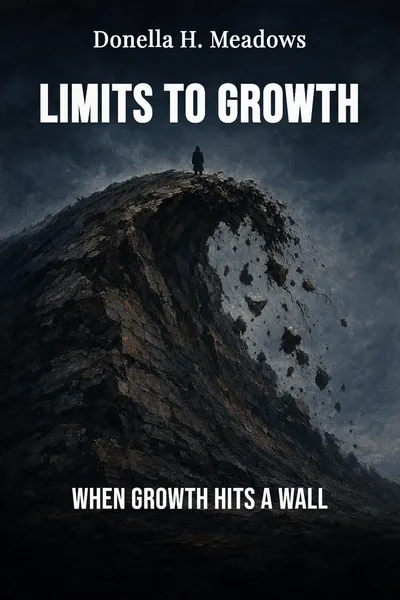
Limits to Growth
When growth hits a wall
Description
In 1972, a slim paperback landed on desks around the world with a title that sounded almost too plain: The Limits to Growth. Behind it stood a team of researchers at MIT, led by Donella Meadows and her colleagues, who had done something few had tried at that scale — they built a computer model of the whole planet. Not a country, not an economy, but the entire tangle of population, food, industrial output, pollution, and the raw materials the earth holds. They called the model World3, and they asked it a deceptively simple question: what happens if humanity keeps growing the way it had been growing?
The answer unsettled a great many people. Run the standard assumptions forward, and the curves that had been climbing for a century — more people, more factories, more consumption — did not climb forever. They peaked, then turned down, sometimes sharply, somewhere in the twenty-first century. The report sold in the millions and was translated into dozens of languages. Governments cited it, economists attacked it, and a whole genre of argument about whether the earth could sustain endless expansion took shape around its pages. Half a century later, more than ten million copies have circulated, and the book remains a reference point whenever the conversation turns to whether our economy can keep expanding on a finite world.
It is easy to remember the book as a doomsday pamphlet, and easy to dismiss it the same way. Neither reading is quite fair. What Meadows and her co-authors produced was less a prophecy than a way of thinking — a claim about how a finite planet and a growth-driven civilization interact over time. The predictions were the part everyone argued about. The method was the part worth keeping.
The question we’re asking : What did a computer model of the entire planet actually say would happen if growth continued unchecked?What we’ll see : How a handful of researchers modeled the world as a single system, what its most famous scenario really claimed, and why the argument outlived the numbers.
Table of contents
01Chapter 1 — A computer, a club, and a question about the future
The project began not at MIT but with a loose network of industrialists, scientists, and civil servants who called themselves the Club of Rome. Founded in 1968, the group was preoccupied with what they termed the world problematique — the sense that population, resources, pollution, and economic growth were no longer separate issues but a single knotted problem no government was equipped to see whole. They wanted someone to study the tangle as a whole. They found their researchers in a team at MIT working under Jay Forrester, a systems engineer who had pioneered a technique for modeling how complex feedback-driven systems behave over time.
Donella Meadows, a biophysicist by training, led the writing team alongside her husband Dennis Meadows, Jørgen Randers, and William Behrens. Their tool was World3, a model that linked five global quantities and let them influence one another: population, food production, industrial output, pollution, and the stock of nonrenewable resources. The point was not to forecast any single number with precision. It was to watch how the whole thing moved once you connected the parts and let them run forward for a century or more.

02Chapter 2 — How a world behaves like a system
The genuinely new thing in the book was not the gloom. It was the insistence that the world should be understood as a system — a web of quantities connected by feedback, where a change in one place ripples through the rest and comes back around. This was the discipline Forrester had built, and Meadows made it the spine of the argument. Once you see the world this way, the behavior that follows is not a matter of opinion. It falls out of the structure.
Two features of that structure did most of the work. The first was exponential growth. Population and industrial output do not grow by fixed amounts each year; they grow by a percentage of what already exists, which means they double, and double again, at a steady rate. A quantity growing at a few percent a year looks gentle for a long while and then, quite suddenly, becomes enormous. Meadows liked to illustrate this with the old riddle of the lily pond that doubles its cover each day and is only half covered the day before it is entirely full. The danger of exponential growth is that the crisis looks distant until it is upon you.
03Chapter 3 — The overshoot scenario, and what it actually predicts
The scenario everyone remembers is the one the authors called the standard run — sometimes described as business as usual. It assumed no dramatic changes in policy or behavior: population and industry keep growing, resource use keeps climbing, technology improves at roughly historical rates. In that run, industrial output per person peaks in the early part of the twenty-first century, food and population follow it down, and the model shows a decline steep enough to qualify as collapse before the century is out. This is the graph that made the reputation, for better and worse.
It is worth being precise about what the book did and did not claim, because the misreadings run deep. The authors were emphatic that the standard run was not a prediction of the future. It was one scenario among several, meant to show what the structure produced under a particular set of assumptions. They ran other scenarios too — doubling the estimate of available resources, adding pollution controls, boosting agricultural yields, stabilizing population. In several of those runs, collapse still arrived; it simply arrived by a different route, because relieving one limit let growth press harder against another.
04Chapter 4 — What a fifty-year-old model still measures
The instinct, fifty years on, is to grade the book against the calendar: did the world end on schedule? It did not, and the authors never said it would, which makes that scorecard the wrong one. The more honest test is whether the way of seeing the world holds up — whether thinking in stocks, flows, feedback, and delay still explains the trouble we find ourselves in. On that test, the book has aged remarkably well, and in some respects it reads as more relevant now than in 1972.
Consider climate change, which barely figured in the original text. It is, structurally, exactly the kind of problem World3 was built to describe: a stock of pollution accumulating faster than the system can absorb it, with a long delay between cause and effect, driven by growth that the signals arrive too late to check. The book did not predict global warming by name, but it described the shape of the problem — overshoot with a lag — decades before that shape had a household word attached to it. The same can be said for the erosion of soils, the depletion of aquifers, the collapse of fisheries. Each is a limit felt late.
05Conclusion
Donella Meadows spent the rest of her life extending the argument she helped begin, writing and teaching about systems until her death in 2001, and the team returned twice — in 1992 and 2004 — to update the model against three decades of real data. The updates did not overturn the original picture so much as sharpen it: the world, on the whole, had kept tracking the growth-heavy scenarios rather than the stabilized one. The curves the paperback drew in 1972 turned out to be a reasonable sketch of the path we actually took.
Related books