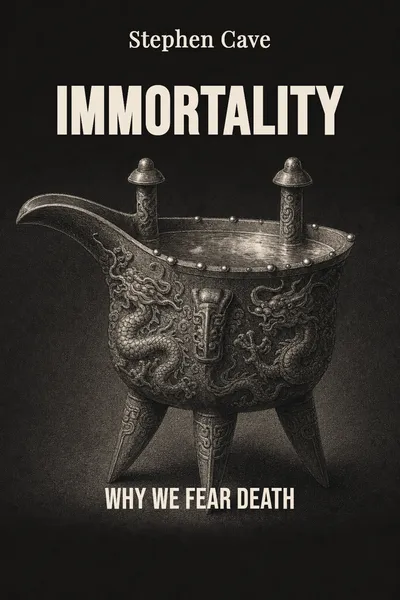
Immortality
Why we fear death
Description
Around 210 BCE, the first emperor of a unified China sent expeditions across the sea in search of a plant said to confer eternal life. Qin Shi Huang had built roads, a currency, the early spine of the Great Wall — and he wanted to enjoy it forever. His court alchemists brewed elixirs, some of them laced with mercury. The emperor drank them faithfully. The mercury, most historians think, is roughly what killed him, at forty-nine, on a journey east, still chasing the island where the herb was supposed to grow.
It is easy to feel superior to a man who poisoned himself trying not to die. But the philosopher Stephen Cave, in his book Immortality, argues we are all running the same errand, only with better branding. We diet, we pray, we freeze our tissue, we carve our names into buildings — and underneath it all sits the same refusal Qin Shi Huang couldn't shake. Civilizations, Cave suggests, are elaborate machines built to talk us out of the one fact we cannot metabolize: that we end.
What interests Cave is that the strategies barely change across millennia and continents. Strip away the costumes and there are only a handful of stories a human being has ever told about beating death, and every religion, every wellness trend, every dream of digital upload is a variation on one of them. Naming those stories, and asking why they never quite work, is where the book earns its unease.
The question we’re asking : Why does a creature that knows it will die spend its whole history refusing to believe it?What we’ll see : How the oldest human wish keeps returning in the same few shapes, and what happens when we look straight at the reason it never lets go.
Table of contents
01Chapter 1 — The body that refuses to end
The simplest immortality story is the most literal: just don't die. Cave calls it the Staying Alive narrative, and it is the oldest and stubbornest of them all. It assumes the body we have is the self worth keeping, and that with enough ingenuity we might keep it going indefinitely. Qin Shi Huang's herb, the medieval alchemists' philosopher's stone, the fountain of youth Ponce de León is legend to have hunted — all of it is the same bet placed in different currencies.
The bet has never gone away because it feels the most plausible. Every other strategy asks us to believe in a soul, a resurrection, a heaven. This one only asks us to believe in medicine, and medicine has a track record. Life expectancy in the wealthy world roughly doubled over the last two centuries. Diseases that emptied villages are now footnotes. If we pushed mortality back that far, the reasoning goes, why not push it all the way to the wall and then through it?

02Chapter 2 — Death as a door, not a wall
When the body clearly fails — and it always does — the next story concedes the death and denies its finality. Cave calls it Resurrection: the belief that this same person, flesh included, can be destroyed and then brought back. It is the wager at the heart of Christianity, where the promise is not a ghostly survival but the literal rising of the body, and it appears in Islam and in strands of Judaism too. Death becomes a door rather than a wall, a passage you walk through and out the other side, intact.
The appeal is obvious. Resurrection lets you keep everything the Staying Alive story loved about the body while admitting the body will die. You don't have to escape mortality; you only have to survive it. For much of Western history this was not a metaphor but the plainest expectation of what would happen — Cave notes that early Christians buried their dead carefully, whole, facing east, precisely because they expected those bodies to be needed again.
03Chapter 3 — The part of us that isn't the body
If the body is the problem — too fragile, too easily scattered — then the obvious move is to stop identifying with it. This is Cave's third story, the Soul: the belief that the real self is not the perishable flesh at all but something immaterial that the flesh merely carries for a while. When the body drops away, the essential you floats free. It is the most widespread immortality narrative on earth, threaded through Hinduism, Buddhism, Platonism, and most of popular Christianity, and it has an elegance the others lack.
Its power is that it sidesteps every physical objection at once. No herb needed, no atoms to reassemble. If the self was never made of matter, matter's decay cannot touch it. Plato argued the soul must be immortal because it grasps eternal truths that the changing world cannot contain; countless traditions since have located the true person in a spark, a breath, an atman that the grave simply cannot reach.
04Chapter 4 — The name that outlives the man
The fourth story gives up on personal survival and settles for the echo. Cave calls it Legacy: the hope that though the self dies, something of it persists in the world — a name remembered, a book still read, a child who carries the blood, a monument that outlasts the hand that raised it. Achilles chose a short life and lasting glory. Qin Shi Huang, when the elixirs failed, left behind a terracotta army and a wall you can see from the sky. If we cannot last, perhaps our fame or our works or our descendants can stand in for us.
But underneath all four stories, Cave locates a single engine, and Legacy is where its strangeness shows most plainly. He calls it the Mortality Paradox. We know, as no other animal seems to, that we will die — the knowledge is the price of being able to think about the future at all. And yet we cannot actually imagine our own non-existence. Try to picture the world with no you in it and there is still, sneaking in at the edge, a you doing the picturing. The mind is structurally unable to represent its own absence. So we hold two incompatible convictions at once: I will die, and I cannot really be gone.
05Conclusion
Qin Shi Huang got his terracotta army and his wall, and neither did him any good where he was going. Cave's book walks through the four stories humanity has told to unmake death — the enduring body, the resurrected body, the deathless soul, the surviving name — and finds each one buckling at the same joint, the place where the mind refuses to picture its own end. The strategies are ancient and modern, religious and technological, and they are all, at root, the emperor drinking his elixir with total conviction.
Related books