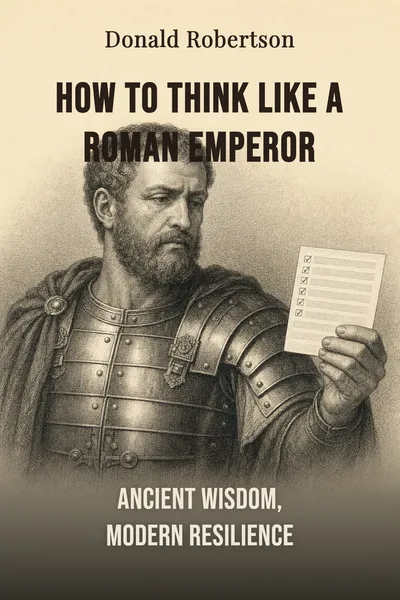
How to Think Like a Roman Emperor
Ancient wisdom, modern resilience
Description
On March 17, 180 AD, in a military camp near the Danube, a sixty-year-old man died of what was probably plague, having spent much of the last decade of his life fighting wars he had never wanted on the empire's cold northern frontier. His name was Marcus Aurelius, and he had been the most powerful person in the Western world. He is remembered less for anything he built than for a private notebook he kept in Greek, by lamplight, in the field — a set of reminders to himself that he never meant anyone to read. We call it the Meditations. It is one of the strangest documents to survive from antiquity: not a philosophy addressed to students, but a man coaching himself through fear, grief, irritation, and the daily prospect of his own death.
Donald Robertson, a cognitive psychotherapist who trained in the very techniques he writes about, noticed something that the reverent editions tend to miss. Marcus was not writing beautiful maxims. He was doing exercises. The repetitions, the odd turns of phrase, the returning to the same worries again and again — these look less like literature and more like the homework a therapist gives a patient between sessions. Robertson's book reads the emperor's notebook the way a clinician would read it, and the resemblance to modern practice turns out to be uncomfortably close.
That resemblance is the wager of the whole project. Stoicism spent centuries filed under "admirable but impractical," the creed of men who suppressed their feelings and called it virtue. Robertson argues almost the opposite: that Marcus offers a working method for handling the emotions we actually have, tested under conditions most of us will never face.
The question we’re asking : Can a dead emperor's private notebook actually function as a manual for handling fear, anger, and loss today?What we’ll see : How a Roman's self-directed exercises map onto techniques a modern therapist would recognize — and where the resemblance stops.
Table of contents
01Chapter 1 — A boy who chose his own teachers
Marcus was born in 121 AD into a wealthy Roman family, and by an accident of imperial politics he was marked out for the throne while still a child. The emperor Hadrian arranged the succession so that Marcus would eventually rule; the boy grew up knowing he was being groomed for absolute power. What Robertson finds telling is how Marcus responded to a childhood most people would have found intoxicating. He seems to have treated the privilege as a hazard rather than a prize.
The first book of the Meditations is a long list of thank-yous — a debt to each person who taught him something worth keeping. He credits one relative for teaching him not to take sides at the chariot races, another for a plain way of living, a tutor for showing him how to bear pain and want little. Robertson reads this as more than gratitude. Marcus was cataloguing the character he wanted, borrowing traits from real people he had watched, building himself deliberately out of models rather than drifting into whatever a young prince naturally becomes.

02Chapter 2 — The therapy hiding in the Meditations
Robertson's day job is treating people with anxiety, anger, and depression using cognitive behavioral therapy, the most evidence-backed talking treatment we have. CBT rests on a simple claim that Marcus would have found familiar: it is not events that disturb us, but our judgments about events. Epictetus had said exactly this, and the founders of cognitive therapy in the twentieth century, notably Albert Ellis and Aaron Beck, openly credited the Stoics as their ancestors. The book is not drawing a loose parallel. It is tracing a real line of descent.
The core technique is what Marcus does constantly in the notebook: catch a distressing impression before it hardens into a conviction, then examine it. When Marcus tells himself that a rude man at court is simply behaving according to his own nature, that his rudeness cannot touch Marcus's own character, and that Marcus will meet him without being dragged into anger — that is, almost line for line, the cognitive restructuring a modern therapist teaches. You separate the raw event from the story you tell about it, and you test the story.
03Chapter 3 — Rehearsing the worst before it arrives
The most counterintuitive Stoic exercise is also the one Marcus practiced most, and Robertson spends real time on it because it sounds, at first, like a recipe for misery. The Stoics called it the premeditation of adversity: deliberately picturing the setbacks, losses, and even the deaths that might come, calmly, in advance. Modern instinct says this is catastrophizing. The Stoics argued the opposite — that facing a hardship in the imagination, unhurried and by choice, drains it of its power to ambush you.
Marcus had every reason to practice it. He lost several children in infancy, buried his co-emperor and his most trusted general, endured years of war and a devastating plague, and lived with the knowledge that the throne corrupted almost everyone who held it. In the notebook he rehearses these blows before they land. He reminds himself each morning that he will meet the ungrateful, the arrogant, the dishonest, so that when he does, he is not surprised into rage. He reminds himself that those he loves are mortal, so that love does not curdle into panic at the thought of loss.
04Chapter 4 — The emperor who never wanted a statue
Step back from the individual techniques and something about Marcus comes into focus that explains why Robertson can hand him to a modern reader so cleanly. The Meditations was never meant to be published, quoted, or admired. It was maintenance — the private upkeep of a mind under pressure, done for no audience and no reputation. This is the opposite of how philosophy usually reaches us, as a system built to persuade or a performance staged to impress. Marcus was not performing Stoicism. He was using it, alone, and forgetting to make it presentable.
That private quality is precisely what makes the book portable. A doctrine written to convince you asks for your agreement; a set of exercises asks only whether they work. Robertson's whole method depends on this. He is not asking readers to convert to an ancient worldview or to accept every metaphysical claim the Stoics made about the cosmos. He is pointing at a man who left behind his actual practice notes and saying: here is what he did when he was afraid, here is what he did when he was angry, try it and see. The gap between admiring Marcus and using Marcus is the gap the book is built to close.
05Conclusion
The man who died in the camp near the Danube left behind no monument he had intended. He left a notebook of reminders, written to steady a mind that faced war, plague, betrayal, and grief without the option of stepping away. Robertson's achievement is to read that notebook for what it plainly is — a working method — rather than for its polish, and to show that the emperor's private exercises line up, with unsettling precision, against techniques a psychotherapist would recognize and defend today.
Related books