
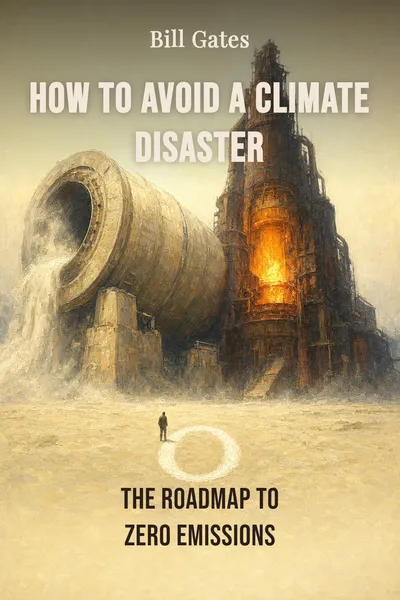
How to Avoid a Climate Disaster
The roadmap to zero emissions
Description
In 2015, Bill Gates started asking a question that would eat the next several years of his life. He was sitting with scientists, energy researchers, the people who model the atmosphere for a living, and he kept coming back to the same two numbers. The planet adds roughly 51 billion tons of greenhouse gases to the air every year. To stop the warming, that figure needs to reach zero. Not lower. Zero. A software billionaire turned philanthropist, Gates admits the obvious objection right away: he flies on private jets and owns big houses, which makes him a strange messenger. He decided the honest move was to write the book anyway, and to make it about systems rather than about his own carbon footprint.
The book that came out of that, published in early 2021, is not a work of despair and not a work of cheerleading. It is closer to a spreadsheet with a pulse. Gates treats climate change the way he once treated software problems: break the thing into parts, find where the numbers actually live, and refuse to be impressed by solutions that feel good but move nothing. The result cuts against a lot of comfortable intuitions. The sectors we obsess over turn out to be smaller than we think, and the ones we ignore turn out to be enormous.
What makes the book worth reading is not that Gates has a secret answer. It is that he insists on doing the arithmetic before offering one, and the arithmetic changes the conversation. Getting to zero, on his account, is less a story about willpower and more a story about cost, invention, and who pays for what.
The question we’re asking : If the target is zero and not merely less, what would it actually take to get there?What we’ll see : How Gates counts the emissions, why the hard sectors are the ones we rarely discuss, and what he thinks moves the needle.
Table of contents
01Chapter 1 — Fifty-one billion, and then zero
Two numbers anchor the entire book, and Gates repeats them until they stick. Fifty-one billion is roughly how many tons of greenhouse gases humanity pumps into the atmosphere in a normal year. Zero is where we need to land. He is careful about that word. Zero does not mean a modest reduction, or a plateau, or a peak followed by a gentle decline. Because carbon dioxide lingers for a very long time, slowing our emissions still means the total in the air keeps climbing. To actually stop the warming, we have to stop adding to the pile — get the net figure down to something near nothing.
This reframing does quiet but heavy work. A lot of climate talk celebrates progress measured in percentages: emissions down a tenth, a country hitting an interim goal. Gates does not dismiss those steps, but he keeps pulling the frame back to the finish line. A 30 percent cut, on its own, is a slower path to the same crisis. The only target that ends the problem is zero, and once we accept that, the question stops being how do we do less and becomes how do we rebuild the systems that emit in the first place.

02Chapter 2 — The five things nobody thinks about
Ask most people where emissions come from and they say cars, or maybe electricity. Gates lays out a breakdown that rearranges the furniture. He sorts human activity into five buckets. Making things — cement, steel, plastic — accounts for about 31 percent. Plugging in, meaning electricity, is around 27. Growing things, which is farming and land use, is roughly 19. Getting around, all transport combined, is about 16. And keeping warm and cool, the heating and air conditioning of buildings, is close to 7.
The lesson lands the moment you look at the order. Transportation, the sector that dominates the public conversation and the electric-car headlines, is fourth on the list. The single biggest slice is manufacturing the physical stuff of civilization, and it is the part almost nobody argues about at dinner. Cement is the example Gates keeps returning to. The chemistry of making it releases carbon dioxide as an inevitable byproduct — it is not a matter of running the kiln on cleaner power, because the reaction itself emits. And the world pours a staggering amount of concrete, much of it for the cities that developing countries are still building.
03Chapter 3 — The Green Premium is the whole game
The most useful idea in the book is a phrase Gates coins and then applies relentlessly: the Green Premium. It is simply the extra cost of choosing the clean version of something over the dirty one that does the same job. Jet fuel made from plants instead of petroleum costs more per gallon. Zero-carbon cement, where it exists, costs more per ton. The Green Premium is that gap, and Gates treats it as the single best diagnostic for where we stand.
Where the premium is small or zero, the clean option can win on its own, and adoption is mostly a matter of will and policy. Where the premium is large, no amount of moral urgency will make the world switch, because the poorer countries doing most of the future building simply cannot afford to pay double for concrete. So the real work, in Gates's framing, is driving those premiums down — and in some sectors there is no affordable green option at all, which means the premium is effectively infinite and we have to invent our way out.
04Chapter 4 — Rich countries pay, poor countries build
Step back from the technology and a harder argument surfaces, one Gates keeps circling even as he talks about kilns and grids. Climate change is, underneath the engineering, a problem of fairness. The countries that emitted the most getting rich are not the ones who will suffer the most from the warming. The heaviest costs fall on people near the equator, often farmers, often poor, who did almost nothing to cause the problem and have the least capacity to adapt to floods, droughts, and failing harvests.
That asymmetry drives Gates's insistence that the rich world's job is not to lecture but to pay — to fund the research, to eat the early Green Premiums, to buy down the cost of clean technology until it becomes the obvious, cheapest choice everywhere. The developing world will keep building cities, growing food, and demanding electricity, exactly as the wealthy world did before it. The moral and practical goal is to make sure that when they build, the clean version is already affordable. A just transition, in his telling, is not charity; it is the only version of the transition that reaches zero.
05Conclusion
The book closes where it opened, on those two numbers. Fifty-one billion tons a year, and a target of zero. Everything in between — the five sectors, the Green Premiums, the case for research and for helping poorer nations build clean — is Gates trying to turn an overwhelming abstraction into a set of problems that can be worked on one at a time. He does not promise it will be easy, and he does not pretend a single invention will save us. He offers instead a way of keeping score that survives contact with reality.