Hons and Rebels
A rebel from the cradle
Description
In the drawing rooms and drafty attics of Swinbrook, the Redesdale family seat in the Cotswolds, six sisters and one brother grew up in the 1920s under a father who distrusted schools, foreigners, and most of the human race. Lord Redesdale — "Farve" — ran his house like a small, tweed-covered kingdom. There was no formal education for the girls, few outside friends, and a linen cupboard warm enough to serve as headquarters for a secret society of children who called themselves the Hons. Into this closed world the sixth child, Jessica, was born in 1917, and almost from the start she wanted out.
The Mitford children scattered in directions that would make the family a fixture of twentieth-century notoriety. Nancy became a celebrated novelist. Diana left her first marriage for Oswald Mosley, leader of British fascism. Unity crossed to Germany and attached herself, catastrophically, to Hitler's inner circle. Deborah became a duchess. And Jessica, raised on the same aristocratic boredom, went the opposite way entirely — toward communism, elopement, and a running fight with everything the name Mitford stood for.
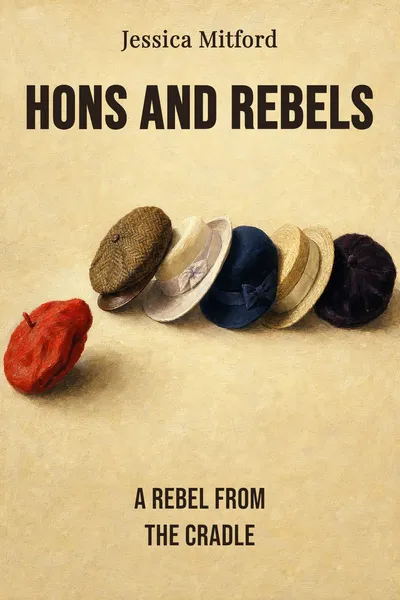
Written in 1960, her memoir "Hons and Rebels" tells that story from inside the family that produced it. It is funny where you expect it to be bitter, tender where you expect settling of scores. And it treats her own escape not as a heroic break but as the most natural thing in the world — as natural, she says, as learning to shoplift, or falling in love with a young man she had never met.
The question we’re asking : How does a girl raised in one of England's grandest and most sheltered households end up running away to a civil war?What we’ll see : We follow Jessica Mitford out of the linen cupboard, into an elopement, across an ocean, and up to the edge of a world war.
Table of contents
01Chapter 1 — Growing up between the Hons' cupboard and the swastika
The household Jessica describes runs on rules nobody else could quite follow. Farve keeps the children away from schools because he thinks education makes girls' ankles thick. Muv — Lady Redesdale — believes in the "Good Body" and its capacity to heal itself without doctors. Between them they raise their daughters in a bubble where the outside world arrives mostly as rumour, and where the sisters invent their own private language, their own society, their own running jokes to fill the empty hours. The warm airing cupboard becomes the meeting place of the Hons, and the word "Hon" — half a play on "Honourable," half on the hens they kept — becomes the code of their small resistance.
Boredom, in Jessica's telling, is the great engine of the house. With no school, no career, and no prospect but a good marriage arranged among people exactly like themselves, the girls are left to entertain each other and to grow, slowly, into whatever they will become. She starts a "running-away fund," squirreling money into an account against the day she can leave. She teaches herself, with a kind of cheerful matter-of-factness, how to shoplift. The idea that any of this is shocking never seems to occur to her; it is simply what one does when there is nothing else to do.

02Chapter 2 — The boy she loved before she met him
Long before she met him, Jessica had decided on Esmond Romilly. He was a nephew of Winston Churchill, a runaway from his own respectable world, and by his late teens something of a public scandal — he had bolted from school, published a rebellious little magazine, and gone off to fight for the Republic in the Spanish Civil War. To a girl planning her own escape from Swinbrook, he was less a person than a destination. She followed his exploits in the papers the way other girls followed film stars, and she made up her mind that she would find a way to Spain and to him.
So she pulled strings. When Esmond came back to England on leave, wounded and briefly famous, Jessica engineered a meeting through cousins, and the plan she had built in her imagination survived contact with the real young man. They understood each other at once — two children of privilege who found their own class faintly absurd and could not stop laughing about it. When he prepared to return to Spain, the question of whether Jessica would go too was hardly a question at all. She went.
03Chapter 3 — Blueblooded babes in Hobohemia
Marriage did not bring money, and the young Romillys never expected it to. Back in London after Spain, they gathered around themselves an odd, cheerful crowd of friends and lived on almost nothing at all — a condition Jessica treats less as hardship than as the natural climate of their life together. They had left the world of butlers and shooting parties, and they had no intention of going back to it, even when going back would have solved every practical problem they had.
The last third of the memoir carries them across the Atlantic to America, and it is here that the book fully earns its comedy. An American newspaper once described them as "blueblooded babes in Hobohemia" — a phrase that infuriated the babes in question and that Jessica repeats with obvious relish. They knock about the country broke and undaunted. Esmond takes lessons so he can go door to door selling stockings; later he tends bar in Miami. They turn up as house guests badly in need of a shave and a dinner jacket, yet somehow perfectly well known to the butler who opens the door.
04Chapter 4 — When a childhood ends with a war
What lifts "Hons and Rebels" out of the category of a lively family memoir is the way one household became a map of the whole political fracture of the 1930s. It was common enough for a generation to be split by fascism and communism; it was rare for the split to run through a single set of sisters who had shared a nursery, a language, and an airing cupboard. The Mitfords make the abstraction of the decade painfully concrete. Diana and Unity turned toward Berlin; Jessica turned toward the barricades; and none of them, in the end, could keep the argument at the dinner table.
Jessica's book is, among other things, an attempt to explain how this happened without pretending to fully understand it. She keeps returning to the boredom, the isolation, the sense of being raised for nothing in particular — as if the same vacuum that made her a rebel had made her sisters into something far darker. She does not excuse Unity or Diana, but she does insist on their shared origin, which is more unsettling than any condemnation would be. The rebellion and the fascism grew from the same soil.
05Conclusion
The memoir ends in Washington, with Jessica waiting for her child and Esmond gone to fight the war they had both, in their different ways, been arguing toward all their lives. Readers of the book know what Jessica, on its final pages, was still learning: that Esmond was killed in action, lost over the North Sea, fighting for a world he had so thoroughly enjoyed. The young man she had loved before she met him did not come back, and the running-away years came to a sudden, unforgiving stop.