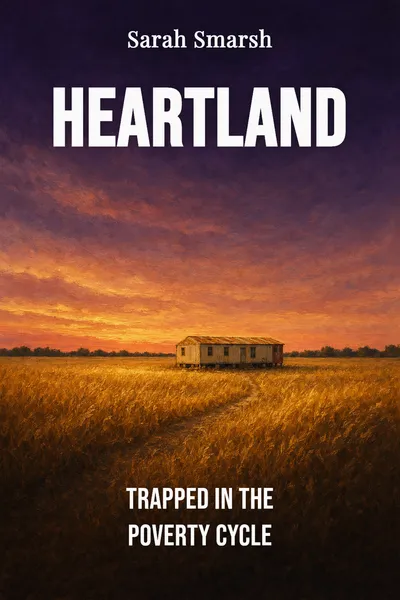
Heartland
Trapped in the poverty cycle
Description
Sarah Smarsh spent her childhood on a wheat farm outside Wichita, Kansas, in the 1980s and 1990s, in a family where the women had a habit of getting pregnant young and the men had a habit of leaving or breaking. She was the daughter of a teenage mother who was herself the daughter of a teenage mother, a chain that ran back generations. Her grandmother Betty had married and divorced several times before Sarah was old enough to count them. The land, the trucks, the double-wides, the physical bodies worn down by labor — this was the world she was born into, and she was determined not to add another link to the chain.
Years later, working as a journalist, Smarsh wrote a book about all of it. The narrative device she chose is unusual and easy to underestimate: she addresses the whole account to a child she never had, the daughter she decided, at great cost, not to conceive as a teenager the way every woman before her had. That unborn child becomes the reader Smarsh is trying to spare, and the mirror she holds up to her own family. The book, published in 2018, was a finalist for the National Book Award, and it did something rare — it made the American class divide feel like a body, not a statistic.
What it refuses to do is treat poor people as a problem to be diagnosed from a distance. Smarsh grew up hearing that people who earn less are worth less, that hard work is rewarded, that anyone stuck at the bottom must have made bad choices. She had watched her family work harder than almost anyone she would later meet, and stay poor anyway. The gap between what the country said about people like her and what she lived is the whole subject.
The question we’re asking : Why did a family that worked relentlessly stay poor across generations, and what does that reveal about who the country decides to see?What we’ll see : A childhood in rural Kansas told as the story of a class — its women, its labor, its wages, and the mark poverty leaves on a person long after the paycheck clears.
Table of contents
01Chapter 1 — The girl who wasn't supposed to be born
Smarsh opens with a fact she cannot quite forgive and cannot quite regret: she almost wasn't born, and neither was almost everyone she loves. The women in her family conceived early, often by accident, often in relationships that fell apart under the weight of money and drink. Her mother, Jeannie, was seventeen when Sarah arrived. Her grandmother Betty had Jeannie at a similarly young age. The pattern wasn't a moral failing so much as a groove worn smooth by circumstance — few options, little sex education, marriages entered into fast and left faster.
The unborn daughter she writes to is the counterweight to all of this. Smarsh explains that she carried this imagined child through her teenage years like a talisman, a reason to say no when the groove pulled her toward the same early motherhood. Naming that child, speaking to her, was how a girl with almost no models of a different life kept one alive in her head. The book's tenderness comes from this: it is written to someone who was never allowed to exist precisely so that she could escape.

02Chapter 2 — Five generations of women running a farm and a household
The book's center of gravity is its women. Smarsh traces a line of them — great-grandmother, grandmother Betty, mother Jeannie, herself — and the men come and go around this line like weather. It was the women who held households together, who worked jobs and raised children and managed the impossible arithmetic of a paycheck that didn't reach the end of the month. Betty worked in a courthouse and had a mouth on her; Jeannie tried retail, real estate, whatever might lift them a rung. Their labor was doubled: paid work outside, unpaid work inside, and no acknowledgment of either.
Smarsh is careful not to romanticize these women. They could be volatile, absent, wounded in ways that wounded their children. Jeannie's restlessness meant Sarah moved constantly, never sure which house or which school was next. But the instability wasn't character; it was the shape poverty takes when a woman is trying to outrun it. Every move was a bet on something better. Most bets didn't pay.
03Chapter 3 — The wages that never caught up
Smarsh grew up during exactly the decades when the ground shifted under working families, and the book keeps pulling the camera back to show it. The 1980s and 1990s were years when American productivity kept climbing while the wages of ordinary workers flattened. Manufacturing jobs thinned out, unions weakened, farm consolidation accelerated, and the safety net was steadily trimmed. Her family didn't read the policy papers, but they lived the results — working the same or harder for a dollar that bought less.
The insight she keeps returning to is that her family's poverty was not a private accident but a public arrangement. When wages stall and the cost of health care, housing, and education climbs, the distance between effort and reward widens, and the people on the bottom run faster just to stay in place. Smarsh names the cruelty of the era's dominant story: that the market rewards the deserving, so anyone left behind must be undeserving. She had watched deserving people lose, over and over, and she refuses to let the story stand.
04Chapter 4 — What poverty does to the people it doesn't kill
Having told the story, Smarsh steps back to ask what poverty actually is — and her answer is that it is more than a lack of money. It is a lived experience, a metaphor, and a form of consciousness that gets carried inside a person. Growing up poor teaches the body to brace, teaches the mind to expect the floor to drop, teaches a person to distrust institutions that have mostly arrived to take something away. That interior condition doesn't vanish when the income rises. Smarsh, a successful writer, describes still flinching at bills, still feeling like an impostor in rooms full of people who never learned that fear.
She is sharp about the way class hides in a country that prefers to talk about almost anything else. Americans discuss race, region, and politics far more readily than they admit to a hierarchy based on money — and so the working poor become invisible, or worse, become a caricature. The word she resists is the shame attached to being from where she is from. The myth that poor people are less — less smart, less disciplined, less deserving — is the myth she was raised inside, and the book is a sustained argument that it is a lie designed to protect the people at the top from having to look down.
05Conclusion
Smarsh got out. She went to college, became a journalist, and did not, at seventeen, have the daughter she had been writing to all along. The chain her great-grandmother, her grandmother, and her mother had each extended, she broke. But the book refuses to treat this as a triumph of individual grit, because she watched too many people work just as hard and stay exactly where they were born. Her escape was real and rare, and she knows the difference.