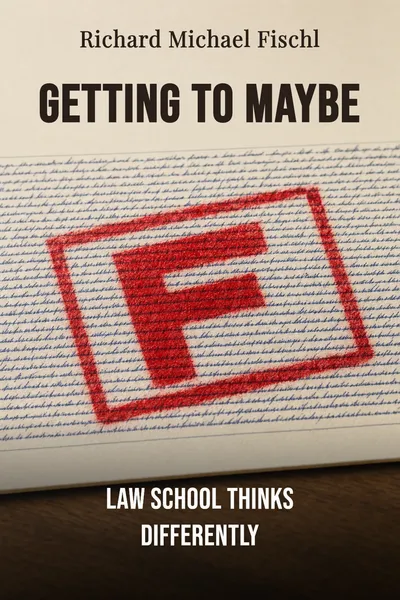
Getting To Maybe
Law school thinks differently
Description
Somewhere in late October, in a law-school library, there is a student who has never earned anything but top marks. They read every case, briefed every one, color-coded the outline, memorized the rules. Then the first exam comes back, and it says B-minus. The student stares at it, genuinely baffled, because they know the material cold. They can recite the elements of a contract in their sleep. And that, it turns out, is exactly the problem. This scene repeats every year on every campus, and it is the scene Richard Michael Fischl and Jeremy Paul set out to explain in Getting to Maybe, their book on how law school exams actually work.
Their diagnosis is unsettling because it flatters no one. The struggling student isn't lazy or slow. Very often they are the best memorizer in the room. The trouble is that everything school has rewarded up to this point — knowing the right answer and producing it fast — is close to useless on a law exam. Law exams are built, on purpose, out of situations where there is no single right answer, where two competent lawyers would argue opposite sides and both be right to do so. The professor isn't hiding the answer. There isn't one. What's being graded is something the student has never been asked to perform before.
Fischl and Paul, both law professors, wrote the book they wished someone had handed them at the start. Not a cram guide, not a list of tricks, but an honest account of why legal thinking produces so many maddening in-between situations — and how to write about them in a way that earns the grade. The title is the promise: the goal is not to reach yes or no, but to get, convincingly, to maybe.
The question we’re asking : Why do the students most practiced at finding right answers so often stumble on the exam that asks them to argue both sides?What we’ll see : How a culture built on certainty collides with a discipline built on ambiguity, and what it takes to write inside the doubt instead of fleeing it.
Table of contents
01Chapter 1 — The straight-A student who suddenly can't
Fischl and Paul open with a mismatch of cultures. From grade school through college, most of us are trained in what they call the culture of the right answer. A question has a correct response; you learn it, retrieve it, and you're rewarded. Multiple choice, fill in the blank, the essay that lands on the expected thesis — the whole apparatus points toward closure. Getting the answer means the exercise is over. Students who thrive on this become very good at a particular motion: absorb the material, find the one thing the teacher wants, hand it back cleanly.
Law school runs on almost the opposite fuel. The professors who write the exams are not looking for the student who spots the rule and applies it. They already know the rule; they wrote the question. What they want is the student who sees why the rule is hard to apply here — why the facts pull two ways, why a reasonable court could go either direction, why the tidy statement of law dissolves the moment it touches a messy situation. The exam rewards the analysis of doubt, not the resolution of it.

02Chapter 2 — Why the fork in the road is the whole point
The heart of the book is its patient explanation of where all this ambiguity comes from. Fischl and Paul refuse to treat the perplexing exam question as a trap the professor set to be cruel. Instead they show that legal analysis produces forks in the road by its own nature — that the doubt is baked into the material, not sprinkled on top. They spend real care mapping the recurring situations where the law genuinely can't tell you what happens next, and they give these situations names so a student can recognize them on sight.
Some forks come from the rules themselves. A statute says one thing, a competing rule says another, and the facts sit squarely in the overlap. Sometimes a rule and its own exception both seem to apply. Sometimes the law offers a clear test but the test uses a fuzzy word — reasonable, foreseeable, material — and the whole case turns on how you read that single fuzzy word. Other forks come from the facts. A story can almost always be told two ways, and a lawyer's craft is precisely the ability to arrange the same events into two competing narratives, each honest, each pointing at a different result.
03Chapter 3 — Reading the question the professor actually asked
Knowing that ambiguity is the point doesn't yet tell a student what to write. So Fischl and Paul turn to the exam itself — the long, tangled fact pattern that most first-years read too fast and answer too soon. Their advice starts with a discipline that sounds obvious and almost no one follows under time pressure: read what is actually there, and take seriously why every detail is there. Professors, they explain, don't pad. If a fact appears in the hypothetical, it was placed there to do work — to trigger an issue, to muddy one, to let you argue both ways.
The classic mistake is what they call issue-spotting on autopilot: the student sees a keyword, fires off the associated rule, and races on, harvesting issues like a checklist. That earns a few points and misses most of them. The better move is to slow down at each fork and forgo the rush to a verdict. Instead of writing the court will find for the plaintiff, the strong answer writes on the one hand, then on the other hand, then explains what the outcome depends on. The magic words, only half-jokingly, are it depends — followed by a precise account of what it depends on.
04Chapter 4 — The shape of thinking the law wants
Step back from the exam and the book is describing something larger than test strategy. The reason the law exam looks so strange is that it's a faithful miniature of how lawyers actually think, and how the legal system actually operates. In most of life we treat uncertainty as a temporary condition to be cleared away. The law treats it as the permanent working environment. A case only reaches a courtroom because reasonable people disagree about the answer; the easy ones settle or never arise. Litigation is the residue of genuine doubt, and a lawyer's job is to live there professionally.
This reframes what the exam is training. It isn't asking students to memorize law so much as to acquire a tolerance for holding two live possibilities at once without collapsing them prematurely into one. That capacity — to build the strongest case for a position you may not hold, to see the seams in a rule you'd like to be solid, to locate the exact point where a case could tip — is the intellectual muscle the whole profession runs on. Fischl and Paul's exam advice is really an initiation into a mode of thought that clients pay for later.
05Conclusion
Return to the student holding the B-minus in October. Fischl and Paul's message to them is not work harder or read more; it's that the exam was asking a question they'd never been trained to answer. The years of right-answer schooling built a fast, confident reflex, and that reflex is precisely what a law exam is designed to catch out. The fix isn't more effort in the old direction. It's a turn toward the doubt — reading every fact as deliberate, naming the fork in front of them, arguing both sides all the way down, and reaching maybe on purpose rather than fleeing it.
Related books