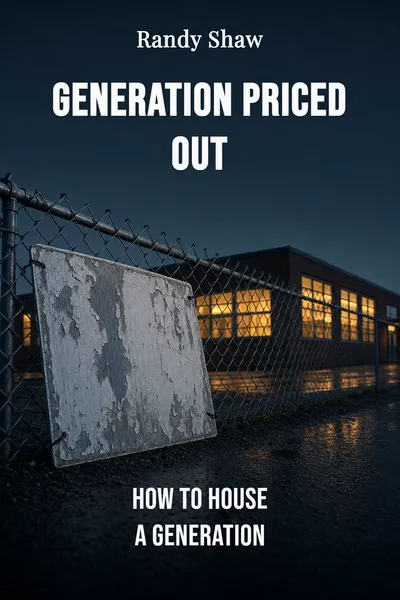
Generation Priced Out
How to house a generation
Description
In San Francisco in 2013, a middle-school teacher earning what would count almost anywhere else as a solid salary did the math on a one-bedroom apartment near her school and realized she could not afford to live in the city she taught in. She was not poor. She was not new. She was exactly the kind of person cities have always run on — the teacher, the nurse, the bus driver — and the city had quietly stopped having room for her. That gap, between people who do essential work and neighborhoods that no longer let them stay, is where Randy Shaw begins.
Shaw has spent decades running the Tenderloin Housing Clinic in San Francisco, which gives his book its particular texture: it is less a policy treatise than a tour, city by city, of the people caught in the squeeze. Tenants, small developers, homeowner associations, mayors, activists — he lets each of them talk, and what emerges is not a story of impersonal market forces but of decisions. Zoning votes. Neighborhood meetings. Ballot measures. Someone, somewhere, chose this.
The book's argument runs against a comfortable assumption — that soaring rents in desirable cities are simply what happens when a lot of people want to live somewhere nice. Shaw doesn't buy it. Prices climbed, yes, but so did the walls cities built to keep new housing out, and the two are not separate stories. If the crisis was made by choices, it can be unmade by different ones.
The question we’re asking : Why can't a generation of working- and middle-class people afford to live in the cities their labor keeps running?What we’ll see : A journey through a dozen American cities where the fight over housing is really a fight over who gets to stay.
Table of contents
01Chapter 1 — The city that closed the door behind it
Shaw opens with a paradox that sits at the center of the whole book. The cities where housing has become most unaffordable — San Francisco, Los Angeles, Seattle, New York — are also, by reputation, the most progressive. They vote for tenant protections. They march for economic justice. And they have presided over the fastest displacement of working- and middle-class residents in the country. The contradiction is not incidental; for Shaw it is the puzzle worth solving.
The mechanism is supply, or rather the deliberate absence of it. As populations and jobs grew through the 1990s and 2000s, the number of new homes did not keep pace. San Francisco, Shaw notes, added far more jobs than housing units for years running. When demand climbs and supply is frozen, the people with the most money win the bidding, and everyone else moves further out or leaves. The teacher, the line cook, the young family renting their first place — they are simply outbid, quietly, one lease at a time.

02Chapter 2 — Who actually blocks the new apartments
If the crisis is about housing that never got built, the natural question is who stopped it. Shaw's answer is uncomfortable for cities that see themselves as liberal: much of the blocking is done by existing homeowners, often longtime residents, frequently themselves the beneficiaries of decades of rising property values. They show up to the neighborhood meetings. They know the process. And they use it, effectively, to keep new density out.
He traces a generational fault line here that has come to define city politics. Boomer-era homeowners bought in when housing was cheap, watched their equity balloon, and now have every financial and emotional incentive to protect the scarcity that made them wealthy. Millennials arriving to rent — or hoping to buy — inherit the opposite side of that bargain. The fight over a proposed apartment building is, underneath, a fight between people who already got in and people trying to.
03Chapter 3 — Rent control was never the whole answer
For readers who assume Shaw, a lifelong tenant advocate, will simply prescribe more rent control, the book resists the easy landing. He defends rent regulation firmly — it keeps existing tenants housed, prevents the raw shock of a doubled lease, and buys stability for people who would otherwise be gone. In a crisis, protecting the people already in their homes is not a footnote. It is survival.
But he is clear-eyed about what rent control does not do. It protects the tenant who is already there; it does nothing for the family that needs to move to the city, the young worker looking for a first apartment, the person who simply arrives too late. A city can have strong tenant protections and still be closed to newcomers, because protecting the inside of the wall is not the same as opening the gate. Shaw watches cities congratulate themselves on tenant laws while producing almost no new homes, and he refuses to call that a win.
04Chapter 4 — When affordability becomes a choice cities make
Step back from the individual cities and the argument sharpens into a single claim: urban unaffordability is not weather. It is not a natural condition that arrives when a place becomes desirable and can only be endured. It is the aggregate of decisions — zoning maps, review rules, hearing schedules, ballot measures — made by identifiable people in identifiable rooms. Shaw's entire tour is designed to strip away the fatalism, because fatalism is what protects the status quo. If the crisis is inevitable, no one is responsible. If it was chosen, it can be chosen differently.
This reframing changes who is accountable. When rents rise, the instinct is to blame tech workers, or foreign capital, or 'the market,' as if these were forces beyond anyone's reach. Shaw redirects attention to the local politics that decide how much housing is legal to build and how easily it can be stopped. A city that adds jobs while forbidding apartments has made a choice, whatever its self-image, and the price of that choice is paid by the people who quietly disappear from the census.
05Conclusion
The teacher who could not afford to live near her school was never an anomaly. She was an early reading of where a whole category of American cities was heading — places that still needed the people who keep them running but had quietly stopped having room for them. Shaw's dozen-city tour returns, again and again, to that same figure in different guises: the worker who is essential to the city and priced out of it, standing at a door that closed while everyone insisted nothing could be done.