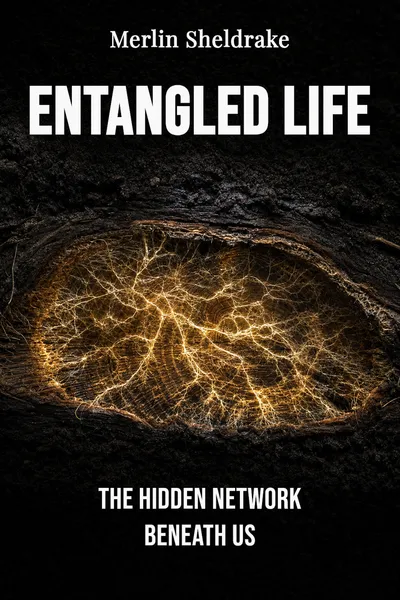
Entangled Life
The hidden network beneath us
Description
Merlin Sheldrake spent part of his doctoral research crawling through the tropical forests of Panama, digging up roots to trace the fungal threads knotted into them. He later did something stranger with his own book: he grew oyster mushrooms on a copy of Entangled Life, then ate them. The gesture was not a stunt. It was the argument in miniature. Fungi decompose, they transform, they turn one thing into another — including, if you let them, the pages describing what they do. Sheldrake is a biologist who writes about fungi the way a good friend tells you about the thing they cannot stop thinking about, and by the end you cannot stop thinking about it either.
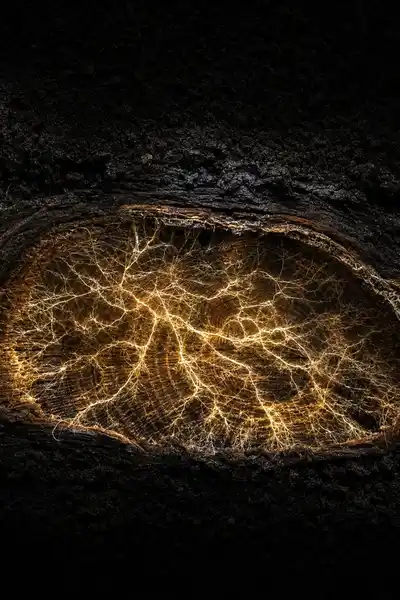
We tend to file fungi somewhere between plant and afterthought. They are the mushroom on the pizza, the mold in the fridge, the thing that ruins bread. But the mushroom is only the fruiting body — the visible tip of an organism that mostly lives out of sight as mycelium, a branching web of threads running through soil, wood, and living roots. There are fungal networks in a single forest that stretch for kilometres and may be among the oldest and largest living things on the planet. Most of the time we walk right over them.
Sheldrake's book is an attempt to take these organisms seriously, not as a curiosity but as a challenge to how we think about life at all. Fungi digest rock, ferment our drinks, feed forests, and — in some cases — rearrange the behaviour of the creatures they infect. They do not fit our categories, and Sheldrake suspects the categories are the problem, not the fungi.
The question we’re asking : What are fungi actually doing beneath our feet, and why does taking them seriously unsettle the way we think about life?What we’ll see : A journey from the underground web of mycelium to the chemistry of a mushroom, guided by a biologist who thinks fungi have something to teach us about ourselves.
Table of contents
01Chapter 1 — The organism that broke the rules
For most of scientific history, fungi were shelved with plants. They grow in the ground, they don't move, they seem passive — so botanists claimed them. It took until well into the twentieth century for biologists to accept that fungi belong to their own kingdom, one that is, genetically, closer to animals than to plants. They cannot photosynthesise. Like us, they take in food from the world around them and digest it. Unlike us, they digest it outside their bodies, releasing enzymes into their surroundings and absorbing what dissolves. A fungus is, in a sense, a mouth turned inside out.
This makes fungi extraordinary chemists. Sheldrake describes species that can break down rock, extract minerals, dissolve rust, even survive the radiation inside the ruined Chernobyl reactor — some appear to grow toward the radiation, as if feeding on it. They were among the first complex organisms to colonise land, hundreds of millions of years before there were forests, and they did it in partnership with algae, forming the crusty patches we call lichen. A lichen is not one organism but a collaboration so tight that for a long time nobody could tell where one partner ended and the other began.

02Chapter 2 — Mycelium as a way of being
The mushroom gets the attention, but the real organism is the mycelium — the network of fine threads, called hyphae, that spreads through whatever the fungus is feeding on. A single teaspoon of soil can hold kilometres of it. Sheldrake keeps returning to a simple, disorienting fact: mycelium has no centre, no head, no single place where decisions get made. It is a body that is all edge, all frontier, growing outward at every tip at once and reabsorbing itself where growth no longer pays.
This forces Sheldrake to reach for language that keeps failing him, which he finds honest rather than frustrating. We describe fungi as if they were animals — they "forage," they "decide," they "communicate" — and every metaphor smuggles in assumptions that don't quite fit. A mycelial network can find the shortest path through a maze to reach food. Famously, Japanese researchers laid out oat flakes in the pattern of Tokyo's rail stations and watched a slime mould — not a fungus, but a network organism that raises the same questions — reconstruct something close to the actual rail map. Nothing was in charge. The pattern emerged from thousands of threads solving a problem together.
03Chapter 3 — The deals struck underground
The most consequential thing fungi do happens where we can't see it, in the soil around plant roots. The great majority of land plants live in partnership with mycorrhizal fungi — the word simply joins the Greek for fungus and root. The fungal threads wrap around and even enter the roots, and a trade opens up. The plant, which can photosynthesise, hands over sugars. The fungus, whose threads are far finer and reach far further than any root, hands back water and nutrients like phosphorus it has mined from the soil.
This partnership is not a marginal detail of botany. It is roughly how plants managed to live on land in the first place, and it is still how most of them feed themselves. Sheldrake describes the fungal networks linking many plants together as a kind of shared infrastructure. Through it, trees can pass carbon and chemical signals to their neighbours; a dying tree may unload its resources into the network before it goes. The popular phrase for this is the "wood wide web," a label Sheldrake handles with care, because it is easy to turn a genuine phenomenon into a tidy fairy tale of forest cooperation.
04Chapter 4 — What a fungus does to a mind
Fungi don't stop at feeding plants; they reach into behaviour and consciousness in ways that are hard to keep at a comfortable distance. Sheldrake tells the story of the so-called zombie-ant fungus, Ophiocordyceps, which infects a carpenter ant, spreads through its body, and steers it to climb to a precise height, clamp its jaws onto a leaf vein, and die there — a spot ideal for the fungus to sprout a stalk and rain spores onto the ants below. The fungus does not, it seems, invade the brain directly. It appears to work on the muscles and body, hijacking the animal from the outside. The ant walks to its death under someone else's control.
Then there are the fungi that alter our own minds. Yeasts have shaped human culture for thousands of years by fermenting bread, beer, and wine — a chemistry we built civilisations around without understanding it. And psilocybin, the compound in certain mushrooms, produces the dissolving of boundaries between self and world that many people describe under its influence. Sheldrake, without becoming an evangelist, follows the renewed clinical research suggesting these compounds may help with depression and the fear of dying, precisely by loosening the sense of a fixed, separate self.
05Conclusion
Sheldrake ends more or less where his research began, with his hands in the dirt and his categories in disarray. The mushrooms he grew on his own book are the closing image because they hold the whole argument: matter passing through a fungus and coming out transformed, a boundary crossed so completely that the question of where the book ends and the meal begins stops making sense. Fungi, he shows, are not a niche topic for specialists. They are the decomposers, the traders, the connectors — the organisms doing the quiet work that keeps the visible world standing, and doing it in a form that refuses to hold still inside our definitions.
Related books