

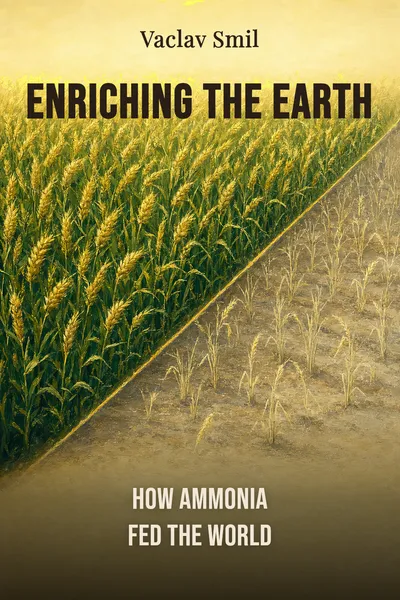
Enriching the Earth
How ammonia fed the world
Description
In the summer of 1909, in a laboratory at Karlsruhe in southwestern Germany, a chemist named Fritz Haber ran a tabletop apparatus at roughly 200 atmospheres of pressure and around 500 degrees Celsius, and watched droplets of liquid ammonia form at a rate of about a cup every couple of hours. It does not sound like much. A trickle of a pungent liquid, dripping out of a steel tube the size of a rifle. But representatives from the chemical firm BASF were watching, and what they saw was that nitrogen pulled straight from the air had been forced to combine with hydrogen, on demand, in a machine. The air is nearly four-fifths nitrogen. Until that afternoon, almost none of it could be made to feed anything.
Vaclav Smil, the Czech-Canadian scholar who has spent a career counting the material flows nobody else bothers to count, built an entire book around that trickle. His claim in Enriching the Earth is deliberately immodest: the industrial synthesis of ammonia has mattered more to the modern world than the airplane, than nuclear power, than spaceflight or television. Those inventions changed how we move, fight and entertain ourselves. This one changed how many of us there could be. In 1900 the planet held about 1.6 billion people. It now holds several times that. Smil argues, with the arithmetic to back it, that the difference is largely made of synthetic nitrogen.
That is a strange kind of importance — enormous and invisible at once. We can picture a plane or a rocket. Almost nobody can picture the reaction that keeps roughly half the world fed, or knows the names of the two Germans who made it work. Smil's book is an attempt to drag that reaction into the light and set its true weight on the scale.
The question we’re asking : How did forcing nitrogen out of thin air quietly become the invention that decides how many people the planet can hold?What we’ll see : How a chemical bottleneck defined human numbers for millennia, and how two men in imperial Germany broke it open — with everything that followed.
Table of contents
01Chapter 1 — The invisible ceiling on every field
Nitrogen is the element that decides how much a field can grow. Plants build their proteins and their DNA out of it, and there is no substitute. The frustrating part, as Smil lays it out, is that nitrogen is everywhere and nowhere at once. It makes up about 78 percent of the atmosphere, but in that form it exists as two atoms locked together by one of the strongest bonds in chemistry, so tight that a crop standing in a sea of the stuff can starve for want of it. To be useful, nitrogen has to be 'fixed' — broken apart and joined to hydrogen or oxygen into a form a root can take up.
For all of human history before the twentieth century, that fixing was done by nature at nature's pace. Lightning cracked a little out of the air. Certain bacteria living on the roots of legumes — clover, beans, peas — pulled some down and left it in the soil. Farmers who understood none of the chemistry still learned the rhythm: rotate a grain with a legume, let a field lie fallow, and the yield came back. Manure returned nitrogen the animals had eaten. It was a slow, closed loop, and it set a hard ceiling on how many mouths an acre could feed.

02Chapter 2 — Fixing what the air would not give up
The problem Crookes described was not that nobody knew the target. Everyone knew the goal: combine atmospheric nitrogen with hydrogen to make ammonia, NH3, a compound crops could use directly or that could be turned into nitrate fertilizer. The problem was that the nitrogen molecule simply refused. Its triple bond is so stable that under ordinary conditions the two elements ignore each other completely. You could mix nitrogen and hydrogen in a flask and wait forever, and nothing would happen.
There had been detours. One approach, the electric-arc method, essentially imitated lightning — passing air through a searing electric discharge to force nitrogen and oxygen together. It worked, after a fashion, but it devoured colossal amounts of electricity and only made economic sense near the cheap hydropower of Norway. Another route, the cyanamide process, ran nitrogen through calcium carbide at high temperature; it too was ravenous for energy. Both were stopgaps. Neither could feed a continent.
03Chapter 3 — The wager between Haber and Bosch
Haber had a recipe. What he did not have was any machine that could survive it. Two hundred atmospheres of pressure, hydrogen gas at 500 degrees, running continuously for years — this was territory no industrial equipment had ever entered. When BASF handed the project to a young engineer named Carl Bosch, they were betting the company on the idea that a chemistry-bench trick could be scaled up by a factor of thousands without blowing up.
The first obstacle nearly ended it. Hydrogen at high temperature and pressure attacks steel, seeping into the metal and stripping out the carbon that gives it strength. Bosch's early pressure vessels burst after hours. His answer, arrived at through relentless testing, was a double-walled reactor: a soft inner liner of low-carbon iron to take the hydrogen's assault, wrapped in a strong outer shell drilled with fine holes so the gas that leaked through could escape harmlessly rather than embrittle the load-bearing steel. It is exactly the sort of unglamorous fix Smil admires — the difference between an idea and a working plant.
04Chapter 4 — The bargain nobody voted on
Step back from the reactors and the arithmetic gets vertiginous. Smil's estimate, the one that anchors the whole book, is that roughly two out of every five people alive today owe their existence to synthetic nitrogen — their food, traced back through the fertilizer that grew it, would not exist without Haber-Bosch. That is not a metaphor. It is a headcount. Of the six billion people the book counts, on the order of two billion are, in a strict material sense, standing on ammonia made in factories.
This is why Smil insists the invention outranks the airplane and the atom. Those changed the texture of modern life; this one changed its scale. And it did so almost silently. There was no vote, no founding moment anyone celebrates, no monument on a square. A civilization quietly restructured itself around a chemical reaction, and then went on assuming the food would always be there. The dependence is total and invisible at once — which is precisely what makes it the kind of thing Smil thinks we ought to look at squarely rather than take on faith.
05Conclusion
Fritz Haber received the Nobel Prize in Chemistry in 1918 for the synthesis of ammonia, an award shadowed by his wartime work with poison gas; Carl Bosch received his own Nobel in 1931 for the high-pressure methods that made the process industrial. The recognition was real, but it never translated into public memory. Most people who eat bread made from fertilized wheat have never heard either name, and could not describe the reaction if asked. The trickle that dripped out of a steel tube in Karlsruhe became one of the largest chemical industries on earth, and stayed almost completely anonymous.