Enough
When wealth becomes the enemy
Description
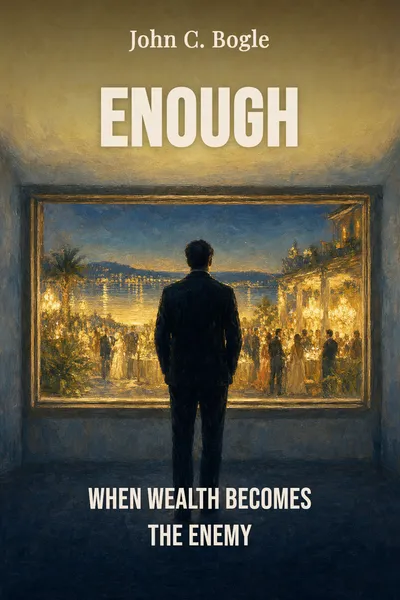
At a party given by a billionaire on Shelter Island, the writer Kurt Vonnegut told his friend Joseph Heller that their host, a hedge fund manager, had made more money in a single day than Heller had earned from his novel Catch-22 over its whole history. Heller answered that he had something the billionaire could never have. What could that possibly be, Vonnegut asked. "The knowledge," Heller said, "that I've got enough." John Bogle opens his 2008 book with that exchange, and it does most of the work of the title. Enough is not a memoir of frugality. It is a reckoning, written by a man who spent fifty years inside the machine that manufactures the opposite feeling.
Bogle knew the machine from the inside because he had helped build a corner of it that ran the other way. In 1974 he founded Vanguard, and in 1976 he launched the first index mutual fund available to ordinary investors — a fund that simply tracked the market instead of trying to beat it, and charged almost nothing to do so. The industry laughed at it and called it "Bogle's folly." Over the following decades the idea quietly reorganized how millions of people save. By the time he sat down to write, Bogle had watched the financial world grow richer and, in his reading of it, poorer at the same time.
The book arrived in the middle of a financial crisis, which gave its quiet argument a sudden edge. But the crisis was the occasion, not the subject. Bogle was after something older and harder to price — the point at which the pursuit of more stops serving a life and starts consuming it, and the strange fact that a whole industry is built on making sure that point never arrives.
The question we’re asking : What does a man who spent his career building wealth mean when he says the wealth industry has lost its way?What we’ll see : How the drive for more quietly turns from servant into master, told by the insider who watched it happen.
Table of contents
01Chapter 1 — A number that never sits still
Bogle builds the book around three distinctions, and the first is the one that gives the party anecdote its sting: there is no such thing as enough when the target keeps moving. He borrows a phrase from his own career on Wall Street — "too much cost, not enough value; too much speculation, not enough investment; too much complexity, not enough simplicity." Underneath each pairing sits the same problem. We measure success against other people, and other people are always doing a little better, so the finish line retreats exactly as fast as we approach it.
The hedge fund manager at that party is Bogle's clearest example. He was, by any external measure, a spectacular success. He had won the game the whole industry plays. And yet what struck Bogle was that a man like that has no way to stop, because the number he watches is relative — it compares him to his peers, to last year, to the next quarter. Enough is a threshold, and a threshold requires a fixed point. The financial world is engineered to remove fixed points.

02Chapter 2 — The cost of counting on cost
From the philosophy Bogle turns to the arithmetic, because he is, above all, a numbers man, and the numbers make his case more calmly than any sermon could. The mutual fund industry, he argues, has quietly reversed its purpose. It exists, in theory, to help ordinary people grow their savings. In practice, he says, a large and growing share of the returns the market generates never reaches the people who supplied the capital. It is skimmed off in fees, trading costs, and the machinery of an industry that charges to manage money it mostly cannot outperform.
His indictment rests on a fact that took him decades to make legible: costs compound as relentlessly as returns. A fee that sounds trivial — two percent a year — eats a startling fraction of a lifetime's gains, because it is charged every year on a growing balance while the market's real return does the same. Over fifty years, Bogle calculates, the cost-heavy fund can hand the intermediaries more than half of what the investor might otherwise have kept. The saver takes all the risk. The manager takes a guaranteed cut regardless of outcome.
03Chapter 3 — When money forgets what it was for
The third movement of the book widens out from funds to finance itself, and here Bogle's tone sharpens. He watched the financial sector swell over his career until, by the 2000s, it claimed an outsized share of all corporate profits in the American economy — a system that had grown enormous by moving money around rather than by building anything. He describes a shift from what he calls an ownership society, where people bought pieces of real companies and held them, to an agency society, where layers of intermediaries trade on other people's behalf and collect a toll at every step.
The problem with the agency society is that agents have their own interests, and those interests are rarely the same as the owners'. A pension fund manager rewarded on this quarter's performance has no reason to care about a company's next decade. Speculation crowds out investment. Bogle draws on Keynes here, who distinguished enterprise — forecasting the actual yield of an asset over its life — from speculation, forecasting the psychology of the market. When speculation dominates, he argues, capital stops flowing toward genuine value and starts chasing motion for its own sake.
04Chapter 4 — The measure that lost its meaning
Step back from the funds and the fees, and Bogle's real target is a confusion older than finance: we have started to believe that the things we can count are the only things that count. Money is simply the purest example, because it is the easiest thing in the world to measure. You can put a precise number on a fortune. You cannot put one on a good reputation, a marriage that held, or work that mattered — so those things drift to the edge of the ledger, and the ledger starts to feel like the whole of reality.
Bogle keeps returning to the character that made his kind of enterprise possible in the first place. He writes about the values his grandfather and his early mentors handed him — trust, integrity, the sense that a professional owes something to the people who depend on him. These are precisely the qualities that resist measurement, which is why a metrics-driven culture erodes them without ever intending to. Nothing in a quarterly report registers the moment a fund company decides to charge its clients fairly. The virtue is real, and it is invisible to the instrument.
05Conclusion
The book closes near where it opened, on the difference between the hedge fund manager and the novelist at that Shelter Island party. One had more money than he could measure; the other had something the first man had no way to acquire, because it was not for sale and could not be counted. Bogle spent his career proving that a financial business could be built to serve rather than to skim, and Vanguard, structured so its investors are its owners, was the working model of a company that knew when it had taken enough. The argument of the book is that the same threshold is available to a person.
Related books