Energies
The currency of everything
Description
Sometime in the middle of the nineteenth century, a handful of scientists working separately — a Munich physician, a Manchester brewer's son, a German physiologist — arrived at the same strange idea from different directions. Heat, motion, electricity, the chemical fire inside a living cell: these were not separate things at all. They were the same thing, wearing different masks. James Joule spent years measuring, with almost obsessive care, exactly how much falling weight it took to warm a bath of water by a fraction of a degree. What he was really measuring was a conversion rate — the exchange price between mechanical work and heat. He had found, without quite saying so, that the universe runs on a single account.
This is the conviction that runs through Vaclav Smil's book Energies. Smil, an ecologist and prolific analyst of how the material world actually works, takes one deceptively simple principle and refuses to let go of it: energy is the only truly universal currency. Nothing happens anywhere — a star igniting, a planet turning, a seed splitting its husk, a city drawing breath at dawn — without one form of energy being converted into another. It is the one thing every process in the cosmos has in common, and the one measure that lets us compare a hurricane to a heartbeat, a wheat field to a microchip factory.
And yet, Smil notes, we rarely look at the world this way. We talk about biology, economics, and history in their own vocabularies, as if they were unrelated countries. Energies is an attempt to read all of them in the same denomination — to hold the sun and the human body, bread and a semiconductor, in one frame and watch the exchange rates appear.
The question we’re asking : What changes when we treat energy — not money, not information — as the single currency behind everything that happens?What we’ll see : How one nineteenth-century insight quietly connects stars, cells, harvests and civilizations, and why the connection stays so easy to miss.
Table of contents
01Chapter 1 — One thing, wearing many masks
The core claim of Energies is almost aggressively simple. Everything that occurs — everything — is a transformation of energy from one form into another. A photon leaving the sun, a river cutting a canyon, a muscle contracting, a thought firing across a synapse: each is a conversion, governed by the same accounting rules. The two laws of thermodynamics, worked out over the nineteenth century, say that the total quantity in the account never changes, but that every transaction extracts a fee. Energy is conserved; usable energy is not. It degrades, spreads out, cools toward uselessness. That fee is why perpetual motion is impossible and why the future looks different from the past.
Smil's point is that this recognition was one of the genuine triumphs of modern science, and one of the least celebrated. Before it, heat and work and electricity were studied as separate phenomena by separate specialists. After it, they became interchangeable expressions of a single quantity, all measurable in the same unit — the joule. That unit lets us do something remarkable. We can put the metabolic output of a resting human, the yield of a burning log, the punch of a lightning bolt and the annual radiation of the sun on one scale and simply compare the numbers.

02Chapter 2 — From the sun to the loaf of bread
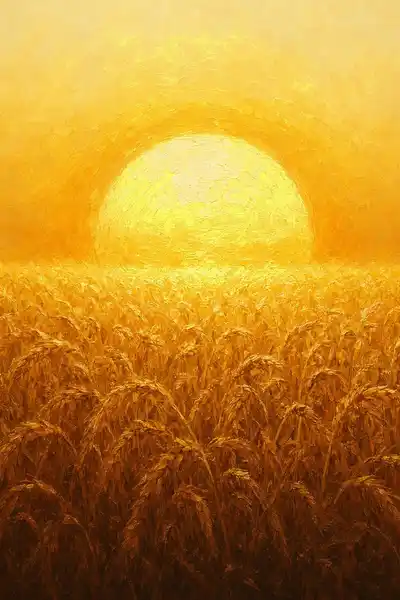
Follow a single joule and you see the chain Smil is fascinated by. Nearly everything begins with the sun, which fuses hydrogen into helium and pours the released energy outward as radiation. A tiny fraction reaches Earth, and a tinier fraction of that is caught by plants, which use it to split water and fix carbon into sugars. Photosynthesis is famously inefficient — under real field conditions it captures only around one to two percent of the sunlight falling on a crop — but on that thin margin the entire living world is built. Every calorie in every body traces back to that first capture.
From there the conversions cascade. A wheat plant stores solar energy as starch in its grain. A farmer harvests it, a mill grinds it, an oven bakes it, and the loaf that emerges is, in the strictest sense, packaged sunlight with a great deal lost along the way. When we eat it, our cells burn the sugars to power muscle and thought, releasing heat as the inevitable fee. Smil delights in tracing these pathways because each step obeys the same rules and each step pays the same tax in degraded, dispersed energy.
03Chapter 3 — The metabolism of civilizations
Smil's boldest move is to treat human history itself as an energy story. A society, in this reading, is a kind of organism with a metabolism: it takes in energy, converts it into structures and activity, and is limited at every moment by how much it can command and how well it can use it. For nearly all of human existence, that budget was brutally tight. It came from the sun through crops, from human and animal muscle, from wind and moving water and burning wood. These are diffuse, low-density sources, and they set a hard ceiling on what any pre-industrial society could build.
This is why, Smil argues, so much of ancient and medieval life looks the way it does. When your only prime movers are people and draft animals, monumental construction demands enormous mobilizations of labor, most of the population must farm to feed everyone else, and economic surplus is thin. The great preindustrial achievements — pyramids, cathedrals, canal systems — are astonishing precisely because they were wrung from such a meager energy base, one muscle contraction at a time.
04Chapter 4 — Reading the world in joules
Step back from the specific chains — sun to grain, coal to city — and the deeper wager of Energies becomes clear. Smil is proposing a lens, not just a survey. He is suggesting that if we insist on describing biology, economics, geology and history each in its own private language, we miss the thing they most obviously share, and that a single question — where does the energy come from, and what happens to it? — cuts across all of them at once. It is a way of seeing that dissolves the borders between disciplines we usually keep in separate rooms.
The strange part, for Smil, is how underused this lens remains. The universality of energy was established more than a century and a half ago, and it is not controversial. Yet there is still surprisingly little writing that tries to look at the whole world through it. We are far more comfortable talking about money as the universal solvent of human affairs, or lately about information and data. But money and information are conventions layered on top of a physical reality that answers to neither. Beneath every price and every signal, joules are being moved and degraded, and those flows set limits that no market can vote away.
05Conclusion
James Joule measured his falling weights and warming water without knowing he was charting an exchange rate the whole universe honors. What began as a set of careful laboratory numbers turned out to be the deepest kind of unity science has found: heat, motion, life and light are one quantity in different guises, conserved in total, taxed at every turn. Smil takes that discovery at its full word and follows it wherever it leads — into the sun, the wheat field, the loaf, the burning seam of coal, the metabolism of an entire civilization.
Related books