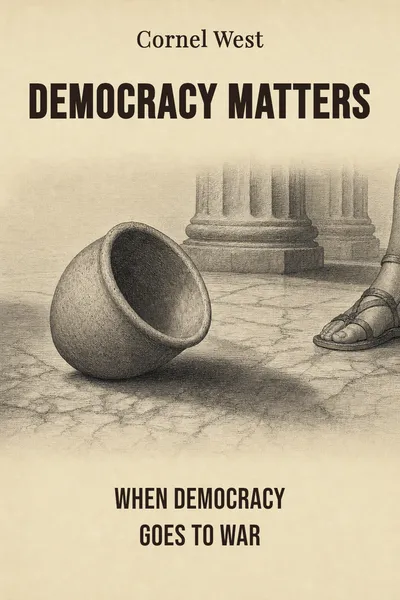
Democracy Matters
When democracy goes to war
Description
In 2004, Cornel West — Princeton philosopher, sometime hip-hop collaborator, preacher's cadence in an academic gown — published a book with a title that reads almost like a dare: Democracy Matters. It arrived three years after the towers came down, in the middle of the war in Iraq, when to question American conduct abroad was to risk being called something worse than wrong. West wrote it as a sequel to Race Matters, his 1993 bestseller, but the frame had widened. The subject was no longer only the color line. It was whether the country still deserved to call itself a democracy at all.
West's argument is not the tidy one you might expect from a professor. He does not simply say America betrayed its ideals after September 11. He says the betrayal was already underway, and the attacks handed it an accelerant. What he saw taking hold was a mood — fearful, vengeful, allergic to self-examination — dressed up as patriotism. And he named a set of forces he believed were quietly hollowing the republic from within, long before any plane hit anything, forces that thrive precisely when a people is frightened enough to stop asking questions.
The odd thing about the book is where West looks for hope. Not to think tanks or party platforms, but to the blues, to the Hebrew prophets, to Socrates in the Athenian street asking one more inconvenient question before they made him drink the hemlock. He reaches back into the American grain — into figures the country would rather sand smooth — to argue that democracy is less a system than a disposition, a nerve, something a people either keeps alive or lets die.
The question we’re asking : What did West see happening to American democracy after 9/11, and where did he think its cure had always been hiding?What we’ll see : How a philosopher diagnosed a republic drifting toward empire, and named the tradition he believed could still call it back.
Table of contents
01Chapter 1 — The imperial temptation after 9/11
West begins with a wound and what a country does with it. September 11 was a genuine catastrophe, and he refuses the poses of both the cheerleaders and the cynics. But grief, he argues, is a fork in the road. A democracy can meet violence by deepening its commitment to justice and self-scrutiny, or it can meet violence by mimicking the very thing that struck it — closing ranks, punishing dissent, casting the world into friends and enemies. America, in West's reading, chose the second path with alarming ease, and the ease is what worries him most.
What emerged was a temperament he calls imperial. Not an empire in the old sense of colonies and viceroys, but a habit of mind: the assumption that American power is self-justifying, that its intentions need no examination, that the exercise of force abroad is a moral gift rather than a moral question. The invasion of Iraq becomes, for West, less a policy than a symptom — the outward sign of a country that has begun to confuse its might with its virtue, and that treats anyone who points this out as an enemy of the flag.

02Chapter 2 — The three dogmas eating the republic
At the center of the book sit three forces West holds responsible for what he calls the arrested development of American democracy. He names them without euphemism: free-market fundamentalism, aggressive militarism, and an insidious authoritarianism. Each is old; what unsettles him is how they have fused, reinforcing one another until the energy of democratic life is drained and citizens are left as spectators to a system that runs above their heads.
Free-market fundamentalism is the first and, he suggests, the most corrosive because it is the least visible. It is the conviction that the market is not merely useful but sacred — that whatever it produces is by definition just, and that a human life not translated into a price has no standing. West sees this creed colonizing spheres it has no business in: schools, prisons, the press, the imagination itself. Under its logic, the citizen shrinks into a consumer, public goods become private opportunities, and the common wealth is quietly renamed and carried off.
03Chapter 3 — The blues, the prophets, and Socratic nerve
Having diagnosed the sickness, West does something a policy book would never do: he goes looking for a cure in music and scripture and a dead Athenian. His claim is that democracy is not primarily a set of institutions but a set of energies, and that those energies have been carried, in America, by traditions the official story neglects. Three in particular anchor his hope.
The first is Socratic questioning — the refusal to let any authority, including one's own certainty, go unexamined. West reminds us that Socrates was executed by a democracy that could not bear his questions, and he reads that as a permanent warning. A free society needs its gadflies, its people willing to ask whether the emperor is dressed. Silence those, and you keep the form of democracy while gutting its nerve. The post-9/11 impatience with dissent is, in his eyes, the Athenian jury reassembling.
04Chapter 4 — When the empire outgrows the citizen
Step back from the particular quarrels of 2004 and West's book poses a question older than the United States and larger than any war: can a republic behave as an empire abroad and remain a democracy at home? His answer is that it cannot, not for long, because the two demand opposite kinds of citizens. Empire needs subjects who trust, obey, and avert their eyes. Democracy needs citizens who doubt, argue, and insist on seeing. Try to run both at once and one of them wins — and West is convinced it is usually the empire.
The corrosion he traces runs inward. A country that grows accustomed to secrecy and force overseas imports those habits home; the surveillance justified against a foreign enemy is turned, eventually, on its own dissenters. The market logic that reduces distant lives to figures on a ledger does the same to the poor in one's own cities. West's point is not that America is uniquely wicked but that this is the standing temptation of power everywhere: domination is efficient, self-government is slow, and the efficient thing is always whispering that the slow thing is a luxury we can no longer afford.
05Conclusion
West ends where he began, in a country he refuses to give up on. Democracy Matters is not a farewell to the American experiment but a summons — a demand that citizens take the promise back from the forces that have hollowed it. The three dogmas remain, the imperial temptation remains, but so does the older tradition of Socratic questioners, prophetic truth-tellers, and blues singers who turned catastrophe into a stubborn, clear-eyed hope. The book is a wager that this second lineage is stronger than the first, if enough people choose to carry it.
Related books