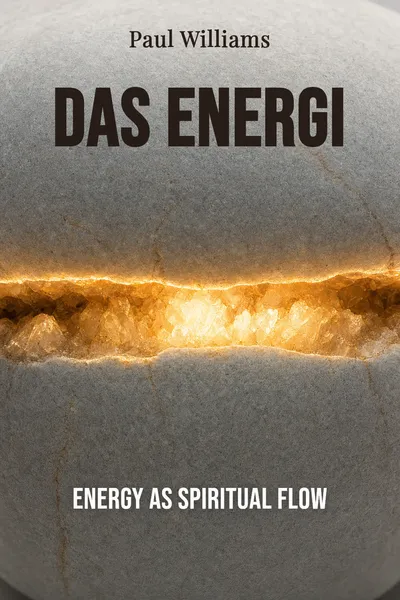
Das Energi
Energy as spiritual flow
Description
In 1973, a twenty-five-year-old American named Paul Williams published a small book with an oddly spelled title. Williams was already a known figure in a narrow world: at seventeen he had founded Crawdaddy!, one of the first magazines to treat rock music as something worth writing about seriously. But Das Energi was not music criticism, and it was barely a book in the usual sense. It had no chapters, no argument, no narrator explaining what he meant. It was pages of short lines, some a single sentence long, laid out with the white space of poetry, circling one word over and over: energy.
The word does a strange amount of work here. Williams uses it the way a physicist never would and a mystic always has — not as a measurable quantity but as the living current he claims runs through everything. Rocks, thoughts, oceans, the reader holding the book. The whole text is an invitation to feel that current, stop resisting it, and let it carry you. Williams called this alignment, and he treated it less as an idea to accept than as something to practice, line by line, the way you might repeat a chant until it stops being words.
Half a century later the book sits in an unusual place — too spare to be philosophy, too earnest to be poetry, too calm to be a manifesto. It sold steadily for decades on word of mouth, passed hand to hand among readers who found something in its stillness. It belongs to a moment when a generation was trying to build a spiritual life without the institutions that used to supply one, and Williams gave that search one of its quietest, most concentrated expressions.
The question we’re asking : What is Paul Williams actually asking us to do when he tells us to flow with energy — and why did he say it in a form this bare?What we’ll see : How a slim, aphoristic book turned a single word into a spiritual practice, and what its calm confidence reveals about the era that made it.
Table of contents
01Chapter 1 — A book that reads like a wave
Open Das Energi anywhere and the first thing that registers is the form. There are no paragraphs building toward a point, no thesis stated and then defended. Williams writes in short declarative lines, often centered, often surrounded by empty page. A line will assert something enormous — that the universe is love, that everything is one energy — and then simply stop, letting the space around it do the arguing. The effect is closer to scripture or to a meditation manual than to an essay. You do not read it fast, because there is nothing to skim toward.
This is deliberate. Williams is not trying to convince anyone in the way a philosopher convinces. He is trying to produce a state. The repetition, the affirmative cadence, the way phrases circle back and rephrase themselves — all of it works on the reader the way a mantra works, by accumulation rather than proof. Read one page and it seems slight. Read forty and something shifts in the reading itself; the mind slows to match the pace of the lines.

02Chapter 2 — Energy is the only word that fits
Everything in the book hangs on that one word, so it's worth asking what Williams means by it. He is not talking about calories or electricity, though he does not mind if the physical associations bleed in. Energy, for him, is the animating force behind all things — the same current in a growing plant, a passing thought, a rising tide, a feeling of love. It is consciousness and matter treated as a single continuous substance, which is why he can move in one line from the stars to the reader's mood without seeming to change subject.
The move is old. Mystics across traditions have described a single life-force under the surface of things — prana, chi, the divine spark. What Williams adds is a distinctly modern, distinctly American vocabulary. He strips out the theology, the priests, the ritual apparatus, and keeps only the felt experience of connection. "Energy" is the perfect word for this because it sounds scientific enough to satisfy a secular reader and vague enough to hold anything you pour into it. It asks for no belief, only attention.
03Chapter 3 — Saying yes as a practice
If the book has a single verb, it is yes. Williams keeps returning to affirmation — say yes to what is, yes to yourself, yes to the current carrying you. This is not the mindless positivity it can sound like out of context. It is closer to a discipline: the ongoing practice of dropping the reflex to argue with reality and instead meeting it openly. The energy, in his framing, flows freely only through someone who has stopped clenching against it.
What is striking is how physical this becomes. Williams does not stay in the realm of belief. He keeps pointing back to the body, the breath, the moment — the concrete sensation of being alive right now, which is the only place the current can actually be felt. Ideas about oneness are useless to him if they stay ideas. The book wants to be used, repeated, returned to, the way you return to a breathing exercise, until the affirming stance stops being a thought and becomes a default.
04Chapter 4 — The counterculture learned to sit still
Step back from the lines themselves and Das Energi looks like an artifact of a specific spiritual moment. It arrives in the early 1970s, just as the loud, outward energy of the sixties was turning inward. The marches and the music had not delivered the transformation people hoped for, and a generation that had rejected the churches and institutions of its parents still wanted a spiritual life. Williams's book is one answer to that want: a faith with no church, no clergy, no creed you have to sign.
What that generation reached for, again and again, was flow — the sense of a benevolent current you could join rather than a doctrine you had to obey. It shows up in the Eastern practices suddenly everywhere in American cities, in the language of consciousness and vibration, in the whole loose movement that would soon be labeled New Age. Williams gave this instinct one of its purest forms, because he stripped away almost everything except the core intuition: relax, trust, align. No cosmology to defend, just an attitude toward being alive.
05Conclusion
The book that circles the word energy for a hundred spare pages is finally not making a claim you can check. It is offering a stance — toward struggle, toward the self, toward the current Williams insists runs through everything. Take it as philosophy and it falls apart under the first hard question. Take it as a practice, a thing to sit with and repeat, and the missing arguments stop mattering. That was always the point. Williams wrote a book you use, not one you evaluate, and its bareness is the instruction.
Related books