
Cooked
Four elements, infinite flavors
Description
Somewhere in the mid-2000s, Michael Pollan noticed something odd about the way Americans watched television. Cooking shows were everywhere — whole channels devoted to braising, searing, whisking — and yet almost nobody was actually cooking. We had turned the kitchen into spectator sport. The average American spent about twenty-seven minutes a day preparing food, roughly half of what people spent a generation earlier, and much of that was really just unwrapping and reheating. Pollan, who had spent years writing about where food comes from, realized he had skipped a step. He knew a lot about farms and supermarkets. He knew almost nothing about the transformation that happened between the raw ingredient and the plate.
So he did what he tends to do: he apprenticed himself. He stood beside a whole-hog barbecue pitmaster in North Carolina, learned to build a braise from a chef in Berkeley, badgered a professional baker until his sourdough stopped coming out like a brick, and fermented cabbage, cheese and beer in his own garage. The organizing idea he landed on is almost absurdly old. The four transformations he learned map onto the four classical elements the Greeks thought made up the world — fire, water, air and earth. Each one turns the stuff of nature into something we can eat, and each one carries its own way of thinking.
Cooked is the record of that education, and it is also a quiet argument. Somewhere along the way, most of us stopped performing these transformations ourselves and let corporations do them for us. Pollan wants to know what we gave up when we did — not out of nostalgia, but because the answer turns out to touch our health, our households and our sense of where we sit in the natural world.
The question we’re asking : What do we actually lose when we hand the daily work of cooking over to somebody else?What we’ll see : How four ancient ways of transforming nature — through fire, water, air and earth — turn ingredients into food, and turn cooking into more than a chore.
Table of contents
01Chapter 1 — Fire — the first transformation
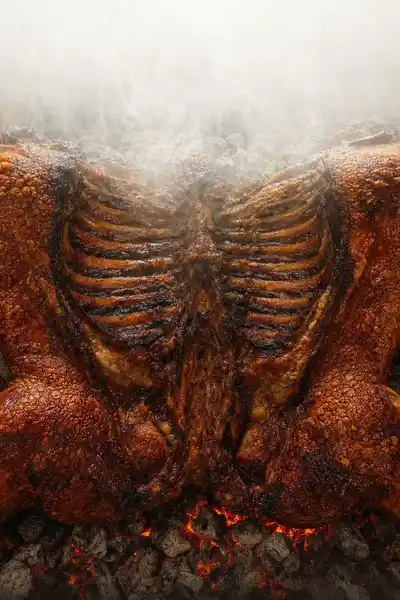
Pollan starts with the oldest technique we have. To learn it he goes to the American South, to men who cook whole pigs over hardwood coals for the better part of a day and night. Barbecue, in this world, is not a recipe but a vigil. Someone has to tend the fire, feed it, read the smoke, and stay awake while the animal slowly gives itself up to the heat. The result is one of those foods people drive across three states to eat, and Pollan wants to understand why fire and meat together exert such a pull on us.
The answer runs deep. Following the primatologist Richard Wrangham, Pollan lays out the argument that cooking with fire may have made us human in the first place. Heat predigests food — it unlocks calories, softens fibers, kills pathogens — so that our ancestors could feed a large, expensive brain on a smaller gut. If Wrangham is right, we did not invent cooking so much as cooking invented us. That gives the smell of meat over coals a claim on us that no marketing department installed.

02Chapter 2 — Water — the pot that holds the day
If fire is spectacle, water is domesticity. The pot arrives late in human history — you need a container that won't burn — and it changes everything. Suddenly you can combine many ingredients, extract their flavors slowly, and stretch a little meat across many mouths. Pollan learns this element in a home kitchen in Berkeley, cooking alongside a chef who teaches him the braise: the onion, carrot and celery softened in fat, the browning, the long low simmer that turns tough and cheap into tender and deep.
Water cooking is the everyday cooking, the kind that actually feeds households, and Pollan treats it as the emotional center of the book. It is unhurried and forgiving. A braise doesn't demand your constant attention the way a grill does; it asks only that you begin it and then let time do the work. In that patience Pollan finds something almost countercultural. The pot runs on a slower clock than the one the food industry sells us, which promises to give us our evenings back by taking the cooking away.
03Chapter 3 — Air — the loaf that breathes
The third transformation is the strangest, because its active ingredient is invisible. Bread rises on air — on the carbon dioxide exhaled by yeast — and turning flour, water and salt into a light, open loaf is, Pollan discovers, far harder than it looks. He tries commercial yeast, then abandons it for a wild sourdough starter he has to cultivate and feed, a living colony of microbes with moods and preferences. His early loaves are dense, sour disasters. Bread humbles him in a way fire and water never did.
What makes bread fascinating is that it is barely a natural food at all. A wheat grain is nearly indigestible and not especially nutritious on its own; it takes an elaborate sequence of human interventions — grinding, mixing, fermenting, baking — to unlock it. Bread is a technology, arguably one of the first, and civilizations organized themselves around it. Pollan spends time with bakers and grain scientists trying to understand why the loaf, once the literal staff of life, became something many people now blame for making them sick.
04Chapter 4 — Earth — the microbes we depend on
The fourth element takes Pollan underground, into fermentation — the transformations run not by heat or air but by bacteria, molds and yeasts working in the dark. He makes sauerkraut and kimchi, coaxes a cheese into ripening, brews beer. Here cooking stops being something we do to nature and becomes something we do with it. The cook's real job is to build a world where the right microbes thrive and the wrong ones don't. We are, at best, stewards of an invisible workforce we don't fully control.
This is where the book steps back and reveals its underlying frame. Cooking, in all four of its forms, is the act that stands between raw nature and the human body — the place where we negotiate our relationship to the living world. Fermentation makes that literal. Pollan connects the fermenting crock to the ecosystem of the human gut, the trillions of bacteria we now know shape our health, and to a broader unease about a culture at war with microbes. We sanitize, pasteurize and sterilize, and then wonder why our insides have grown fragile. The fermenter's patience is a kind of peace treaty.
05Conclusion
Pollan begins the book as a spectator of cooking and ends it as a practitioner, standing over his own coals, pot, oven and fermenting crock. The four elements that organized the ancient imagination turn out to be a surprisingly good map of the kitchen — four different ways of persuading nature to become food, each with its own tempo, its own risks, and its own small philosophy. None of them is efficient. That, he comes to think, is the point.