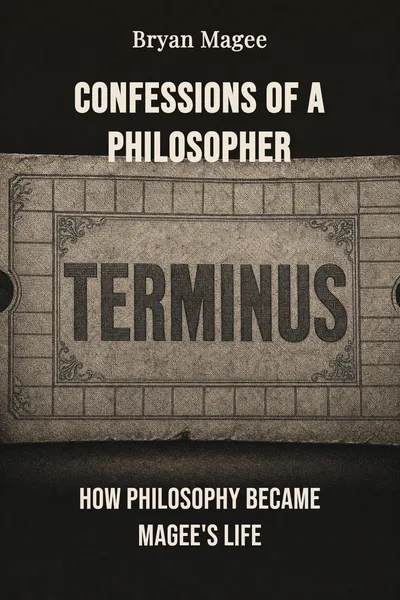
Confessions of a Philosopher
How philosophy became Magee's life
Description
Sometime in the early years of childhood, a boy lying in bed in a working-class corner of London becomes convinced, with real terror, that he is going to die one day and that time itself might have had no beginning. He tells no one, because there is no one to tell — his family is warm but not bookish, and these are not the sorts of things people say out loud. The panic passes, mostly. But it never fully leaves. Decades later, that same person, having become a Member of Parliament, a television broadcaster, and a familiar British voice, sits down to write not a memoir of public life but an account of the questions that had been chasing him since before he could name them. The book is called Confessions of a Philosopher, and it is Bryan Magee telling the truth about what philosophy actually did to him.
Magee was, by the time he wrote it, the person who had introduced more people to philosophy than almost anyone alive — through television series where he sat across from the great thinkers of the age and simply asked them to explain themselves. He was the great populariser, the one who could make Kant or Schopenhauer feel like a live problem rather than an exam topic. But Confessions is not a tour of ideas from a safe distance. It is the story of a life organised, secretly and then openly, around a refusal to stop asking why anything exists at all.
What makes the book so unusual is that it treats philosophy as an emergency rather than a subject. Most people who write about it write as guides. Magee writes as someone reporting back from inside the experience of being genuinely troubled by the world, and finding that a handful of dead thinkers were troubled in exactly the same way.
The question we’re asking : What happens when someone treats philosophy not as a discipline to study but as the only honest response to being alive and confused?What we’ll see : How a childhood dread grew into a lifelong obsession, and how the thinkers Magee met along the way turned that dread into something he could think with.
Table of contents
01Chapter 1 — The boy who couldn't stop asking
The Magee who narrates Confessions grew up in Hoxton, in east London, in a family of modest means and no particular intellectual pretension. What he describes is not a precocious little scholar but a child ambushed by questions that adults seemed strangely uninterested in. Why is there something rather than nothing? What was there before he was born, and where does the self go when it ends? These were not clever puzzles to him. They were sources of genuine vertigo, the kind that could keep a child awake and frightened.
The crucial thing, in his telling, is that nobody around him shared the affliction. The questions felt urgent and enormous, and yet everyone else appeared to walk through the same universe without noticing the abyss underneath it. This produces one of the book's quietly recurring notes: the loneliness of caring about things other people find pointless. Magee did not discover philosophy the way one discovers a hobby. He discovered that there was a name for the thing already happening to him, and that other people, mostly long dead, had felt it too.

02Chapter 2 — A career and a double life
What separates Magee from most people who write about philosophy is that he did not spend his life inside a university. He read history at Oxford, but his career took him outward, into the noisier machinery of public life. He became a broadcaster, a music and theatre critic, a novelist, and eventually a Member of Parliament, sitting in the House of Commons through the second half of the 1970s and into the early 1980s. By every external measure he was a man of the world, not a cloistered thinker.
And yet, running beneath all of it, was the private preoccupation that had never gone away. Confessions describes a kind of double life: the public figure moving through Westminster and the television studio, and the person who, alone, was still turning over the same questions about time, existence, and the reliability of what we call knowledge. The two lives were not in harmony. Magee is candid about the strain of belonging fully to neither the professional philosophers nor the practical men around him.
03Chapter 3 — Kant, Schopenhauer, and the shape of the world
The intellectual heart of the book is Magee's encounter with the great German tradition, and above all with Kant. For much of his early life he had lived with a nagging problem: the world we experience — colours, sounds, solid objects in space and time — is not obviously the world as it is in itself. Our senses and our minds shape everything that reaches us. Magee had felt this as a private disturbance long before he could formulate it, and then he read Kant and found it laid out with overwhelming force.
Kant's claim, as Magee absorbs it, is that space and time are not features of reality as such but the framework our minds impose in order to have experience at all. What we can never do is step outside our own apparatus and see things as they truly are. There is, Kant argued, a realm of things-in-themselves that lies permanently beyond the reach of knowledge. For Magee this was not a dusty doctrine. It was the confirmation of his oldest intuition: that the visible, tangible world is a kind of appearance, and that something unreachable lies behind it.
04Chapter 4 — Philosophy as a way of staying alive
Stepping back, the deepest argument running through Confessions is not about any single thinker but about who philosophy belongs to. Magee's whole life is a standing rebuke to the idea that it is the private property of professionals. The questions that drove him — why anything exists, what death is, whether we can know reality — are not specialist questions. They are the questions any reflective person bumps into, usually in childhood, and then learns to suppress in order to get on with things.
What Magee insists on is that suppressing them is a loss, and that keeping them alive is not morbid but the opposite. His own case is the evidence. Here is a man who was, by any account, fully engaged with the world — politics, broadcasting, music, friendship — and who nonetheless never let the childhood wonder be trained out of him. The two things did not compete. If anything, the sense of standing on a mystery made the ordinary world more vivid, not less. Philosophy, for him, was less a body of doctrine than a refusal to go numb.
05Conclusion
The boy lying awake in Hoxton, terrified by time and death, never really stopped being the author of this book. What changed was that he found the words, the thinkers, and eventually the audience for what had begun as a private panic. Confessions traces the whole arc — from the child who could tell no one, to the broadcaster who spent his life helping millions ask the same questions out loud, to the older man finally setting down the honest record of an obsession that outlasted every career.
Related books