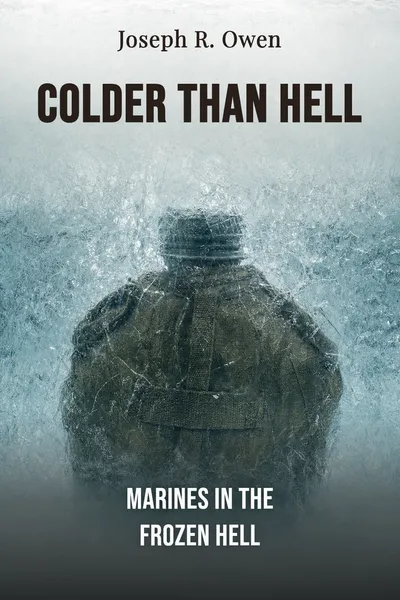
Colder Than Hell
Marines in the frozen hell
Description
In the late summer of 1950, a young Marine lieutenant named Joseph Owen watched a company assemble at Camp Pendleton, California, from parts that did not obviously fit. Roughly two hundred men reported in: a core of regulars who had done this before, and a mass of reservists pulled off jobs and out of classrooms, some of whom had barely fired a rifle since the last war ended. Korea had erupted in June, the American position was collapsing, and there was no time to do this properly. They would learn to be a company on the way.
Owen was there for the whole arc, and that is what makes his account, published as Colder Than Hell decades later, so unusual. He was not a historian reconstructing a battle from maps and after-action reports. He was the mortar section leader in Baker Company, First Battalion, Seventh Marines, from that first ragged muster through the amphibious landing at Inchon, the fight for Seoul, and finally the mountains above the Chosin Reservoir, where the temperature fell far below zero and the Chinese army came down out of the dark in numbers nobody had planned for.
What he sets out to capture is not strategy. It is the texture of frontline war as the men who fought it felt it — frozen rations, jammed weapons, foxholes dug in ground like iron, and the strange, hard tenderness of men keeping each other alive. Told on the eve of the war's fiftieth anniversary, woven from his own memory and the accounts of other survivors, it is a book about how ordinary people become soldiers, and what that costs.
The question we’re asking : How does a hastily thrown-together mix of regulars and raw reservists become a rifle company that can fight, freeze, and keep moving forward?What we’ll see : A firsthand account that moves from a California parade ground to the frozen ridgelines of Chosin, following the men who had to learn combat while doing it.
Table of contents
01Chapter 1 — Two hundred men who had never met
The company Owen describes did not begin as a company. It began as a roster. In the panicked weeks after North Korea poured across the 38th parallel, the Marine Corps had to conjure fighting units almost from nothing, and the way it did so was to fold reservists into a thin frame of experienced regulars. The regulars were men who had fought in the Pacific five years earlier, or had at least served long enough to know how the machine was supposed to work. The reservists were something else entirely — young, civilian in every reflex, called up so fast that many arrived without the basic training a Marine was supposed to have behind him.
Owen, newly commissioned, was handed a mortar section made of exactly this mixture. He writes without sentimentality about the gap between the two groups. The regulars carried themselves with a settled confidence that the reservists could only imitate. There were noncommissioned officers, hard men who had seen combat, whose job was to turn a list of names into something that would hold together when people started shooting at it. The book is honest that this transformation was not guaranteed and not gentle.

02Chapter 2 — How a rifle company is made under fire
The amphibious landing at Inchon in September 1950 was the beginning of the education. Then came Seoul, and street fighting through a city, where the company learned lessons that no training ground could deliver. Owen's narrative moves fast here, matching the pace of the thing itself. Men learned to advance under fire, to read the sound of incoming rounds, to keep a mortar section firing while the world came apart around it. The learning was not abstract. It was paid for.
What Owen conveys, better than any diagram could, is how competence arrives in combat: suddenly, and only through survived mistakes. A reservist who froze the first time steadied the second. A regular who had seemed invincible was killed doing everything right. The book refuses to make the deaths tidy. Wounded and dead went down, and the company had to keep moving forward, because stopping was its own kind of death. That discipline — to keep going when your friends are on the ground behind you — is the hardest thing the men had to learn, and Owen does not pretend it came naturally.
03Chapter 3 — The cold became the second enemy
The march inland and up toward the Chosin Reservoir carried the company from steamy lowlands into high mountains as winter closed in. Owen describes the temperature falling to levels that turned every routine act of soldiering into a struggle. Rations froze solid and had to be thawed against the body before a man could eat. Weapons jammed as lubricant stiffened. Digging a foxhole meant hacking at ground frozen hard as rock. The cold was not a backdrop; it was an adversary that never let up, working on the men every hour whether or not the enemy was near.
And the enemy was near. Chinese forces had entered the war in strength, unseen until they struck, and they attacked at night in numbers that overwhelmed the map. Owen's account of the fighting on those ridgelines is close and immediate: foxhole fights in the dark, waves of attackers coming down slopes, patrols pushing out through Chinese lines to feel for the shape of the encirclement. The company was surrounded, outnumbered, and freezing, and the only path was to fight its way through.
04Chapter 4 — What a company remembers
Step back from the battles and the book is really about a single question: what actually holds a fighting unit together when everything is against it. It is not the equipment, which failed in the cold. It is not the plan, which had not anticipated the Chinese or the winter. Owen's answer, arrived at through experience rather than theory, is that it is the human bond built between men who have trained, fought, and suffered together — and that this bond has to be manufactured, deliberately and fast, by leaders who know how.
This is why he lingers so long on the making of the company before the worst fighting begins. The reservists who arrived barely trained mattered less than the noncommissioned officers who taught them and the shared ordeals that fused them. By the time Chosin came, the company could absorb losses and keep functioning because the connective tissue was already there. A unit thrown together the week before the reservoir could not have done what Baker Company did. The cohesion was load-bearing, and it had been under construction since California.
05Conclusion
The company that came down from the Chosin Reservoir was not the roster that had reported to Camp Pendleton in the late summer of 1950. It had been landed at Inchon, bloodied in Seoul, frozen and surrounded in the mountains, and it had held. The reservists who could barely handle a rifle at first muster were, by the end, Marines indistinguishable from the regulars who had trained them. Many did not make it, and Owen names them and refuses to soften how they went down. The survivors carried the cold and the losses out with them.