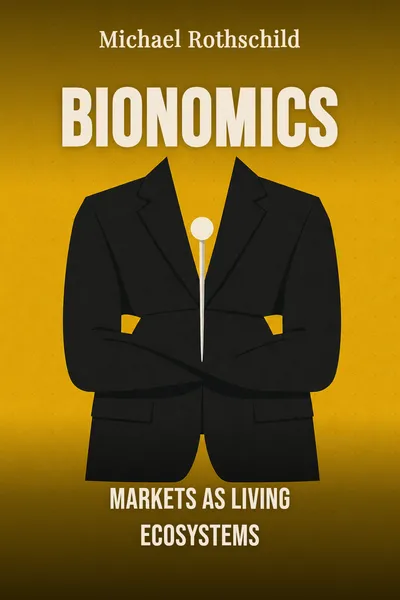
Bionomics
Markets as living ecosystems
Description
When Michael Rothschild published Bionomics in 1990, the reigning image of the economy was still the machine. Policymakers spoke of levers and gears, of fine-tuning and priming pumps, of an apparatus that could be adjusted from a control room in Washington if only the operators were skilled enough. It was a comforting picture. A machine has a designer, obeys fixed laws, and can in principle be repaired. Rothschild, a management consultant rather than a credentialed economist, looked at that picture and found it wrong in a way that mattered — not slightly off, but built on the wrong biology of the thing it was trying to describe.
His counter-proposal was simple to state and unsettling to absorb. The economy is not a machine. It is an ecosystem, and it evolves the way living systems evolve — through variation, competition, selection, and the occasional extinction. Products rise and fall like species. Firms occupy niches, and when the niche disappears the firm dies, however well run it was. Technologies breed with one another and throw off descendants nobody planned. Nobody built this. Nobody is running it. And that, for Rothschild, was not a flaw to be corrected but the central fact to be understood.
The analogy was not decorative. Rothschild pushed it hard, chapter by chapter, matching each concept in evolutionary biology to a mechanism in economic life — and where the machine metaphor produced confident predictions that kept failing, the ecosystem metaphor produced a stranger, humbler, and more accurate account of why economies do what they do.
The question we’re asking : What changes when we stop seeing the economy as a machine to be operated and start seeing it as an ecosystem that evolves?What we’ll see : How one persistent analogy, followed all the way down, reorganizes what we think we can know and control about economic life.
Table of contents
01Chapter 1 — The metaphor that runs the economy
Every era explains the economy through the most impressive technology it owns. In the eighteenth century, when Adam Smith wrote, the marvel was Newtonian mechanics — a universe of forces in stable equilibrium, obeying laws you could write down. Economics borrowed that frame wholesale. Supply and demand met at a point, like two forces balancing, and the whole discipline organized itself around the search for equilibrium, the tidy resting state where everything settled. Rothschild's point is that this was never an observation. It was a metaphor, imported from physics because physics was prestigious, and then quietly mistaken for the truth.
The trouble is that economies do not rest. They lurch, mutate, and reinvent themselves. A physics of equilibrium has no natural way to explain the arrival of something genuinely new — the transistor, the shipping container, the spreadsheet — because in a mechanical universe nothing is ever new; everything is just the same forces rearranged. Yet novelty is the most obvious feature of economic life. Every year the shelves hold products that did not exist, made by firms that did not exist, using methods nobody had thought of. The machine metaphor treats this as noise. Rothschild treats it as the main event.

02Chapter 2 — Genetic information, technical information
The analogy could stay poetic, and plenty of writers have left it there. Rothschild's more serious move is to ask what, exactly, plays the role of the gene. In biology, evolution runs on information — the DNA that codes how an organism is built, copied and passed on with occasional errors that supply the raw variation selection acts upon. If the economy evolves, something must be doing the same job. His answer is technical knowledge: the accumulated, encoded know-how for turning raw matter into useful things.
This is the hinge of the whole book. Genetic information tells a cell how to assemble proteins; technical information tells a workshop how to assemble a watch, a chip, a car. Both are recipes. Both are stored, copied, and transmitted — genes through reproduction, technique through blueprints, apprenticeships, patents, and the tacit skill living in people's hands. And both mutate. An engineer tweaks a process, a machinist finds a shortcut, two unrelated technologies get spliced together, and a new recipe enters the pool. Most variations are useless and vanish. A few work, spread, and become the new baseline that the next round of variation builds on.
03Chapter 3 — Why organizations behave like organisms
If technical knowledge is the gene, the firm is the organism that carries and expresses it. Rothschild spends much of the book at this level, because it is where the biology stops being abstract and starts explaining behavior people actually recognize. A company, in his telling, is a bundle of encoded routines — ways of designing, producing, selling, coordinating — that reproduce themselves as the firm hires, trains, and expands. Those routines are its working genome, and like a genome they are stubborn, self-copying, and slow to change.
This explains something the machine metaphor struggles with: why competent, well-managed firms so often fail to adapt. In a mechanical view, a smart company should simply retool when conditions shift. In the bionomic view, the firm's routines are the very thing that made it fit for the old environment, and an organism cannot easily rewrite the code that built it. The behaviors that were once advantages become liabilities when the niche changes, and the firm, well adapted to a world that no longer exists, declines — not from stupidity, but from the ordinary inertia of any successful organism facing a changed habitat.
04Chapter 4 — The economy nobody designed
Follow the analogy to its end and it lands somewhere genuinely uncomfortable for anyone who wants to steer an economy. If the economy is an evolving ecosystem, then it has no operator, and the fantasy of central control — whether the planner's or the fine-tuner's — is not merely difficult but category-mistaken. You do not operate a rainforest. You cannot dial in the right number of species or command the arrival of a new one. You can protect the conditions under which the system evolves, or you can degrade them, but the evolving itself is not yours to do. Rothschild's economy is the same: a vast, decentralized process of variation and selection that no room full of experts authored or can author.
This is where Bionomics reveals its politics, though Rothschild presents it as biology rather than ideology. Writing as the Soviet planned economies were visibly failing, he read their collapse as an ecological verdict: a system that suppressed variation and centralized the recipe-making had cut itself off from the very mechanism by which economies improve. Without competing variants and honest selection, the technical gene pool stagnates. The lesson he takes is not a slogan about free markets so much as a claim about information — that no central mind can hold the knowledge dispersed across millions of experimenting organisms, an argument that rhymes with Hayek but arrives through Darwin.
05Conclusion
Rothschild set out to replace one metaphor with another, and the swap turns out to reorganize almost everything downstream of it. Start from the machine and you look for the operator, the malfunction, the fix. Start from the ecosystem and you look for the gene pool, the niche, the selection pressure — and you stop expecting anyone to be in charge. Products become species, firms become organisms, technical know-how becomes the DNA that carries the whole thing forward, and economic history becomes what it plainly is: a record of things being born, adapting, competing, and dying, without a plan.